Chatbot vs Customer Service How to Choose Between AI and Human Support
Overview
Introduction
Every day, business owners and support leaders face the same tough question: should they use a chatbot to handle customer questions, or keep a human agent on the line?

The answer is not simple. Get it wrong and you waste money on automation that feels cold, or you overspend on agents who could be doing higher level work. Get it right, and you build a support system that saves time, cuts costs, and keeps customers happy.
Here is the thing: the AI customer service market is moving fast. In 2026, the global market is projected to hit $15.12 billion, and 80% of companies are either using or planning to use AI powered chatbots for support. Those numbers come from the latest AI customer support statistics for 2026. The shift is real, but it is not about replacing people entirely. It is about finding the right balance between a chatbot for customer service and a human touch.
This guide gives you a data driven comparison of chatbot vs customer service approaches. You will learn when automation works best, where humans still win, and how to build a seamless AI hybrid strategy that actually delivers results. Whether you are evaluating tools or planning a rollout, you will leave with a clear framework to make the right call.
If you want to stay ahead of these trends, check out the client service automation framework we built for evaluating AI tools and maximizing ROI. And for daily updates that cut through the noise, consider The AI Newsletter Worth Reading, a trusted source for clear AI intelligence.
The State of Customer Service in 2026: AI’s Role
So what does the customer service landscape actually look like in 2026? The numbers paint a clear picture. AI chatbots now handle a huge share of first-contact interactions across major sectors like e-commerce, banking, and telecom. In fact, customer support holds nearly 42% of the entire chatbot market share, according to the 2026 chatbot statistics from WotNot. That number tells you where the action is.
The growth is not slowing down. The global chatbot market hit about $11.8 billion in 2026, up from $9.6 billion the year before. Experts project it will reach $41.2 billion by 2033, growing over 19% each year. That kind of double-digit growth is driven by real business results. Companies that deploy AI chatbots see cost savings from reduced labor expenses, and newer natural language models make conversations feel much more natural than they did just a few years ago.
In e-commerce, chatbots handle order tracking, return requests, and basic product questions in seconds. In banking, they manage balance inquiries, transaction history, and fraud alerts without human involvement. In telecom, they take care of plan changes, troubleshooting, and bill inquiries.
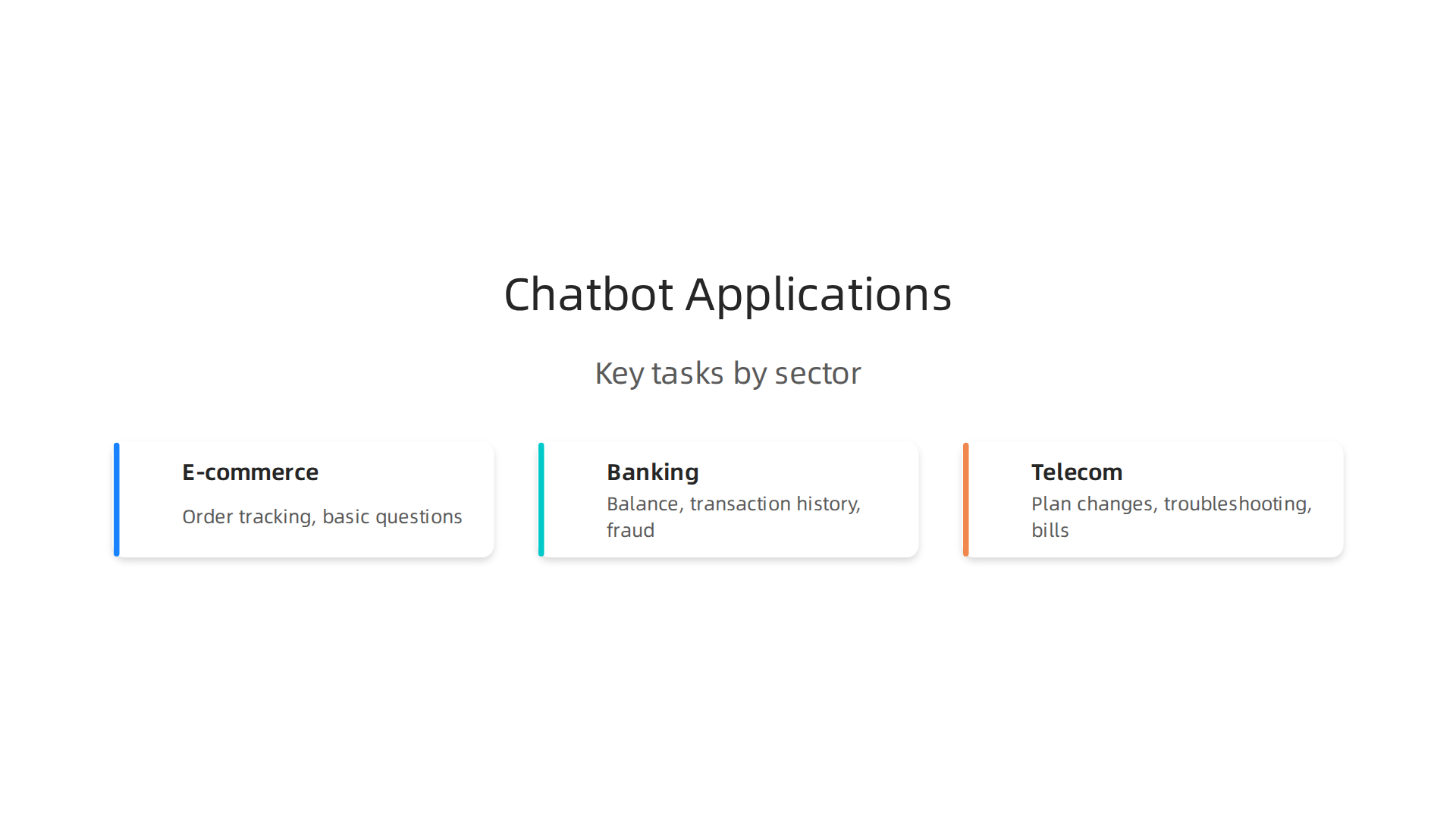
These are the high-volume, repetitive tasks that used to eat up agent time. Now AI handles them fast.
But here is the thing. Not every issue belongs in a chatbot. Complex problems, high-emotion situations, and compliance-sensitive cases still need human agents. Think about a customer disputing a major charge or someone dealing with a service outage that affects their business. Chatbots can only go so far. The best support teams in 2026 use a blended approach where AI handles the first contact and escalates tricky cases to a person who can actually help.

The chatbot vs customer service debate is not about one winning over the other. It is about knowing where each one works best. If you are building or updating your support strategy, start by mapping out which questions are simple and which ones require real judgment. That split will guide your entire setup.
To get started on the right foot, take a look at our roundup of the best AI tools for businesses in 2026. It can help you compare options that fit your specific support needs.
Chatbots vs Human Agents: Key Differences at a Glance
To make the right choice for your support strategy, it helps to look at what each option really brings to the table. Not all chatbots are the same, and knowing the difference between a simple scripted bot and a modern AI assistant is the first step.
Old-school rule-based chatbots follow prewritten scripts. They match keywords and guide users down fixed decision trees. If a customer says something unexpected, the bot gets confused and either gives a useless answer or hands the conversation to a human. These bots work well for simple tasks like checking an order status or resetting a password. But they cannot handle open-ended questions or emotional conversations.
Modern AI chatbots are a different story. They use natural language processing and machine learning to understand what a person actually means, not just what they type. As the comparison in AI Chatbots vs Rule-Based Chatbots explains, these bots can handle complex language, learn from past interactions, and respond in a natural, human-like way. They can even detect the tone of a message and adjust their reply accordingly.
Now, what about human agents? People bring empathy, judgment, and creative problem solving that no machine can fully match. When a customer is frustrated or when a problem has no standard solution, a human can listen, adapt, and build trust. The tradeoff is cost and scalability. Hiring and training a support team is expensive, and scaling up takes time.
Here is a quick side-by-side look at the main differences:
| Feature | Rule-Based Chatbot | AI Chatbot | Human Agent |
|---|---|---|---|
| Understanding language | Keyword matching only | Understands intent and context | Full understanding with empathy |
| Handling unexpected questions | Fails quickly | Adapts and learns | Handles naturally |
| Scalability | Manual updates needed | Learns automatically | Hiring and training required |
| Cost | Low | Medium | High |
| Emotional connection | None | Some, improving | Strong |
| Best for | Simple FAQs | Routine but varied questions | Complex or sensitive issues |
This comparison makes the decision clearer. For high-volume, predictable questions, rule-based chatbots can save money. For more flexible queries, AI chatbots offer a huge jump in capability. And for the hardest cases, humans remain essential.
The real skill is knowing where each fits. If you are building your support stack, start by analyzing your most common customer questions and mapping them to the right resource. To help with that evaluation, check out this client service automation framework that walks through how to assess tools and measure ROI.
And if you want to stay on top of the fast-changing AI landscape that powers these tools, consider subscribing to The AI Newsletter Worth Reading for clear daily updates on what matters most.
When to Use a Chatbot and When to Escalate to a Human
Knowing when to let the chatbot take charge and when to bring in a human is the real secret to great customer service. Get this wrong and you lose unhappy customers. Get it right and you save time, money, and relationships.
Customer satisfaction data reveals clear thresholds. Chatbots handle simple FAQ-type questions very well. Things like checking order status, resetting passwords, or finding store hours. For these, customers are happy to interact with a bot. As explained in this detailed comparison of when chatbots work best, on simple and repetitive cases the answer is yes. But on complex, emotional, or high-stakes commercial cases, the answer is no.
Here is a practical rule of thumb. If a customer satisfaction score for bot interactions falls below 75 percent, that is a clear sign the system needs fixing. It means the bot is running into too many situations it cannot handle.
So when should you escalate to a human right away? Three situations call for an instant handoff.
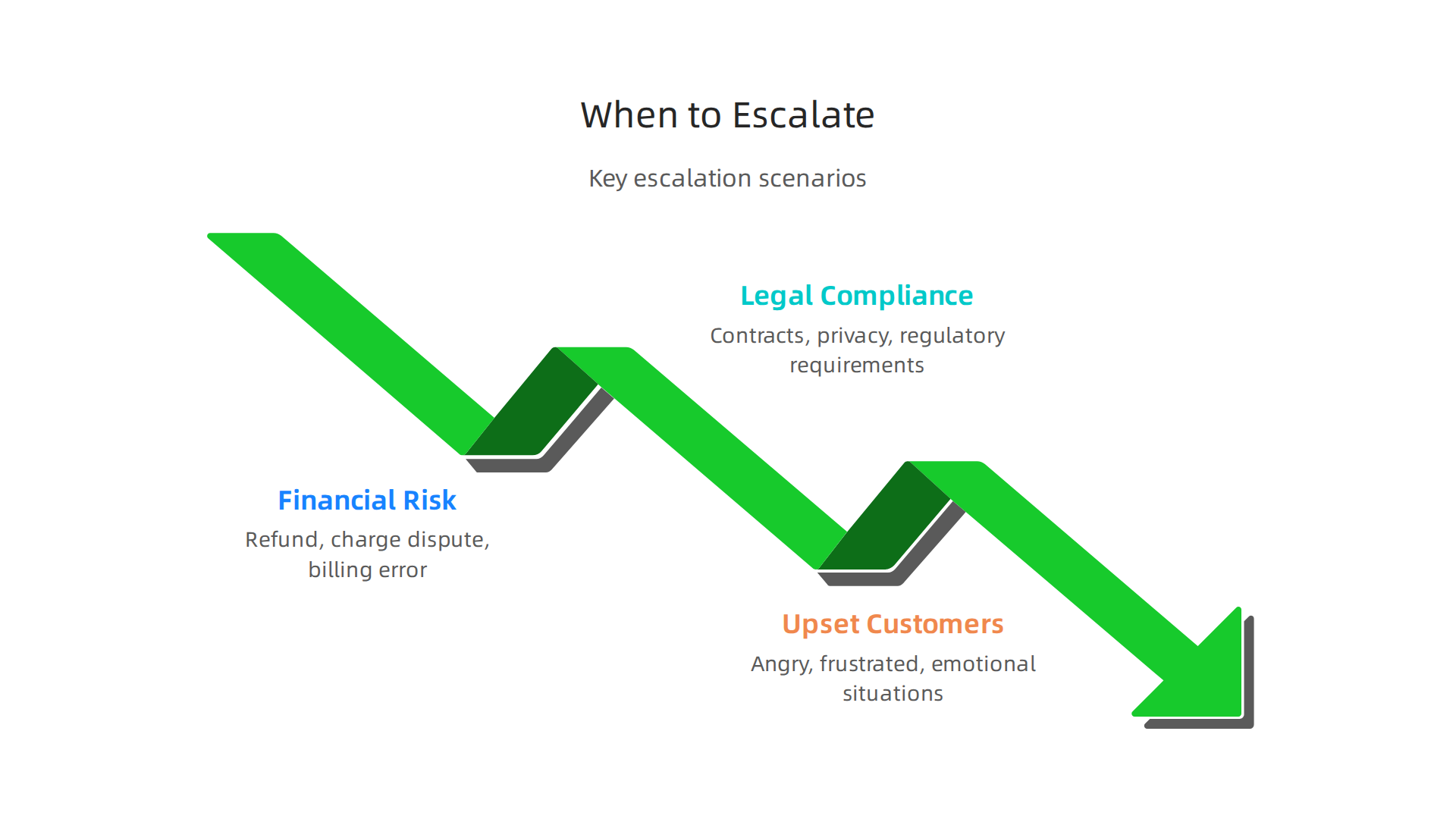
First, financial risk. If a customer asks about a refund, a charge dispute, or a billing error that could cost them money, a human needs to step in. Mistakes here damage trust.
Second, legal compliance. Questions about contracts, privacy, warranties, or regulatory requirements should never be left to a bot. The stakes are too high.
Third, upset customers. When someone is angry, frustrated, or emotional, an automated reply will only make things worse. Data shows that 93 percent of consumers prefer interacting with a human over AI, especially when feelings are involved. A human can listen, show empathy, and rebuild trust.

The best approach combines both. Start with a chatbot to handle triage, collect information, and solve simple requests. Then escalate complex or emotional cases to a human agent with full context. This hybrid model delivers the highest overall satisfaction and efficiency. Organizations that implement AI with seamless human escalation paths see 92 percent of customers report satisfaction with chatbot interactions.
If you are building your own support stack, start by mapping your most common customer issues to the right resource. For simple questions, let the bot handle them. For anything involving risk, emotion, or complexity, route to a person. To discover tools that can help you set this up smoothly, explore this curated list of best AI tools for businesses to maximize your 2026 efficiency. Getting the balance right keeps your customers happy and your support costs under control.
Implementation Roadmap: Choosing the Right Platform
So you know when to use a chatbot and when to bring in a human. The next question is which platform actually delivers on that promise. Without a clear roadmap, you risk picking a tool that does not fit your needs.
Start with a needs assessment before comparing any features. Ask yourself four questions. First, what is your monthly conversation volume? A small business handling 500 chats a month needs something very different than an enterprise managing 50,000. Second, how complex are those conversations? Simple FAQs are easy. Multi-step troubleshooting or compliance questions are not. Third, what systems do you already use? Your CRM, ticketing software, and analytics tools must talk to the chatbot. Fourth, what is your budget?
Platform choices range from no-code tools for simple FAQs to custom AI models for advanced use cases. For small businesses, a SaaS chatbot can cost between $0 and $200 per month on a flat rate plan. For enterprises with deep integration needs, the price climbs fast. According to AI chatbot development cost in 2026 estimates, simple FAQ bots start around $8,000 to $15,000 for one time builds. Enterprise solutions with LLMs and voice capabilities can exceed $100,000. Get the wrong tier and you either outgrow it quickly or pay for features you never use.
Integration is the part most people overlook. Your chatbot must connect with your existing CRM, ticketing system, and analytics platform. Without that connection, you lose the context that makes human escalation smooth. That ruins the whole point of a chatbot for customer service versus customer service handled entirely by humans. For a practical framework for evaluating AI tools and maximizing ROI, check out this guide on client service automation.
As you build your implementation plan, staying informed on the latest platform trends helps you make smarter choices without wasting budget. The AI Newsletter Worth Reading delivers clear daily updates to keep you ahead of the curve. Pick the right platform now and you save yourself months of rework later.
Now that you have a clear needs assessment, it is time to compare low-code platforms and custom-built solutions. This choice directly shapes your chatbot vs customer service experience, so getting it right matters.
Low-code platforms let you launch quickly with a lower upfront cost. They use pre-built templates and simple logic to answer FAQs. If your conversations follow predictable paths, a low-code tool works fine. But be aware: low-code platforms often rely on rule-based systems. They follow rigid if-then rules and can break when users ask unexpected questions. For a clear breakdown of these limits, check out this guide on the key differences between rule-based and AI chatbots.
Custom-built platforms give you full control. You can train AI models on your data, handle complex multi-step issues, and keep all sensitive information inside your systems. The tradeoff is time and money. You need developers, ongoing maintenance, and a bigger budget. But for companies that need deep integration and advanced NLP, custom is the only path that scales.
The right pick depends on your use-case complexity, in-house talent, and long-term goals. If you are still unsure, explore this guide to choosing the right AI tools for businesses to match features to your actual needs. Make the smart choice now and save yourself headaches down the road.
Once you have chosen your build path, the next step is making sure your chatbot connects smoothly with the tools your team already uses. This is where the real work begins in optimizing your chatbot vs customer service experience. A chatbot that sits in isolation cannot help agents or track results. It must talk to your CRM, ticketing system, and analytics platform.
That is why integration matters so much. In fact, according to recent enterprise chatbot integration statistics, 89% of enterprises link their chatbots with CRM systems like Salesforce or HubSpot. Without that connection, your bot cannot pull up a customer’s history or log a support ticket automatically.
APIs, webhooks, and pre-built connectors make most integrations doable. But two common problems slow teams down: identity management and data synchronization. If your chatbot cannot match a user to their account in your CRM, every conversation starts from scratch. A clear data flow diagram drawn before you start coding can catch these gaps early. Pair it with a solid test plan, and you will avoid messy launch-day surprises.
For a deeper look at how to evaluate the tools that make this possible, check out this guide to choosing the right AI tools for businesses. And if you want to stay ahead of fast-moving AI changes that affect customer service tech, subscribe to The Deep View Newsletter for clear daily updates.
Measuring Success: KPIs for Chatbot vs Human Teams
So you have built your chatbot and connected it to your CRM. Now comes the real question: is it working? Without the right metrics, you are just guessing. Tracking the right KPIs helps you understand the true value of your chatbot vs customer service approach.
Start with the standard customer experience metrics that apply to both chatbots and humans. These include CSAT (customer satisfaction score), NPS (net promoter score), resolution time, and first contact resolution. But the benchmarks are different. For live chat support, CSAT averages around 75%, while phone support sits at 76%. Email trails at just 61%, according to the latest customer satisfaction score statistics by support channel. A good chatbot CSAT target is above 80%. Scores below 60% signal a clear problem.
Now layer on chatbot-specific KPIs. The most important ones are containment rate and deflection rate. Containment rate measures how many conversations the bot handles fully without passing to a human. Deflection rate is similar: the percentage of contacts resolved without a human agent. A realistic year-one target for deflection is 55% to 70%. You also want to track average conversation length. Short chats often mean the bot answered quickly and accurately. Long chats may indicate confusion or a loop. The chatbot KPI benchmark guide for 2026 provides detailed targets for these metrics.
To truly compare ROI, you need financial metrics. The cost per interaction tells a dramatic story: a chatbot interaction costs roughly $0.50 to $0.70, while a human interaction costs $6 to $15. That is a 10x to 20x difference. But cost is only one side. You also need to track handle time for human agents when the bot escalates to them. With AI handling data retrieval and documentation, handle time should drop 20% to 30%. And do not forget satisfaction scores for both channels. Track CSAT separately for bot-handled and human-handled contacts. Expect the bot score to start lower. As you refine your system, that gap should shrink.
If you want a deeper framework for evaluating AI tools and maximizing ROI, check out this practical guide on client service automation and AI evaluation. It walks through exactly how to measure what matters in your chatbot vs customer service model.
The bottom line: measure deflection, cost, and satisfaction together. Do not focus on efficiency alone. A bot that deflects 90% of calls but makes customers angry is not a win. A bot that solves simple issues fast and hands off complex ones smoothly is the real goal.
Risks and Pitfalls to Avoid
Even the best chatbot vs customer service strategy can backfire if you ignore the common risks. Let’s talk about the biggest mistakes and how to steer clear of them.
Over-reliance on Chatbots
The easiest trap to fall into is trusting your chatbot too much. When a bot handles everything without human backup, customers feel ignored. A recent survey found that 40.4% of people worry about AI chatbot reliability. That is a big red flag. If your bot gives wrong answers or sounds robotic, trust disappears fast.
The fix is simple: always keep a human in the loop. For sensitive or complex issues, let the chatbot smoothly hand off to a real person. This is where the human element matters most. As experts at Forbes point out, businesses that forget the human touch risk losing customers for good.
Data Privacy and Compliance
Chatbots collect a lot of data names, payment details, even health information. If that data leaks, you face serious trouble. Regulations like GDPR, CCPA, and HIPAA put the responsibility on your business, not your bot.
Make sure your chatbot encrypts customer data, limits what it stores, and follows all privacy laws. Regular security audits are a must. Without them, one mistake can cost you fines, lawsuits, and your reputation.
Poor Training and Bias
A chatbot is only as smart as the data you feed it. If your training data is outdated or biased, the bot will give bad answers. It might even make up facts, a problem known as hallucination. This can lead to misleading advice or offensive responses.
To avoid this, use diverse, high-quality datasets. Keep updating the training material. And test the bot thoroughly before launch. Even then, monitor it constantly for errors.
Weak Escalation Paths
Imagine a customer stuck in a chatbot loop, unable to reach a human. Frustrating, right? Without a clear escalation path, you lose that customer and possibly many more.
Set up rules for when the bot must transfer to a person. For example, if the customer asks three times to speak to someone, the transfer should happen automatically. This keeps the experience smooth and builds trust.
Neglecting Post-Launch Monitoring
Launching the chatbot is not the end. It is the beginning. Many teams forget to watch how the bot performs after go-live. Errors creep in. Customer needs change. Without ongoing checks, quality drops.
Track key metrics like containment rate and customer satisfaction weekly. Use real conversations to retrain the bot. A good rule of thumb is to review chatbot logs every month.
Building a safe, effective chatbot takes careful planning. If you want a deeper look at how to set up strong AI foundations, check out this guide on building AI strong foundations for lasting success in 2026. It will help you avoid many of these pitfalls from day one.
And to stay ahead of AI trends and risks, get clear daily updates with The AI Newsletter Worth Reading. Knowledge is your best defense.
The Future of AI in Customer Experience
Looking ahead, the chatbot vs customer service debate is entering a new phase.

By 2027, experts say the line between bot and human agent will get much blurrier. Generative AI and multimodal interfaces (voice, video, and text all in one conversation) will let chatbots handle complex tasks that used to need a person. Imagine a chatbot that can see your product photo, hear your frustration, and read your order history all at once. That kind of seamless AI is coming fast.
Proactive AI Will Change the Game
Right now, most chatbots wait for you to ask a question. But the next wave is different. Proactive AI will predict what customers need before they even type a word. For example, if a delivery is delayed, the bot might reach out first with a solution. This shift from reactive to proactive support can save time and build loyalty. But it also raises new questions about privacy and trust. Companies will need to balance helpfulness with respecting boundaries.
The Human Side Still Matters
Even as AI gets smarter, the need for real human connection will not disappear. Many businesses plan to invest more in human empathy training alongside their AI tools. The reason is simple: some situations still need a warm, understanding voice. A chatbot can explain a refund policy, but a human can apologize and make it right. The smartest approach is a hybrid model where AI handles the routine stuff and humans step in for the tough conversations.
New Rules Are Coming
Regulators around the world are paying close attention. The FTC, UK Information Commissioner’s Office, and other agencies are crafting rules about AI transparency and accountability. If your chatbot makes a wrong promise or mishandles data, you could face fines or lawsuits. Understanding the evolving regulatory risks with AI chatbots is essential for any business deploying this technology. Being transparent about when customers are talking to a bot and how their data is used will become a legal requirement in many places.
The future of customer experience is not fully automated. It is a partnership between smart AI and skilled humans. To stay prepared for these changes, check out our AI literacy guide for 2026. It will help you cut through the noise and lead with confidence.
Summary
This article gives a practical, data-driven guide to deciding between chatbots and human agents for customer support, and how to build a hybrid model that actually works. It explains the differences between rule-based and modern AI chatbots, when automation shines (high-volume, repetitive tasks) and when humans are essential (financial, legal, or emotional cases). The guide walks through a needs assessment, platform choices from low-code to custom builds, integration requirements with CRMs and ticketing, and realistic cost ranges. It also lays out the KPIs you should track—CSAT, containment/deflection rates, cost per interaction—and common pitfalls like over-reliance, privacy gaps, and weak escalation paths. Finally, the article previews future shifts such as multimodal AI, proactive support, and emerging regulatory requirements, giving teams a clear roadmap to deploy safe, effective customer service automation.