

Generative AI Solutions for Business How to Choose the Right Tools in 2026
Overview
Introduction
By 2026, generative AI has become one of the fastest growing technologies in history. The global market for generative AI solutions was worth $22.21 billion in 2025 and is on track to hit $324.68 billion by 2033. That is a massive jump. In fact, companies spent $37 billion on generative AI in 2025 alone, up more than three times from the year before. And adoption is rising fast: 65% of organizations now use generative AI in at least one business function, according to McKinsey data.
But here is the thing. With so many generative AI solutions flooding the market, it is easy to feel lost. Every day brings a new tool, a new claim, a new "magic AI" that promises to change everything. Decision makers like you are drowning in information. You need clear, reliable signals, not more noise.

That is exactly why we wrote this guide. We cut through the hype and give you a practical overview of the top generative AI solutions for business. We look at the data, the real world results, and the companies driving this shift. Whether you are exploring tools like ElevenLabs AI for voice, or trying to understand which AI companies are worth your attention, you will find actionable insights here.
And if you want to go deeper on managing the flood of AI news, check out our guide on how YouLearn AI cuts through information overload. It covers strategies that work in 2026.
Let us start with a clear look at what generative AI can actually do for your business.
What Is Generative AI? A Primer for Business Leaders
You have heard the term everywhere. But what does generative AI actually mean for your business in 2026? Let us strip away the hype and get to the basics.
At its core, generative AI refers to a type of artificial intelligence that creates new content. Not just analyzing or sorting existing data, but actually producing original text, images, audio, video, and code from scratch. Think of it as the difference between a librarian who can find a book for you and an author who can write a new one just for you.
This is what separates the current wave from older AI tools. Traditional AI could spot patterns or make predictions. Generative AI solutions can draft a contract, design a product mockup, or generate a voiceover using tools like ElevenLabs AI. That is a shift.
How Does It Actually Work?
Three main technologies power most of the generative AI solutions you see today:
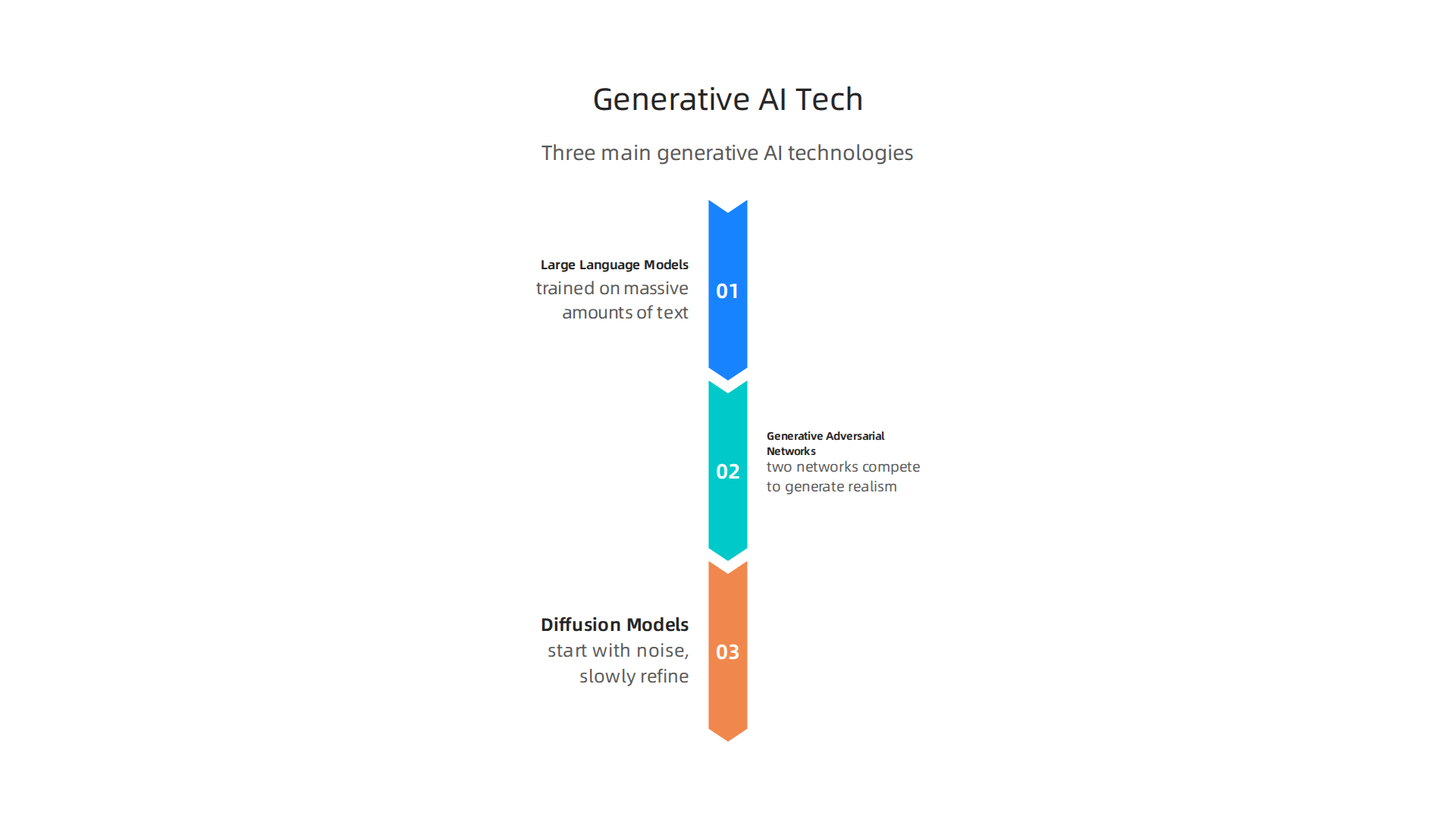
- Large language models (LLMs). These are models trained on massive amounts of text. They learn patterns in human language and can write emails, answer questions, or summarize reports. GPT-4, Claude, and Gemini are examples.
- Generative adversarial networks (GANs). Two neural networks compete to create realistic images, video, and audio. One generates content. The other tries to catch fakes. Over time, both get better.
- Diffusion models. These start with random noise and slowly refine it into a clear image or sound. Tools like Midjourney and DALL-E use this approach.
Each technology has different strengths. The best generative AI solutions often combine them for better results.
Why This Matters for Decision Makers
Understanding the fundamentals helps you ask better questions. You can spot real value versus "magic AI" marketing claims. You can set realistic expectations with your team. And you can identify which ai companies are building tools that actually solve your problems.
Consider this. According to the Stanford HAI 2026 AI Index Report, the estimated value of generative AI tools to U.S. consumers reached $172 billion annually by early 2026.
The median value per user tripled between 2025 and 2026 alone. That signals real, measurable utility, not just hype.
But utility depends on choosing the right tool for the right job. A model that writes marketing copy will not help you analyze supply chain data. Knowing the difference saves time and money.
Setting Realistic Expectations
Here is the honest truth. Generative AI is powerful but not perfect. It can hallucinate facts. It can produce biased outputs. It requires careful prompting and human oversight. The leaders who get the best results are the ones who pair AI capabilities with solid human judgment.
If you want to dig deeper into how specific companies are building and funding these technologies, check out our analysis of AI startup funding in 2026. It covers the key players shaping the market right now.
So what does all this mean for you? Generative AI is not a single tool. It is a category of tools, each with different strengths and limits. The next section breaks down the top generative AI solutions by use case. That way, you can match the right tool to the real problem you are trying to solve.
Top Business Applications of Generative AI in 2026
You might be wondering where generative ai solutions actually deliver value day to day. The real answer is that businesses use them everywhere. According to this overview of generative AI use cases, the most common areas include content creation, software development, and customer service.
Here is how AI companies are applying these tools:
- Content creation. Marketing teams use tools like ChatGPT and Jasper to write blog posts, social copy, and ad text. Designers use DALL-E and Canva AI for images.
- Software development. Developers use GitHub Copilot and similar tools to write code faster and catch bugs early.
- Customer service. Chatbots powered by LLMs handle common questions 24/7, reducing wait times.
This list only scratches the surface. Industries from healthcare to finance are also adopting generative AI. If you want to see how AI is reshaping coding specifically, check out our guide on AI-powered software development in 2026. The sheer diversity of applications shows that generative AI is not a niche tool. It is becoming a standard part of how modern businesses operate.
Content Generation and Personalization
Imagine trying to write a personalized email for every single one of your customers. Exhausting, right? Here is the thing: generative ai solutions now handle this heavy lifting for you.
Tools like Jasper and ChatGPT let you create blog posts, ad copy, and social media content in minutes. But raw content generation is just the start. The real magic happens with personalization. A single AI model can rewrite your message for different customer segments. It adjusts the tone, offers, and examples based on who is reading. According to this guide on enterprise AI tools, platforms like ChatGPT and Claude are the go-to choices for businesses in 2026.
This means your marketing team can send ten different versions of a campaign instead of just one. And they can do it without working ten extra hours. Case studies tracked by industry reports show companies slashing content production timelines from weeks to just a few days.
The ai companies creating these tools are attracting huge investments. If you want to know which startups are leading the charge, check out our coverage on AI startup funding in 2026.
This ability to automate and customize simultaneously is why content generation and personalization remain the most accessible entry points for businesses adopting AI today.
Software Development and Code Generation
Content generation helps you write emails and blog posts. But what about the code that powers your entire business? Developers are turning to generative ai solutions to write, fix, and test software faster than ever.

Tools like GitHub Copilot act like a co-pilot for your engineering team. You describe what you need in plain English, and the AI suggests complete lines or blocks of code. According to a hub of enterprise AI tools, platforms such as GitHub Copilot and ChatGPT are among the top choices for businesses in 2026.
The results go beyond speed. Teams see fewer bugs, shorter development cycles, and happier developers. Instead of wrestling with boilerplate code, your engineers focus on solving harder, more creative problems. Real-world deployments show that ai companies embedding these assistants into their workflows cut development time significantly.
This is not limited to big tech. Small teams and solo founders also use these magic ai tools to ship products that once required a full engineering department. If you want a deeper look at how these tools reshape software creation, check out our guide on AI-powered software development in 2026.
The bottom line? Generative AI is turning every developer into a faster, more reliable version of themselves.
Customer Service and Conversational AI
Code generation is not the only place where generative ai solutions shine. They are also transforming how businesses talk to their customers. Instead of clunky chatbots that give robotic answers, companies now use smart virtual assistants powered by generative AI. These assistants understand tone, remember context, and carry on natural conversations.
The result? Faster help for your customers and lower costs for your business. A support team using these tools can handle common questions instantly. When a problem gets tough, the AI can hand it off to a human. This means your team spends time on bigger issues, not repetitive replies.
Many ai companies now offer platforms that make this simple. Popular tools like ChatGPT and Google Gemini are built right into customer service software. They can pull up order details, check return policies, and even detect if a customer is frustrated. That last part is key. Sentiment analysis helps the AI know when to pass the conversation to a real person.
For small teams, this level of support used to be impossible. Now a solo founder or a tiny startup can offer 24/7 help that feels personal. Real examples from small businesses show that AI customer service tools cut response times from hours to seconds.
If you want to see how one AI tool handles information overload and makes sense of messy data, read our guide on how YouLearn AI cuts through information overload. It shows a similar principle at work.
So whether you run a help desk or a growing ecommerce store, generative AI can turn your customer service from a cost center into a competitive edge.
Real-World Case Studies: Companies Winning with Generative AI
We just saw how generative AI solutions can transform customer service. But the impact goes far beyond support desks. Across healthcare, finance, retail, and more, companies are deploying these tools and seeing measurable results.
The proof is in the funding. In Q1 2026, global venture investment hit a record $297 billion, with AI capturing $242 billion — that is 80% of all funding [1]. Foundational AI startups saw their funding double in the same period [2]. The money is flowing because real businesses are getting real returns.
Take healthcare. A hospital network uses a generative AI solution to draft clinical notes and summarize patient histories. Doctors save roughly two hours per shift. That means more time with patients and less burnout. In finance, a major bank deploys AI to monitor transactions for fraud. The system flags suspicious activity in real time and adapts to new scam patterns. False alarms drop, and genuine threats get caught faster. In retail, a global ecommerce brand uses generative AI to write product descriptions and personalize email campaigns at scale. The result? Higher click-through rates and better customer loyalty.
What can other companies learn from these early adopters? Three lessons stand out.
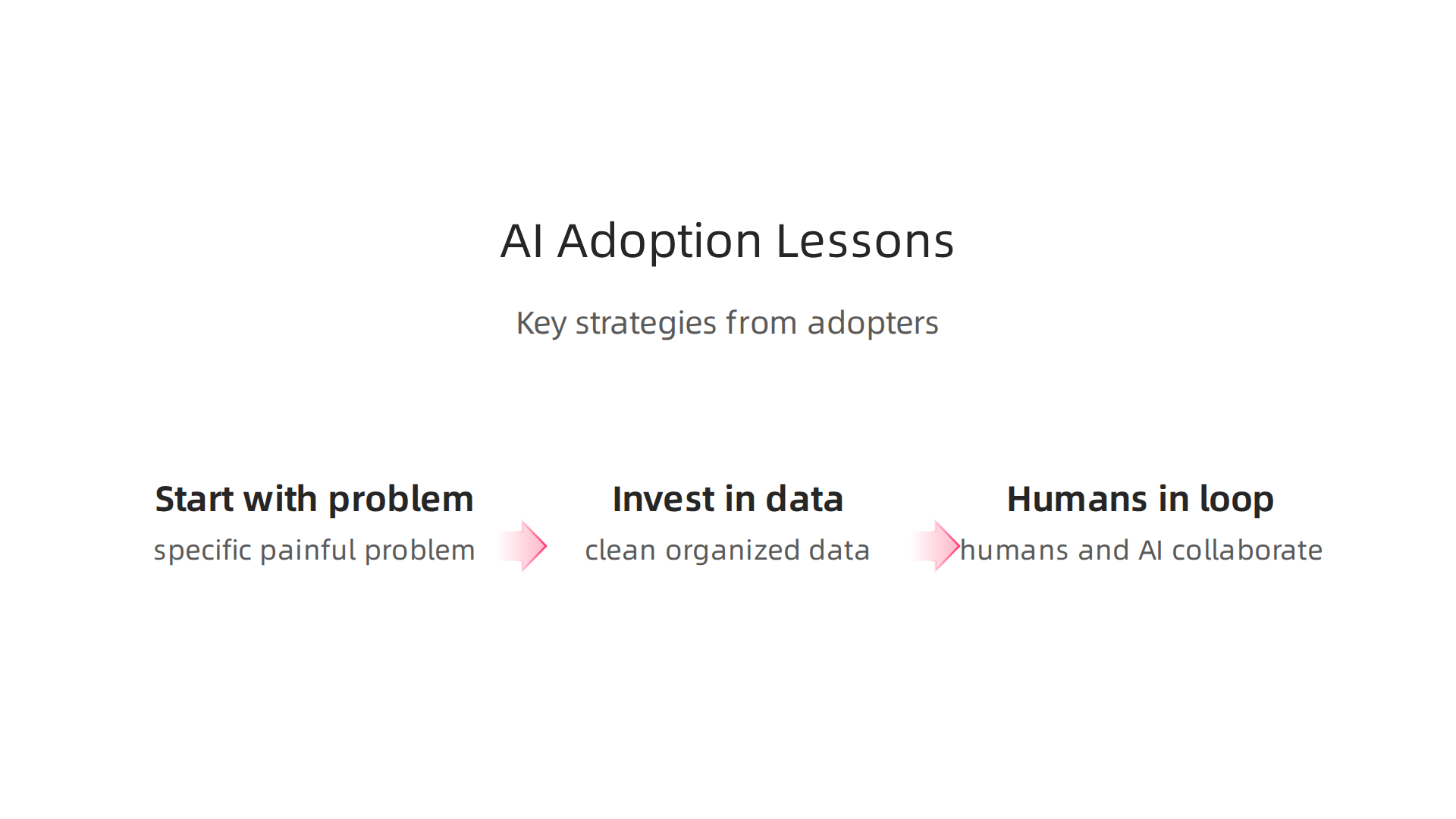
First, start with a specific, painful problem. Do not deploy generative AI just because it is trendy. Pick an area where manual work is slow, expensive, or error-prone. Second, invest in data quality. Garbage in, garbage out. Clean, organized data makes your AI smarter from day one. Third, keep humans in the loop. The best results come from humans and AI working together. Let the AI handle the repetitive work, and let your team focus on judgment calls and creative thinking.
For a closer look at how startups are raising capital to build these tools, read our analysis of AI startup funding deals reshaping the landscape in 2026.
The pattern is clear. Companies that adopt generative AI solutions with a clear strategy are seeing real ROI. They are not just saving money. They are building a competitive edge that will be hard to catch up to.
[1] https://intellizence.com/insights/startup-funding/top-startup-funding-deals-of-q1-2026-record-297-billion-raised-with-ai-dominating/
[2] https://news.crunchbase.com/venture/foundational-ai-startup-funding-doubled-openai-anthropic-xai-q1-2026/
Key Challenges and Risks in Adopting Generative AI
Of course, adopting generative AI solutions is not all smooth sailing. In 2026, 79% of organizations report facing adoption challenges, up from the year before [1].
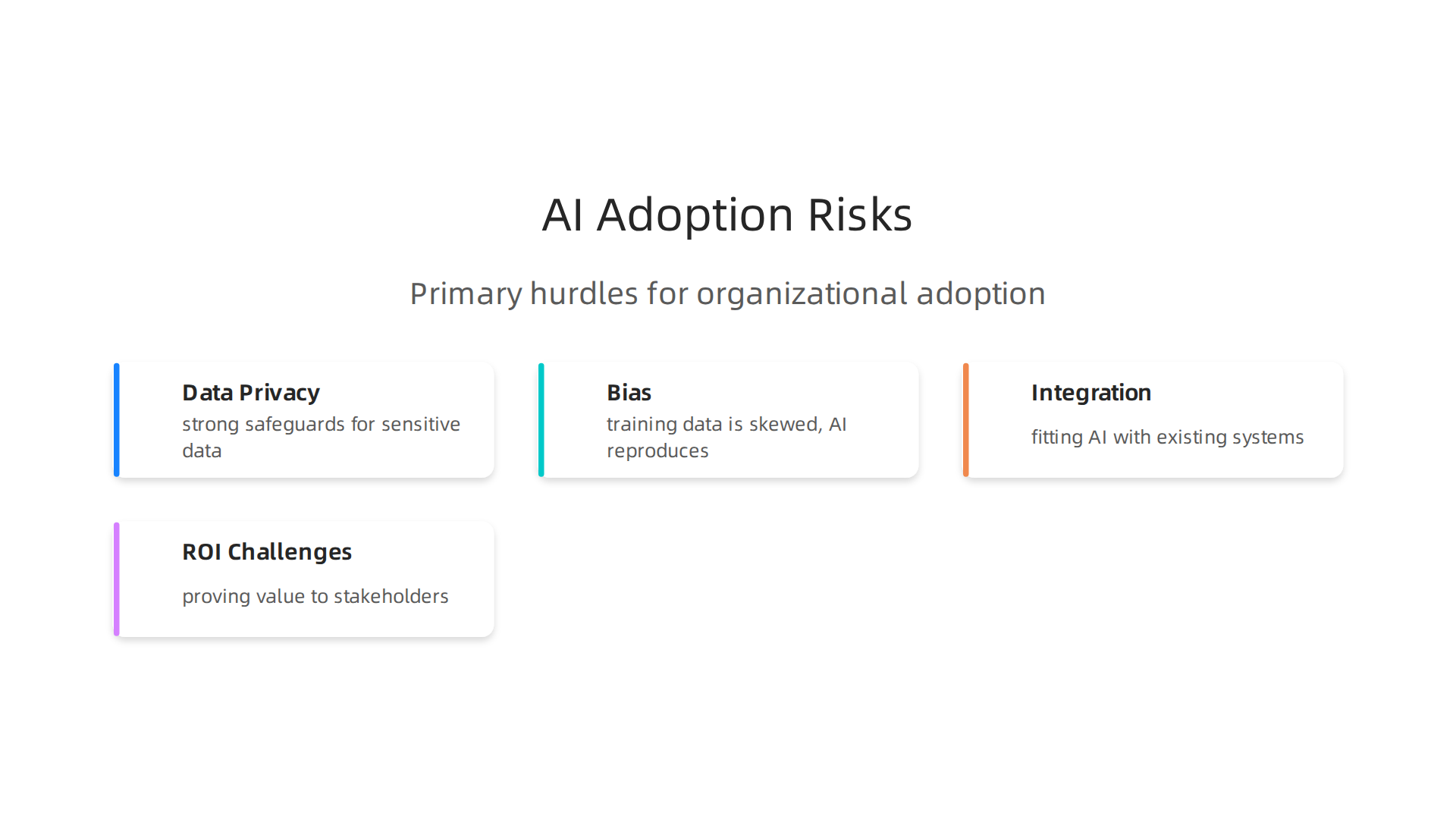
Data privacy tops the list of worries. When you feed sensitive customer or internal data into a model, you need strong safeguards. TrustArc explains how expectations around generative AI data privacy are shifting fast. Another big hurdle is bias. If your training data is skewed, the AI will reproduce those flaws. Integration with existing systems also trips many teams up. In fact, 29% of AI decision-makers say trust is the single biggest barrier [2]. The good news is you can plan for these risks. Start with a clear data governance policy, test outputs for bias, and keep humans in the loop. For a deeper look at how to evaluate AI companies without getting burned by hype, check out our guide on AI stocks in 2026.
[1] https://writer.com/blog/enterprise-ai-adoption-2026/
[2] https://www.forrester.com/technology/generative-ai/
Data Privacy and Security
Think about this: You upload customer data to a generative AI tool. Where does that data go? Who can see it? That question keeps business leaders up at night. In 2026, data privacy is the top worry for companies using generative AI.

And it makes sense. These models need huge amounts of data to work well. But that data often includes sensitive customer or internal information.
TrustArc explains how generative AI is changing what we expect from data privacy.
The rules are shifting fast. If you’re not careful, you could break laws like GDPR in Europe or CCPA in California. Those laws have real teeth. Fines can be massive.
The good news? There are ways to protect yourself. Techniques like differential privacy add random noise to data so individuals can’t be identified. Federated learning lets models train on data without ever moving it off your servers. More and more AI companies are building these safeguards into their products.
When using tools like Magic AI or ElevenLabs AI, always ask: "How do you handle my data?" Look for clear answers in their documentation. Also check if they offer enterprise-grade security controls.
Data privacy isn’t just a compliance box to check. It’s what builds trust with your customers. And as we saw earlier, trust is a massive barrier to adoption. A Forrester poll found 29% of AI decision-makers say trust is the biggest roadblock [1]. By making privacy a priority from the start, you remove that roadblock.
One smart move is to keep an eye on how investors evaluate AI companies. Strong data governance often separates the winners from the hype. For more on that, check out our piece on AI startup funding in 2026.
[1] https://www.forrester.com/technology/generative-ai/
Bias and Ethical Concerns
Now let’s talk about another big worry: bias. Generative AI learns from the data it’s trained on. And that data often contains human biases about race, gender, age, or income. If you’re not careful, your generative ai solutions can repeat or even amplify those biases. Imagine an AI hiring tool that favors certain backgrounds over others. That’s not just unfair. It could also open you up to legal trouble.
So what are ai companies doing about it? Groups like the IEEE and the European Union are developing ethical guidelines to keep AI safe and fair. More and more businesses are also building detection tools that flag biased outputs before they cause harm. These tools help you catch problems early.
It’s smart to check if the tools you use have bias safeguards. For example, when working with platforms like Magic AI or ElevenLabs AI, look for features that let you test for fairness. A recent study found that 79% of organizations face challenges in adopting AI (Writer, 2026). Bias is a big part of that struggle.
Investors and leaders now see strong ethical practices as a must have for the best generative ai solutions. Want to know how to spot the companies that get it right? Check out our guide on AI stocks 2026 how to evaluate the top companies and avoid the hype. It helps you separate the ethical leaders from the rest.
So you have tackled bias, which is a big step. But once you pick a tool, the real work begins. Getting generative ai solutions to actually fit into your day to day operations is harder than it sounds.
Integration and ROI Challenges
Here’s the thing. Even the best AI tool is useless if it doesn’t talk to your existing software. You might need to connect it to your CRM, your database, or your project management system. That takes technical work. And it takes people agreeing to change how they do things. That’s a cultural shift.
The numbers back this up. Data from MedhaCloud shows that 65% of organizations now use generative AI in at least one business function. But a separate survey from Writer found that 79% of organizations still face big challenges in adopting AI. Many of those challenges come from integration and trust. In fact, Forrester reports that 29% of AI decision makers say trust is the top barrier.
So how do you measure success? ROI is tricky. You can’t just look at a single number. Maybe you save time. Maybe you create better content. Maybe you speed up research. But you need to prove it to your boss or your investors.
The best approach is to start small. Run a pilot project with one team. Pick a clear goal like "cut email response time by 20%." Use that data to justify a bigger rollout. You can learn from how other ai companies handle this. For example, our guide on AI-powered software development shows real examples of teams that started small and grew smart.
Don’t try to do everything at once. Pick one workflow. Measure it. Prove the value. Then expand. That’s how you turn integration headaches into real returns.
Investment and Funding Trends in Generative AI
So you have seen how hard it can be to get generative AI solutions to work inside your company. But while you figure out the day to day stuff, something huge is happening in the background. Investors are betting big on this space. Really big.
In Q1 of 2026 alone, global venture investment hit a record $300 billion. And guess what? AI soaked up $242 billion of that. That is 80% of all startup funding going to AI. Crunchbase confirmed that funding to foundational AI startups more than doubled in the first quarter.
These are the generative AI companies building the models and the infrastructure that everyone else depends on.
The biggest names grabbed the biggest checks. OpenAI raised $122 billion at a valuation of $852 billion. Anthropic, xAI, and other frontier labs also pulled in massive rounds. Intellizence reported that the top startup funding deals of Q1 2026 were almost all AI related. Forge Global broke down the same trend, showing how capital is concentrating in just a handful of companies.
But it is not just the giants. Money is flowing into specific sectors too. Healthcare, finance, and enterprise software are getting a huge slice of the pie. Investors see generative AI solutions as a way to save money, speed up work, and create new products in these fields. For example, AI companies focused on drug discovery, fraud detection, and customer service automation are raising solid rounds.
Now, here is the catch. Investors are getting picky. They used to throw cash at any startup with "AI" in the name. Not anymore. In 2026, they want to see real revenue traction and a defensible moat. If your AI tool is just a thin wrapper on OpenAI, good luck. Eqvista points out that investor diligence questions now focus heavily on data ownership, model performance, and unit economics. The hype is still there, but the bar is higher.
This matters for you because where the money goes, the innovation follows. If you are choosing a generative AI solution for your business, pay attention to which companies are getting funded. That is a strong signal of staying power. You can learn more about how to evaluate these players in our guide on AI stocks and how to spot the real winners.
We also track the latest funding rounds closely. For deeper insights into specific deals and the startups reshaping the landscape, check out our coverage of AI startup funding in 2026.
The money is pouring in. But it is flowing to the companies that can prove real value. That is the same standard you should hold any generative AI solution to before you bring it into your own operations.
Expert Predictions for the Future of Generative AI
So the money is flowing fast. But where is it all going? Industry experts have a pretty clear picture of what the next 18 months will look like. And it involves a lot more than just chatbots.
The biggest prediction is that generative AI solutions will become a normal part of everyday business.

No more special projects. No more "let us try it out." PwC says successful companies in 2026 are moving from experimenting to scaling AI across their core operations. PwC’s 2026 AI business predictions highlight that focused strategies and agentic workflows will drive real value. In other words, AI will sit inside your sales tools, your HR systems, your supply chain software.
Two trends are driving this shift: multimodal models and AI agents. Multimodal models can handle text, images, audio, and video all at once. AI agents can take actions on your behalf. Goldman Sachs CIO Marco Argenti predicts these agents will become personal assistants that handle scheduling, research, and even negotiations. Fox Business covered his view that 2026 will see a rise in personal AI agents. And companies like ElevenLabs AI are already pushing voice technology to make those agents sound more human than ever.
But with more power comes more rules. Regulation is tightening fast. Experts from PwC and other firms warn that governments will start enforcing guidelines on data privacy, model transparency, and bias. If your business relies on generative AI solutions, you need to know where your data lives and how the model was trained.
So what should you do as a leader? Start building your AI infrastructure now. Train your teams. And keep an eye on which AI companies are building the most durable technology. If you want to see how this plays out in software development specifically, check out our guide on AI-powered software development in 2026. It covers the tools and workflows that will dominate the next year.
The next 18 months will bring huge opportunities and some real disruptions. The winners will be the ones who prepare today.
Summary
This guide cuts through the hype around generative AI and gives business leaders a practical view of what these tools do, how they work, and where they deliver real value in 2026. It explains core technologies (LLMs, GANs, diffusion models), shows concrete use cases—content generation, code assistance, and conversational AI—and shares real-world results from healthcare, finance, and retail. The article flags the main adoption risks—data privacy, bias, integration challenges—and offers governance and pilot strategies to reduce those risks and prove ROI. It also reviews investment trends and funding signals that indicate which companies may have staying power, and it outlines expert predictions about multimodal models, AI agents, and tighter regulation. After reading, you’ll be able to match generative AI solutions to specific business problems, run a small measurable pilot, and evaluate vendors on privacy, bias controls, and long-term traction.