

AI Stocks 2026 How to Evaluate the Top Companies and Avoid the Hype
Overview
Introduction: Navigating the AI Stock Surge with Clarity
If you have tried to keep up with AI company stocks in 2026, you already know the feeling. One week a new model breaks records. The next week a regulation rumor sends shares tumbling. It is exciting, sure. But it is also confusing.
The truth is, the AI stock market has seen some serious ups and downs this year. According to recent data, NVIDIA alone holds a market cap of over $5.3 trillion, while Alphabet sits close behind at over $3.8 trillion.
That is a lot of money moving around. You can check the full list of top AI companies by market capitalization to see the latest numbers.
But here is the struggle. With so many headlines and hot takes flying around, how do you know which companies have a real advantage? How do you separate hype from lasting value?
This is where most investors get stuck. They want to invest in artificial intelligence, but they get lost in the noise.

They end up chasing the wrong signals or missing the best opportunities entirely.
That is exactly why this article exists.
We have pulled together the latest performance data, valuation metrics, and expert analysis from trusted sources like Morningstar and NerdWallet.


Our goal is simple. Give you a clear, actionable framework for understanding which AI companies deserve your attention right now.
No fluff. No guesswork. Just the facts you need to move forward with confidence.
If you want to stay ahead of these trends without the daily hassle, you can Subscribe Free to get clear daily AI updates straight to your inbox.
Mapping the AI Stock Landscape in 2026
To cut through the noise around ai companies stock, it helps to first understand the different kinds of companies driving this space. In simple terms, you can group them into three main buckets.
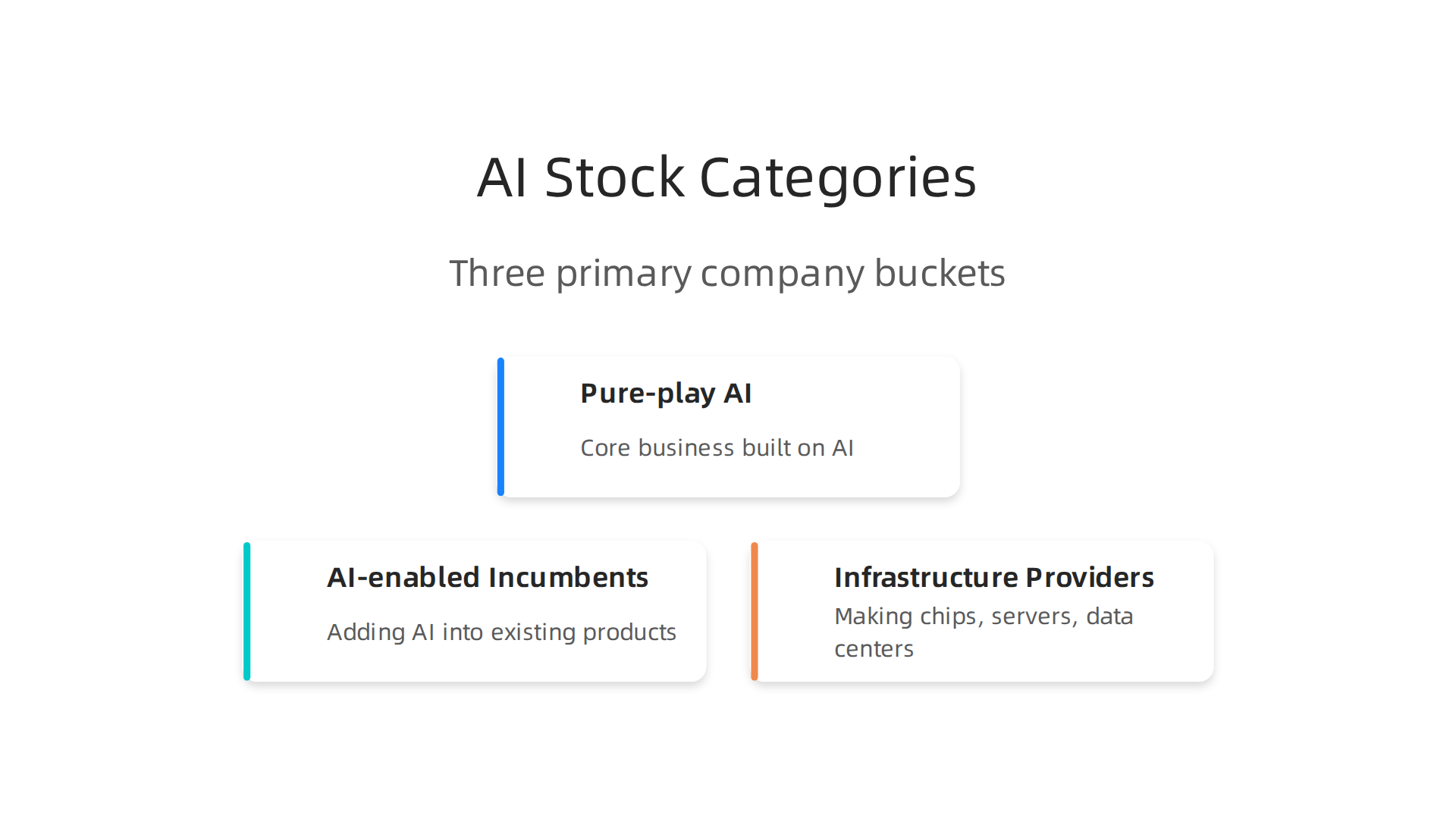
First, you have pure-play AI companies. These are firms whose core business is built on artificial intelligence itself. Private players like Anthropic AI and Cluely AI fit here, but on the public markets, NVIDIA is the biggest example. Second, you have AI-enabled incumbents. These are giant companies that are adding AI into their existing products and services. Think Microsoft, Alphabet, and Amazon. Third, you have infrastructure providers. These are the companies making the chips, servers, and data centers that make AI possible. Micron Technology and Seagate Technology fall into this group.
Why does this matter? Because each bucket behaves differently when the market shifts. According to SoFi’s guide, pure-play stocks can be more volatile but offer higher upside, while incumbents tend to be more stable. Infrastructure providers benefit directly from the massive spending on AI hardware.
The market is also clearly split between two groups. On one side, the mega-cap tech giants dominate. NVIDIA alone holds a market cap of over $5.3 trillion, while Alphabet sits at over $3.8 trillion, as shown by CompaniesMarketCap data. On the other side, a growing number of mid-cap specialists are making their mark. For example, Micron Technology and Seagate Technology have been among the best-performing AI stocks in May 2026, according to NerdWallet. This creates a landscape where you can choose between size and safety or agility and potential.
There is another layer you need to watch. Geographic concentration. Most of the biggest AI company stocks are based in the United States or China. While this has created huge opportunities, it also introduces geopolitical risk. Trade tensions and regulation can shift quickly. Goldman Sachs reports that AI companies may invest over $500 billion in 2026, but much of that spending is concentrated in these two countries. That means a policy change in Washington or Beijing can ripple across your portfolio.
Keeping all this straight is tough. That is why many investors turn to simple, trusted updates to stay ahead. If you want a clear daily view of what matters in AI, you can Subscribe Free to get insights delivered to your inbox without the noise.
Key Metrics for Evaluating AI Companies
Now that you understand the different types of AI companies, the next question is: how do you tell which ones are actually worth your money?

This is where most investors get tripped up. The old ways of measuring value often break down with AI stocks.
Here is the thing. Looking at a standard price-to-earnings (P/E) ratio for a high-growth AI company can be misleading. Many of these firms are spending heavily on research and development, which cuts into profits today. That makes their P/E look sky-high or even negative. But that spending might be building huge value for tomorrow.
So what should you look at instead? According to an AI business valuation model for 2026, you need to focus on what really drives value in this space: proprietary algorithms, unique datasets, recurring revenue, and scalability. These are harder to measure but far more telling.
Here are the key metrics that matter most when evaluating ai companies stock in 2026:
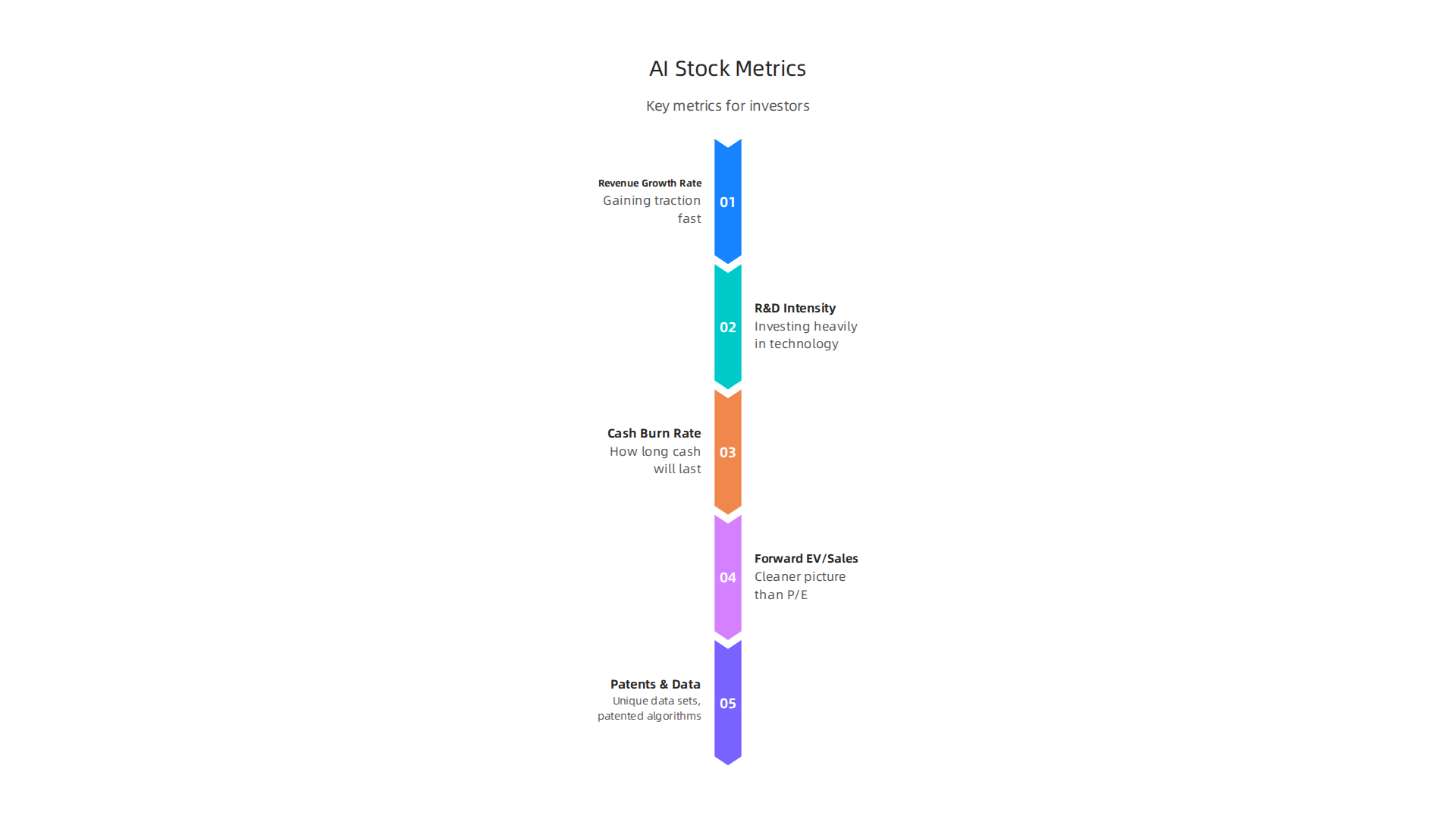
Revenue growth rate. This is the single most important number for a young AI company. Investors want to see that a company is gaining traction fast. A firm doubling its revenue year over year is far more exciting than one with flat sales, even if it is not profitable yet.
R&D intensity. Look at how much a company spends on research and development compared to its revenue. Companies expect to double their AI spending in 2026 according to a broad survey of 2,360 senior executives. A firm investing heavily in its technology is signaling that it plans to lead, not follow.
Cash burn rate and time to profitability. This is critical for pure-play AI companies. These younger firms often burn through cash quickly as they build their products and grab market share. You need to know how much cash they have on hand and how long it will last. If a company has only six months of runway left, that is a major warning sign.
Forward EV/Sales multiple. Traditional valuation multiples still have a place, but you need to use the right ones. Enterprise value to sales (EV/Sales) gives you a cleaner picture than P/E for companies without steady profits. In 2026, EV/Sales multiples have been stabilizing after a sharp correction. For example, in the B2B software space, EV/Sales is now at 4.2x, down from 5.6x at the start of the year. This tells you that the market is becoming more realistic about what these companies are worth.
Patents and proprietary data. The most valuable AI companies own unique data sets and patented algorithms that competitors cannot easily copy. These are hard assets that show up on no traditional balance sheet but drive long-term moats.
Keeping track of all these numbers for every company can feel overwhelming. That is exactly why having a trusted source of daily intelligence makes a difference. If you want to save time and get these insights delivered straight to you without the noise, you can Subscribe Free to get clear daily updates that help you make smarter decisions.
Top AI Stocks: Performance and Market Cap Analysis
Now that you know which numbers to watch, let us look at the actual companies leading the race. In 2026, the top 10 AI companies by market cap control more than 70% of the sector’s total value. That is a massive concentration of power. But we are also seeing big differences in performance across the board.
According to SoFi’s 2026 guide, the top AI stocks by market cap include Nvidia, Microsoft, and Alphabet. These three mega-cap giants alone represent trillions of dollars in value. As of May 2026, Nvidia sits at a stunning $5.3 trillion market cap according to CompaniesMarketCap data.

That makes it the largest company in the world by market cap, not just in AI.
Here is how the leaders stack up in 2026 based on recent market data:
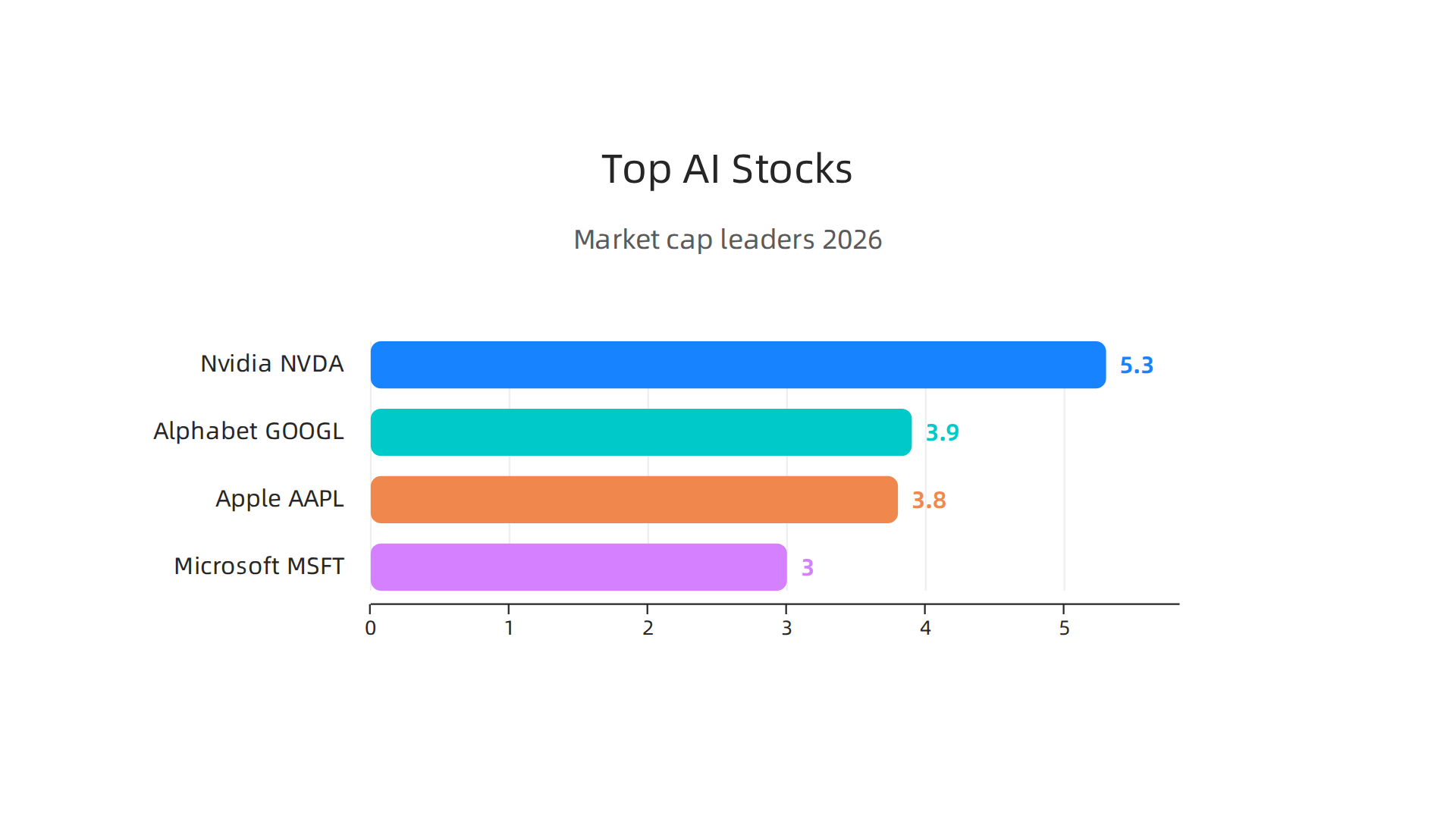
| Company | Market Cap | Key Role in AI |
|---|---|---|
| Nvidia (NVDA) | $5.3 trillion | Leading AI chip maker |
| Alphabet (GOOGL) | $3.9 trillion | AI search, Gemini models |
| Microsoft (MSFT) | ~$3 trillion | OpenAI partner, Azure AI |
| Apple (AAPL) | ~$3.8 trillion | AI integration in devices |
You can see the full list of the largest AI companies by market capitalization on CompaniesMarketCap for more details.
But here is the thing. Mega-cap tech is not the whole story. Mid-cap specialists in enterprise AI and robotics are actually showing higher growth rates. Companies like Micron Technology and Seagate Technology are among the best performing AI stocks in May 2026, according to NerdWallet. These firms focus on specific parts of the AI supply chain, like memory chips and data storage, and they are growing fast.
The performance picture also varies sharply by subsector. In Q1 2026, generative AI leaders outperformed AI infrastructure names. That means companies building the actual AI models and applications did better than those providing the hardware and networking underneath. This is a shift from earlier in the year when infrastructure was leading.
For investors, this matters a lot. You cannot just buy any AI company stock and expect the same returns. The dispersion is real. Some subsectors are hot, others are cooling off. Some companies are overvalued, others are still cheap relative to their potential.
If you want to track these shifts without spending hours every day reading scattered reports, you can Get Free Updates from The Deep View Newsletter. It gives you simple daily AI insights so you always know which subsectors are leading and which stocks are moving.
Valuation Trends: Are AI Stocks in a Bubble?
With AI companies stock prices soaring, a big question is on every investor’s mind: are we in a bubble? It is fair to ask. In 2026, forward P/E ratios for the AI sector are much higher than the broader tech market. That means investors are paying a premium for future earnings that have not happened yet. The fear is that these prices are too high and could crash.
The comparison to the dot-com bubble of 2000 comes up a lot. And yes, there are similarities. Hype is strong. Everyone is talking about AI. But there is a big difference. In the dot-com era, many companies had zero revenue and no clear path to profit. In 2026, the top 5 AI companies like Nvidia, Microsoft, and Alphabet generate massive real revenue and earnings. Still, some smaller AI companies with less established businesses are trading at extreme multiples, which worries experts. A 2026 guide from FE International explains that valuing AI companies now requires looking at proprietary data and recurring revenue, not just hype. You can read more about AI business valuation methods on FE International.
However, the picture is not all scary. Private market valuations have actually come down in some areas. According to QuantPillar, EV/Revenue multiples for B2B SaaS have dropped from 5.6x to 4.2x in early 2026. That is a sign of stabilization after a correction. And a Nasdaq study shows that small and mid-cap AI stocks trade at much lower P/E and EV/EBITDA multiples than large caps, which could mean better value hiding in smaller names.
Institutional investors are still bullish overall on AI, but they are getting picky. They are more cautious about the highest-flying names that have run up the most. Some are shifting to companies with stronger fundamentals and lower valuations. J.P. Morgan’s outlook suggests focusing on markets with improving fundamentals less tied to AI sentiment. That is a sign that even big money is hedging its bets.
So is it a bubble? Not exactly. But some parts of the AI stock market are definitely stretched. The smart move is to stay informed and not chase hype without checking the numbers.
If you want to keep a clear head and get daily updates on which AI companies stock are overvalued and which are still cheap, you can Get Free Updates from The Deep View Newsletter. It gives you simple, actionable AI insights every day without the noise.
Sector Deep Dives
The AI ecosystem is not one single market. It is a collection of distinct sub-sectors, each with its own growth drivers and risk profiles. Understanding these differences is key when you look at ai companies stock picks.
Generative AI is the hottest area. The market was worth $22.21 billion in 2025 and is projected to hit $324.68 billion by 2033, according to a Grand View Research report. That is a compound annual growth rate of 40.8%. Companies like anthropic ai are leading the charge here.
AI infrastructure is the backbone. Demand for chips and data centers is massive. A report from ThemeSetfs highlights that AI chip stocks are seeing prolific growth in 2026, with TSMC raising its 2026 revenue forecast by over 30%. This sub-sector has the most established revenue streams among top 5 ai companies.
Autonomous systems cover robotics, self-driving cars, and drones. This sub-sector is earlier stage but growing fast. Companies like cluely ai are applying AI to real world physical tasks.
Each sub-sector requires a different investment lens. If you want to track which areas are attracting the most venture capital and which ai companies stock deserve your attention, you can Subscribe for daily sector-specific intelligence from the team at AI Startup Funding News Today.
Generative AI: Leaders and Challengers
So who are the main players in this fast growing space? On the private side, OpenAI and anthropic ai are the clear leaders. They are building the most advanced models and attracting billions in funding. For public investors, companies like C3.ai and SoundHound AI offer a way to bet on generative AI through ai companies stock. But here is the challenge: revenue growth is explosive, while profitability is still a distant goal for most.
Enterprise adoption is what really drives this market. A recent report from NVIDIA found that 86% of organizations plan to increase their AI budgets in 2026. That means companies are moving from experiments to real world deployment. They need specialized models and fine-tuning services, which creates opportunities for both the top 5 ai companies and smaller challengers.
But picking the right ai companies stock in this sub-sector is tricky. The hype is huge, but earnings are not always there yet. You need to separate the companies with real enterprise traction from those just riding the wave.
Want to track which generative AI companies are actually landing the biggest enterprise deals? Subscribe Free to The Deep View Newsletter for daily intelligence on the leaders and challengers that matter.
AI Infrastructure: Cloud, Chips, Data Centers
All the generative AI models we talked about need massive computing power. You cannot run models like those from anthropic ai without serious hardware underneath. That is where AI infrastructure companies come in.
NVIDIA is still the king of chips. Its GPUs power most of the training and inference workloads today. AMD is chasing hard with its MI300 series, and cloud providers like AWS, Azure, and Google Cloud build their own custom chips too. The supply chain for advanced chips has eased a bit compared to a year ago, but demand still outstrips supply. According to Theme ETFs, TSMC raised its 2026 revenue forecast to over 30% growth, showing how hungry the market is.
When you think about ai companies stock, do not ignore the infrastructure layer. Data center REITs like Digital Realty and Equinix are booming because AI needs physical space, power, and cooling. Energy companies also benefit as data centers consume more electricity than ever. The top 5 ai companies alone are spending billions on data centers this year.
A recent report from NVIDIA shows that 86% of organizations plan to increase their AI budgets in 2026. That money flows straight into chips, cloud services, and data center real estate. So if you want broad exposure to AI without picking individual model makers, infrastructure stocks offer a more predictable path.
Want to stay ahead of the next big infrastructure trend? Get Free Updates from The Deep View Newsletter for daily intelligence on the companies building the backbone of AI.
Autonomous Systems: Robotics and Edge AI
While the cloud and data centers power large language models, a quieter revolution is happening at the edge. Autonomous vehicles from Tesla and Waymo are now operating on public roads in more cities every quarter. According to a recent survey by NVIDIA, 86% of organizations plan to increase their AI budgets in 2026, and a big chunk of that money flows into autonomous systems and robotics. Companies like UiPath are automating office workflows, while Symbotic reshapes warehouse logistics with AI-driven robots.
But the path is not always smooth. Regulatory approvals and safety benchmarks can act as either accelerators or brakes. In 2026, we have seen more state-level green lights for level 4 autonomous driving, which boosts investor confidence in the sector. On the flip side, any major accident or safety recall can slow adoption quickly. Edge AI chips from Qualcomm and Intel make it possible to run AI directly on devices like cars, drones, and factory robots. This reduces latency and keeps data local, which is critical for real-time decisions.
While anthropic ai focuses on creating safe AGI in the cloud, autonomous systems need intelligence at the device level. So when you evaluate ai companies stock, do not just focus on the cloud giants. Many of the top 5 ai companies by revenue, like Tesla and Alphabet, are already deep in this space. Even niche players like Cluely AI are bringing edge intelligence to specialized applications.
Want simple daily insights on the companies driving AI forward? Subscribe Free to The Deep View Newsletter.
Regulatory and Geopolitical Factors Affecting AI Stocks
You might think the future of AI comes down to who builds the smartest model. But in 2026, government rules and global tensions may be just as important. When you evaluate ai companies stock, you have to look beyond the technology. You need to understand how regulations and geopolitical shifts create winners and losers.

The EU AI Act and US Executive Orders
The European Union’s AI Act is now in full swing. It sets strict rules for high-risk AI systems. Companies must prove their models are safe, fair, and transparent. That costs money. For US companies like Anthropic AI, complying with the EU rules adds a new layer of expense. At the same time, President Trump issued a Proclamation adjusting imports of semiconductors [Mayer Brown, Jan 2026], which directly impacts hardware costs. These overlapping rules create uncertainty. Some of the top 5 ai companies by revenue have dedicated teams just to track and comply with these laws. Smaller players like Cluely AI may feel the pinch harder.
The Chip Export Battle
The biggest geopolitical factor right now is export controls on advanced chips. The US enforcement environment has shifted materially, with record penalties being handed out [Alvarez & Marsal, April 2026]. These controls aim to slow China’s AI progress. But a report from Chatham House argues that export controls on chips alone will not prevent China from developing advanced AI [Chatham House, April 2026]. So what does this mean for stocks? Companies with deep control of the chip supply chain, like NVIDIA and TSMC, still have strong advantages. But any new restrictions can wobble their stock prices overnight. Meanwhile, US allies are building their own legal authority to enforce these rules [CSIS, March 2025], which could reshape supply chains further.
National AI Strategies Provide Tailwinds
Not all government moves hurt. Countries are spending big to boost domestic AI. The US CHIPS Act, EU funding for AI infrastructure, and Japan’s national AI strategy all push money toward local chip makers and data centers. That creates clear tailwinds for stocks in AI infrastructure. According to S&P Global, understanding AI governance and regulations is now essential for investors [S&P Global].
So when you research ai companies stock, always check the regulatory map. A company that looks strong today could stumble tomorrow if new rules hit.
Want simple daily insights on the companies driving AI forward? Subscribe Free to The Deep View Newsletter.
Expert Perspectives on AI Stock Investing in 2026
Beyond rules and geopolitics, what do the people who manage billions of dollars actually think about ai companies stock in 2026?
According to Agecroft Partners, hedge funds are increasingly using AI to drive investment decisions, but the real edge still comes from human judgment [Hedge Fund Alpha, Jan 2026]. That is a key insight: even the money managers themselves admit that picking the right AI stocks requires more than just buying the hype.
So where are the experts putting their money?
Focus on Proprietary Data Moats
Many leading analysts argue that the most sustainable advantage for an AI company is not just having a good model, but owning unique data that competitors cannot easily copy. A report from Janus Henderson warns investors to look beyond first-mover status and instead focus on companies that control proprietary datasets [Janus Henderson, Feb 2026]. This means the top 5 ai companies by revenue might not be the best long-term picks if they don’t have their own data moat. Smaller players like Cluely AI, if they own specialized data, could offer surprising upside.
Why Broad AI ETFs Can Be Risky
Another common warning from experts: be careful with broad AI ETFs. Many funds that claim to track AI actually hold a mix of big tech stocks that are only partly related to AI. The shift from training enormous models to running inference workloads changes which companies benefit. Hedge fund perspectives suggest that active stock picking, based on technical differentiation, is more effective than passive ETFs [Hedge Fund Alpha, Jan 2026]. This is especially true as the market moves from the training phase to the inference phase, where efficiency matters more.
Three Themes to Watch
Experts highlight three major themes for 2026:
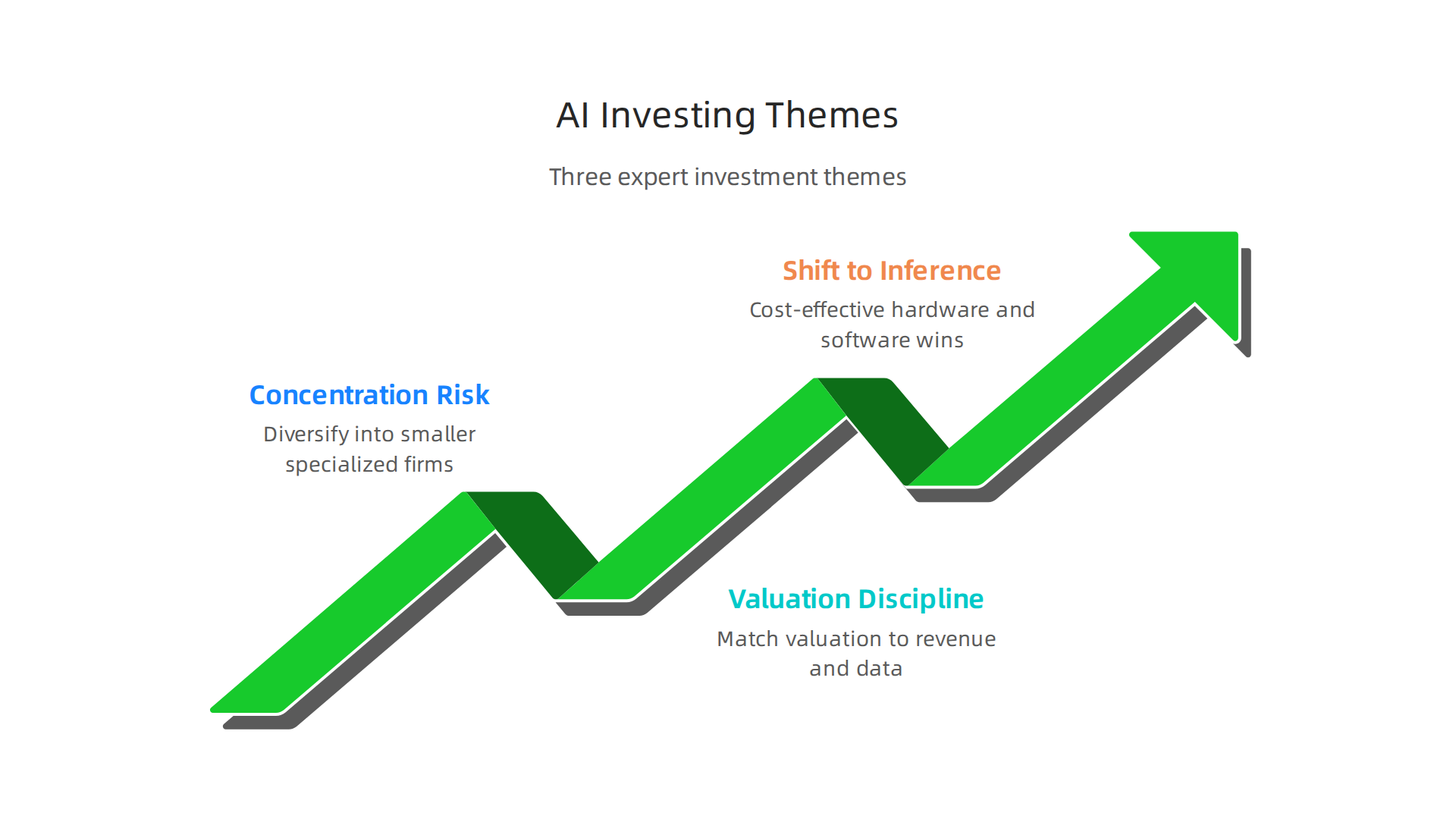
- Concentration risk: The biggest AI stocks, like NVIDIA, dominate indexes. But many experts advise diversifying into smaller, more specialized AI firms.
- Valuation discipline: High growth does not always mean high returns. Investors should check whether a company’s valuation matches its actual revenue and data advantage.
- Shift from training to inference: As AI models mature, the real money moves to deploying them at scale. Companies that provide cost-effective inference hardware or software may outperform.
These expert perspectives show that investing in ai companies stock is not a set-and-forget move. You need to dig into data moats, avoid overly broad funds, and stay ahead of the technology cycle.
Want simple daily insights on where these experts are looking next? Subscribe Free to The Deep View Newsletter.
Summary
This article gives a clear, practical framework for navigating AI company stocks in 2026 by cutting through hype and focusing on what really creates value. It explains the three main types of AI firms—pure-play model builders, AI-enabled incumbents, and infrastructure providers—and shows why each behaves differently when markets shift. You’ll learn the specific metrics that matter today (revenue growth, R&D intensity, cash runway, forward EV/Sales, and proprietary data or patents), plus how mega-cap concentration, subsector performance, and valuation trends affect opportunity and risk. The piece also walks through generative AI, infrastructure, and autonomous systems, and explains how regulation and chip export controls can move prices overnight. Drawing on recent market data and expert views, the article equips you to evaluate AI stocks more confidently, spot stretched valuations, and make more informed allocation choices.