Master AI Stock Trading Hours for Premarket After Hours and Global Markets
Overview
Introduction: Why Every AI Investor Must Master Trading Hours
Imagine this: You find a news alert about a major AI startup just landing a $500 million funding round. The stock of a company tied to that technology is about to surge. You move fast. You open your trading app. But the market is closed. By the time regular trading starts the next morning, the stock has already jumped 15%. The chance is gone.

This happens more than you might think. In 2026, AI company stocks move fast. Really fast. News breaks at all hours. Global AI funding announcements hit the wire during overlapping market sessions in the US, Asia, and Europe. And here is the tricky part. The stock market trading hours you grew up with are only part of the picture.
Why Timing Matters More Than Ever for AI Stocks
AI stocks behave differently than traditional companies. Their prices can swing wildly in just minutes. Have you ever noticed how AI stocks often spike right at the 9:30 AM market open or drop sharply in the final minutes before the 4:00 PM close? That is not random. Big institutional traders place large orders at these moments. If you are not ready, you buy high or sell low.
Here is another layer. Premarket stock trading lets you trade as early as 4:00 AM Eastern Time. The Nasdaq offers pre-market sessions starting at 4:00 AM, as noted in the official US Stock Market Holiday Schedule. That means when a major AI funding story drops at 6:00 AM, you can act before the regular session even opens. But many investors miss this window entirely.
The us market also closes early on certain holidays. In 2026, for example, the NYSE and Nasdaq close at 1:00 PM on the day after Thanksgiving and Christmas Eve. The US Equity and Options Markets Holiday Schedule 2026 shows these early closures. If you do not know the schedule, you could place a trade expecting a full day and find yourself locked out.
The Real Cost of Ignoring Trading Hours
Think about the market risk premium. That is the extra return you expect for taking on risk. When you cannot execute a trade because you misjudged the hours, you are not just missing one opportunity. You are accepting a higher risk for a lower potential return. Over time, these small misses add up.
The fix is simple. Learn the exact stock market trading hours. Know the pre-market and after-hours rules. And keep a calendar of early closures and holidays.
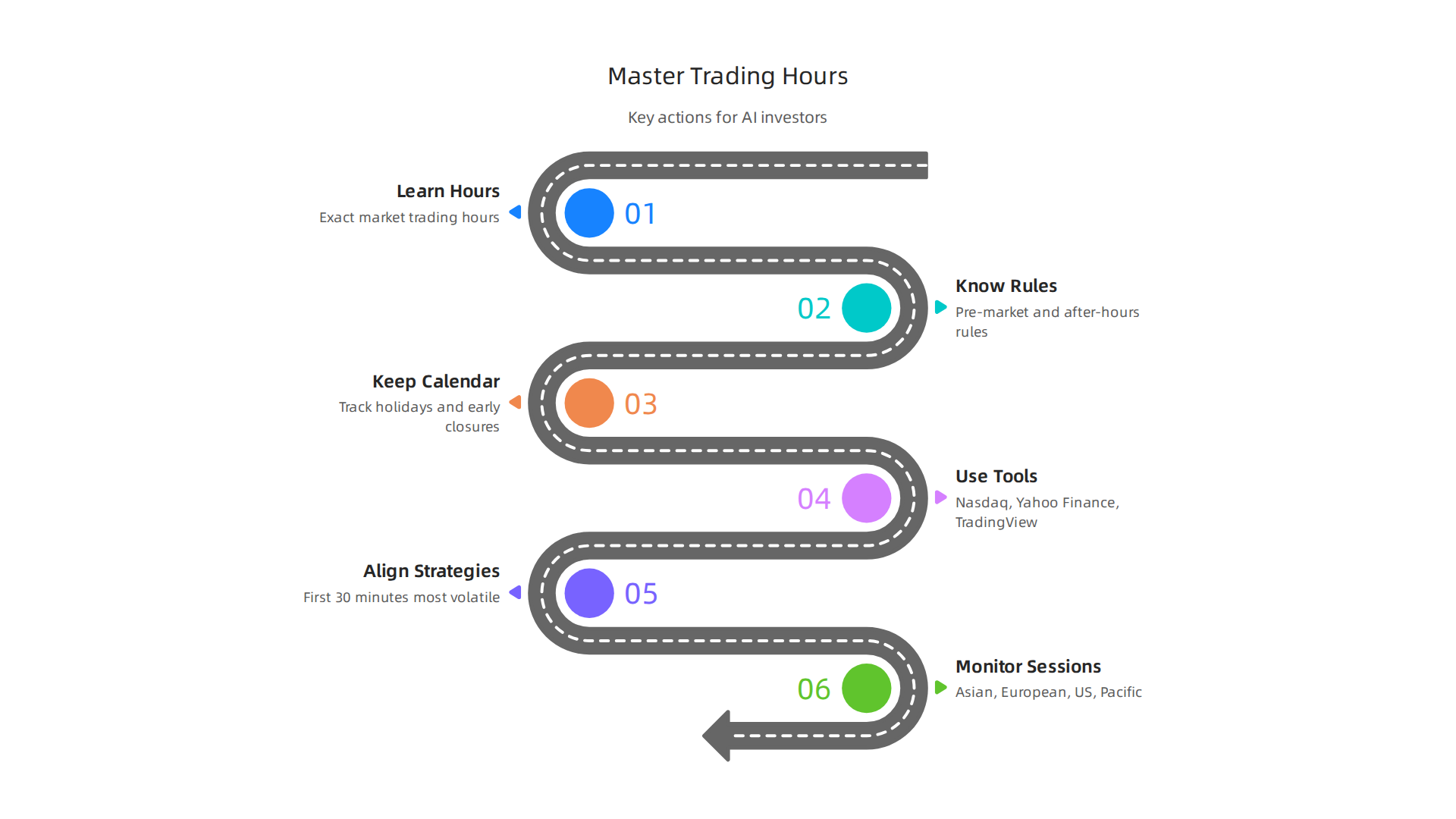
Your AI portfolio depends on it.
Ready to stay ahead of every AI market move? The AI Newsletter Worth Reading delivers daily updates on AI funding news and market signals straight to your inbox. No noise. Just the intelligence you need to trade smarter.
For a deeper look at evaluating companies in this fast-moving space, check out our guide on AI stocks 2026 to learn how to separate real winners from hype.
Why Trading Hours Matter for AI Investors
Let’s break down what actually happens when US and European markets overlap. From roughly 8:00 AM to 12:00 PM Eastern Time, both the New York Stock Exchange and major European exchanges like London, Frankfurt, and Paris are open at the same time. This window is a goldmine for AI stock traders.
Why? Because during these overlapping hours, trading volume spikes. More buyers and sellers are in the market at once. That means tighter spreads and better fills on your orders. But here is the catch. The same high volume also creates wild price swings, especially for AI stocks that react to breaking news.
Think about how AI company announcements work. A startup might drop a funding press release at 8:00 AM Eastern. That is 1:00 PM in London and 2:00 PM in Frankfurt. European institutional traders see it immediately and start placing orders. US traders are already at their desks. The stock moves fast. If you are not watching during this overlap, you miss the first wave. The Session-Based Trading Strategies Guide explains that the London session features high volume and common breakouts, while the New York session sees frequent liquidity grabs. When those two sessions overlap, you get both high volume and breakout potential.
This dynamic directly affects your market risk premium. When you trade during low-liquidity hours, you face wider bid-ask spreads. That means you pay more to buy and get less when you sell. Over time, those small slippages eat into your returns. Setting limit orders during overlapping sessions helps because there is enough liquidity for your order to fill at your price.
Here is a practical example. An AI company announces a partnership with a major cloud provider at 9:30 AM Eastern. The regular session just opened. You have a limit order ready at a price you calculated overnight. Because liquidity is high from the US Europe overlap, your order fills instantly at your target. You captured the move without overpaying.

If you had placed that same order during the Asian session when volume is low, your order might have sat there unfilled or triggered a bad fill.
For a deeper look at how to interpret these kinds of market moving announcements, check out our guide on decode CEO announcements for real AI startup funding insights. It shows you how to spot the signals that actually move stock prices.
The takeaway is simple. If you only trade during regular hours without paying attention to the overlaps, you are leaving money on the table. Know when the US and European sessions align. That is when the real AI stock action happens.
The Four Major Global Trading Sessions
To make the most of those overlaps, you first need to know the four major trading sessions that run around the clock.
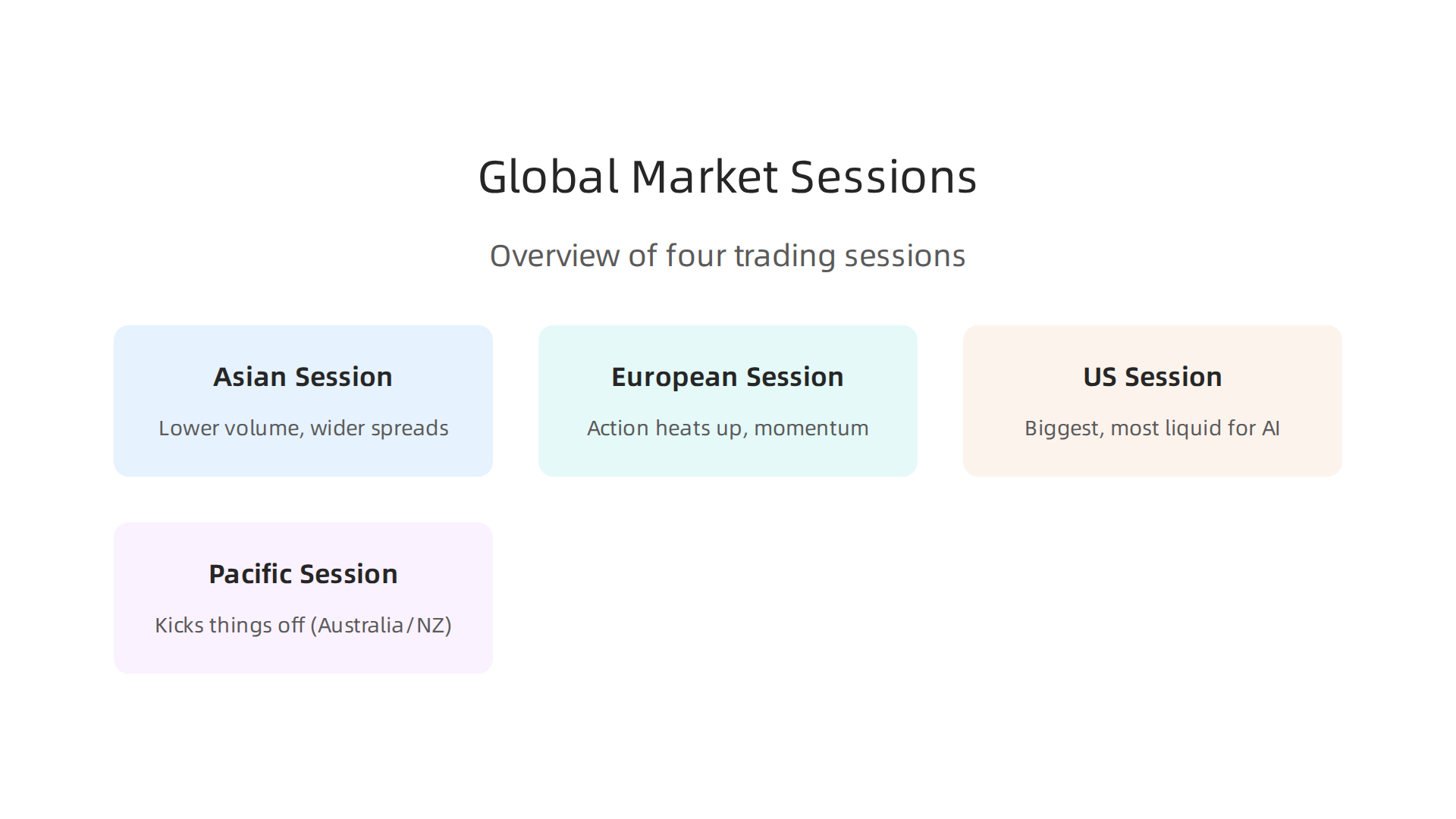
The main three blocks are the Asian session, the European session, and the US session. A fourth block, the Pacific session (Australia and New Zealand), kicks things off when US markets are closed.
The Asian session includes exchanges like Tokyo, Hong Kong, and Shanghai. This session tends to have lower volume and wider spreads. AI stocks that trade on US exchanges barely move during Asian hours because most major AI news breaks during US or European business hours.
The European session centers on London, Frankfurt, and Paris. This is where the action starts to heat up. European institutional traders are active, and AI company announcements from overnight get priced in. According to the What Time Does the Stock Market Open and Close guide, the London Stock Exchange operates from 8:00 AM to 4:30 PM GMT, while US regular hours are 9:30 AM to 4:00 PM ET. That overlap from 8:00 AM to 12:00 PM ET is where most daily volume happens.
The US session is the biggest and most liquid for AI stocks. Premarket stock trading begins as early as 4:00 AM ET, but the real volume starts when the NYSE and Nasdaq open at 9:30 AM ET.
Each session has its own personality. Asian hours are quiet with tight ranges. European hours bring momentum. US hours drive the final direction. The magic happens in the overlaps, especially when London and New York are both open.
For a deeper look at how these sessions affect your investing decisions, check out our guide on AI stocks 2026 evaluation to avoid the hype and find real value.
If you want to stay ahead of AI market movements across all time zones, get clear daily AI updates from The Deep View Newsletter. It cuts through the noise so you never miss a major move.
US Market Hours (NYSE / NASDAQ)
The US market is where most AI stocks live. Both the New York Stock Exchange and the Nasdaq run their regular stock market trading hours from 9:30 AM to 4:00 PM Eastern Time, Monday through Friday. That midday window is the main event. It is when the highest volume flows through and when big price moves happen.
But the action does not start at 9:30 AM. Premarket stock trading opens as early as 4:00 AM ET on Nasdaq and runs until the regular session begins. This early window lets you react to overnight news before the rest of the crowd shows up. Some brokerages offer pre-market access starting at 7:00 AM on the NYSE. After the bell rings at 4:00 PM, after-hours trading continues until 8:00 PM ET. This extended session is useful for trading on earnings reports or AI announcements that drop after the close.
To dig deeper into which US-listed AI companies might be worth your attention, check out our guide on top AI companies in 2026 and how to spot tomorrow’s leaders.
For a full rundown of the official Nasdaq session times, the US Stock Market Holiday Schedule on Nasdaq offers a reliable reference.
European Market Hours (London, Frankfurt)
Now let’s look across the Atlantic. If you trade European AI stocks, the London Stock Exchange (LSE) runs from 8:00 AM to 4:30 PM local time (GMT or BST depending on daylight savings). Over in Frankfurt, the Deutsche Börse (Xetra) opens from 9:00 AM to 5:30 PM Central European Time.
Here is the key part for your schedule. European markets overlap with the US session from about 1:00 PM to 4:00 PM Eastern Time. That window creates the highest liquidity for global AI stocks because both American and European traders are active at the same time. More liquidity usually means tighter spreads and smoother order execution.
Some important European AI names trade during these hours. Think of ARM Holdings or SAP. If you follow those companies, you need to pay attention to both local exchange times and the overlap period.
For daily AI intelligence that covers global markets, you can get clear daily AI updates from The AI Newsletter Worth Reading.
To learn more about finding quality companies on these exchanges, check out our guide on how to evaluate AI stocks and avoid hype.
Asian Market Hours (Tokyo, Hong Kong, Shanghai)
Now we cross into Asia. The Asian session is where the global trading day kicks off. If you track AI stocks based in Japan, China, or Hong Kong, you need to know these exact windows.
The Tokyo Stock Exchange (TSE) opens at 9:00 AM Japan Standard Time and closes at 3:00 PM. But there is a lunch break from 11:30 AM to 12:30 PM when trading stops. So the morning session runs 9:00 to 11:30, and the afternoon session runs 12:30 to 3:00.
In Hong Kong, the Stock Exchange of Hong Kong (HKEX) runs from 9:30 AM to 4:00 PM Hong Kong Time, with a lunch break from 12:00 PM to 1:00 PM. The Shanghai Stock Exchange (SSE) follows 9:30 AM to 3:00 PM China Standard Time, with a lunch break from 11:30 AM to 1:00 PM. You can find a full breakdown of stock market trading hours for Hong Kong on the Carry site.
Here is the important point for US traders. The Asian session overlaps with US after-hours trading only briefly. By the time Asian markets open, it is often late evening in the US. So any major AI news from the US overnight can create price gaps when Asian markets open.
This matters because an increasing number of AI startups are listing in Hong Kong and Shanghai. To invest in those companies, you need to trade during Asian hours or use limit orders to manage gaps. For a broader look at where AI companies are headed, check out our guide to spotting tomorrow’s market leaders.
Extended Hours: Pre-Market and After-Hours Trading
Knowing regular stock market trading hours is just the start. If you want to react quickly to AI news, you also need to understand extended hours. That means pre-market and after-hours trading.
For the US market, pre-market trading on Nasdaq runs from 4:00 AM to 9:30 AM Eastern Time. After-hours trading goes from 4:00 PM to 8:00 PM Eastern Time.
Most of the volume and liquidity show up closer to 8:00 AM during pre-market. As Wikipedia explains in their guide on extended-hours trading, these early and late sessions let you act on news before the regular open or after the close.
Why does this matter for AI investors? Because major AI earnings reports, product launches, and funding announcements often hit after the bell. A startup might announce a huge funding round at 5:00 PM. Without after-hours trading, you would wait until the next morning. By then, the stock price could already be much higher. Extended hours give you a chance to react in real time.
But there is a catch. Liquidity is much lower during these sessions. Fewer people are trading, so prices can swing wildly. The spread between buy and sell prices gets wider. That is why you should always use limit orders instead of market orders. A limit order lets you say, "I will only buy at this price or better." That protects you from getting a bad fill.
For AI stocks especially, being able to trade outside regular hours can help you capture early moves. If you want to learn more about picking the right AI companies to watch during these windows, check out our guide on AI stocks 2026 how to evaluate the top companies and avoid the hype.
Staying on top of fast-moving AI news is key to making smart trades in extended hours. The AI Newsletter Worth Reading delivers clear daily AI updates straight to your inbox so you never miss a critical announcement.
Key Stock Market Holidays and Calendar Events 2026
Knowing extended hours helps you act fast, but you also need to know when the market takes a day off. If you do not check the calendar ahead of time, you could place an order on a holiday and wonder why nothing happens.
The US stock market closes for up to nine full days each year. In 2026, the NYSE and Nasdaq are closed on New Year’s Day, Martin Luther King Jr. Day, Presidents’ Day, Good Friday, Memorial Day, Juneteenth, Independence Day (observed on July 3), Labor Day, Thanksgiving, and Christmas Day. There are also two early closure days. The day after Thanksgiving and Christmas Eve both close at 1:00 PM Eastern Time. The Nasdaq trading calendar from their official site lays out every date, and it is worth bookmarking so you never get caught off guard.
Why does this matter for AI investors? Because earnings season often clusters around these calendar events. A company might rush its quarterly report out the day before a long holiday weekend. If you are not paying attention, you could miss a critical announcement or, worse, place a trade when liquidity is already drying up. During early close days, the window to trade narrows significantly.
You also need to think beyond US borders. Non-US holidays can shake the prices of AI stocks listed overseas or affect companies with global supply chains. For example, Golden Week in Japan and Lunar New Year in China and Hong Kong shut down major exchanges. If you hold shares of an AI chip supplier based in Taiwan or a robotics company in Japan, those stocks will not trade during those weeks. The effect on global liquidity can be real, especially if a big AI earnings report drops while Asia is dark.
Understanding the full stock market trading hours calendar, including these holiday quirks, is a basic but powerful habit. It keeps you from making timing mistakes that cost money.
If you want to know which AI companies are worth tracking during these calendar windows, our guide on top AI companies 2026 spotting tomorrows market leaders can help you build your watchlist before the next holiday lull.
Trading Strategies Aligned with Market Hours
Knowing the holiday calendar is step one. Step two is matching your trading style to the natural rhythm of each trading day. The regular session runs from 9:30 AM to 4:00 PM Eastern, but smart traders know the real action happens in specific windows.
The first 30 minutes after the open are the most volatile. This is when overnight news gets priced in, and big institutional orders hit the tape.
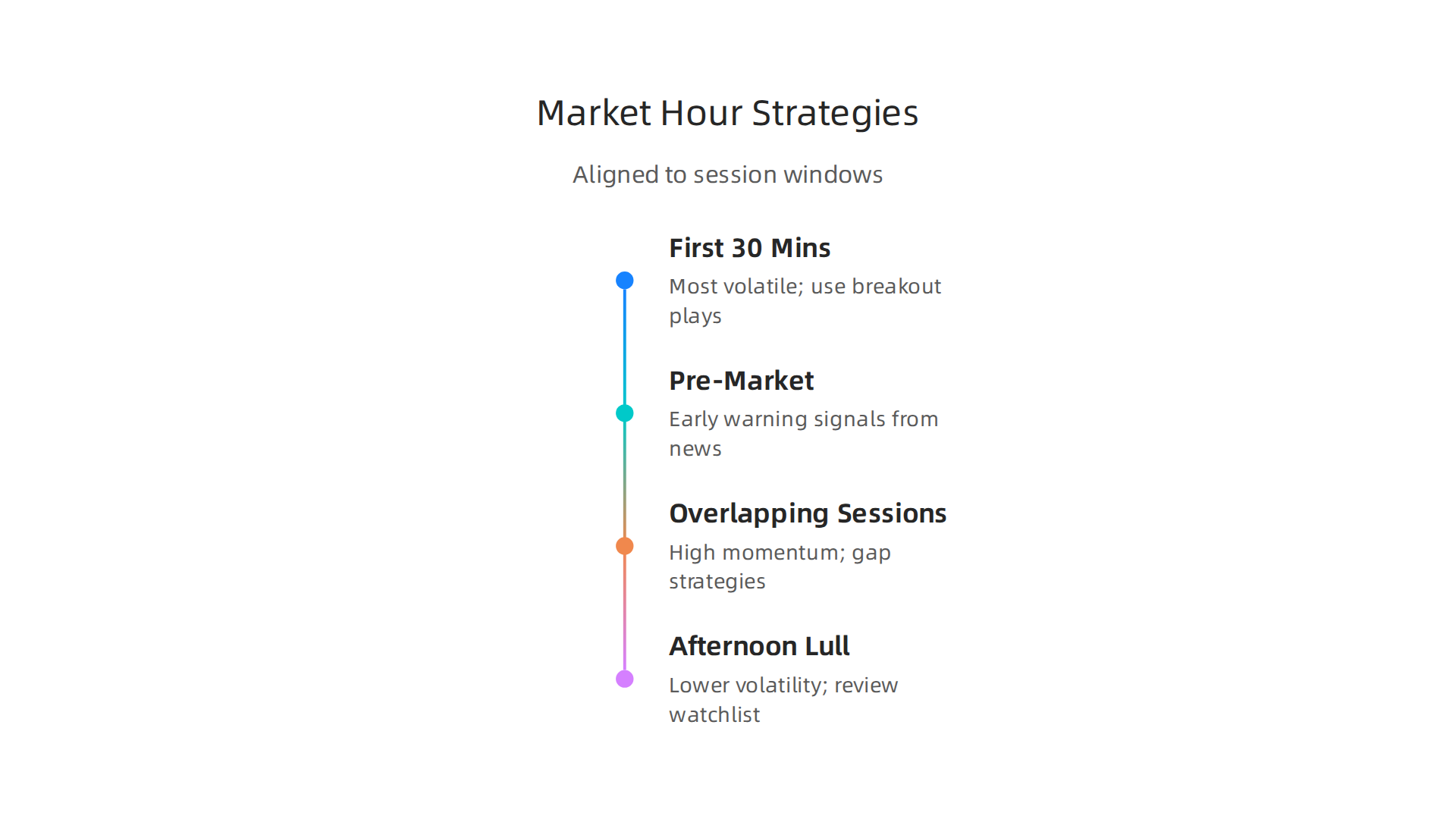
Breakout strategies thrive here. If an AI stock gaps up on strong earnings and holds above the open price, that momentum often carries through the morning. The trick is to wait for the initial chaos to settle a bit. Let the first five to ten minutes pass, then look for a clean breakout above the opening range.
Pre-market trading is your early warning system. From 4:00 AM to 9:30 AM Eastern, you can see how stocks react to news before the regular session starts. The TD Bank guide explains that pre-market activity usually happens between 8:00 AM and 9:20 AM Eastern, when the most volume comes in. If a major AI company like Nvidia or a smaller startup announces a new funding round overnight, the pre-market price tells you whether the market is excited or worried. You can use that signal to plan your entry for the regular open.
Momentum and gap strategies work best during overlapping sessions. For US stocks, the busiest overlap is between 9:30 AM and noon Eastern, when both New York and London are active. High volume means tighter spreads and better fills. If you spot a gap up in an AI stock and it holds support during that overlap, the trade has a stronger foundation.
The market risk premium also shifts during these windows. Early morning, fear and greed are at their peak. By the afternoon lull (around 1:00 PM to 3:00 PM), volume drops and many day traders close positions. That is not the best time to start a new breakout trade. Instead, use that lull to review your watchlist for the next morning.
If you want to learn more about picking the right AI stocks to trade, our guide on AI stocks 2026 how to evaluate the top companies breaks down the signals that matter.
Staying informed about daily market moves and AI company news is key. Get clear daily AI updates from The AI Newsletter Worth Reading to stay ahead of the next momentum shift.
Tools and Resources to Track Market Hours for AI-Focused Investments
You now understand the rhythm of the trading day. But keeping track of session opens, holiday closings, and earnings timing across multiple AI stocks takes real effort. The right tools make it simple.
Start with a strong desktop or mobile app for real-time market status. TradingView ranks as the best overall stock market tracking software in 2026, according to a detailed comparison of 10 platforms.
It gives you real-time charts, customizable watchlists, and programmable alerts that trigger when an AI stock hits your price level during specific market windows. If you trade on the go, the mobile app keeps you synced.
For deeper analysis, Bloomberg Terminal is the gold standard for institutional professionals. It streams comprehensive real-time data, news, and analytics at around $24,000 per year. That is overkill for most individual traders. A more practical alternative is Yahoo Finance, which delivers free portfolio tracking, real-time quotes, and news feeds in a single dashboard. Finviz also deserves a look with its excellent stock screener and interactive heatmaps that show sector performance at a glance. All three tools help you stay aware of premarket stock trading activity so you never miss a gap up before the bell.
Economic calendars are just as critical. You need to know when earnings reports drop for AI companies and when the market closes early for holidays. Investing.com and Yahoo Finance both offer free economic calendars with holiday alerts and earnings timing built in. Set up notifications for the companies on your watchlist. That way, you get an alert the moment an AI startup like Shield AI or Harvey AI reports quarterly results, and you can plan your entry before the regular session begins.
News aggregators that filter AI funding news by time relevance give you an edge. Regular news feeds bury AI-specific updates under general market noise. A curated source focused on AI startup funding rounds and venture capital moves cuts straight to what matters. The AI Newsletter Worth Reading delivers clear daily updates that help you spot momentum shifts early. Pair that with a tool like Finviz to screen for AI stocks showing unusual pre-market volume, and you have a workflow that keeps you ahead.
If you want to understand how venture capital flows into this space, our guide on AI venture capital 2026 trends and strategies for investors breaks down where the smart money is going this year.
Summary
This article explains why mastering global trading hours is essential for anyone investing in fast‑moving AI stocks. It walks through the four major trading sessions (Asian, European, US, Pacific), explains pre‑market and after‑hours windows, and highlights the liquidity spikes that happen when sessions overlap. You’ll learn how timing affects spreads, fills, and the market risk premium, why openings and closings often produce the biggest moves, and how holiday and early‑close calendars can disrupt plans. The guide offers practical tactics — use limit orders in extended hours, trade overlaps for tighter spreads, and set alerts for earnings and funding news — plus recommended tools and news sources to stay ahead. After reading, you’ll be able to schedule trades around the highest‑liquidity windows, avoid common timing mistakes, and set up a workflow to catch AI market moves across time zones.