

AI Venture Capital 2026 Trends and Strategies for Investors in Businesses
Overview
Introduction
If you are tracking where the biggest money flows in 2026, one sector dominates everything else: artificial intelligence. Global venture capital hit an all-time high of $330.9 billion in the first quarter of 2026 alone, according to the latest data on global VC investment record in Q1 2026. And AI companies swallowed more than 80 percent of that capital.
For investors in businesses right now, this is the most dynamic space to watch. Four of the five largest venture rounds in history closed in just 90 days. OpenAI raised $122 billion. Anthropic raised $30 billion. Waymo and xAI each landed massive rounds too. The numbers are stunning, but the real story is how fast the rules are changing.
Top VC firms are no longer generalists who dabble in AI. They are spinning up specialized funds, building exclusive evaluation frameworks, and hiring technical analysts just to keep up. The days when a strong pitch deck and a good network could land a deal are fading fast. In 2026, investors need a completely new playbook to separate the real breakthroughs from the hype.
That is where the challenge hits hardest. With hundreds of billions flowing into AI, the noise is deafening. Not every company that raises a huge round will deliver results. Not every cutting-edge lab will turn research into revenue. To succeed as an investor, you need data-driven insight that cuts through the buzz and points to the most promising deals.
Staying informed day by day is the best way to build that edge. That is why we recommend subscribing to The AI Newsletter Worth Reading. It delivers clear, daily AI updates so you never miss a key funding move or market signal.
For founders and operators, understanding who is writing the big checks matters just as much. If you are looking for capital, knowing the landscape of how to find strategic AI startup funding partners in 2026 can save months of wasted effort.
The rest of this guide will break down the most important funding trends, the firms making the biggest moves, and the practical tools you need to evaluate AI deals with confidence in 2026.
The State of AI Venture Capital in 2026: Key Trends for Investors in Businesses
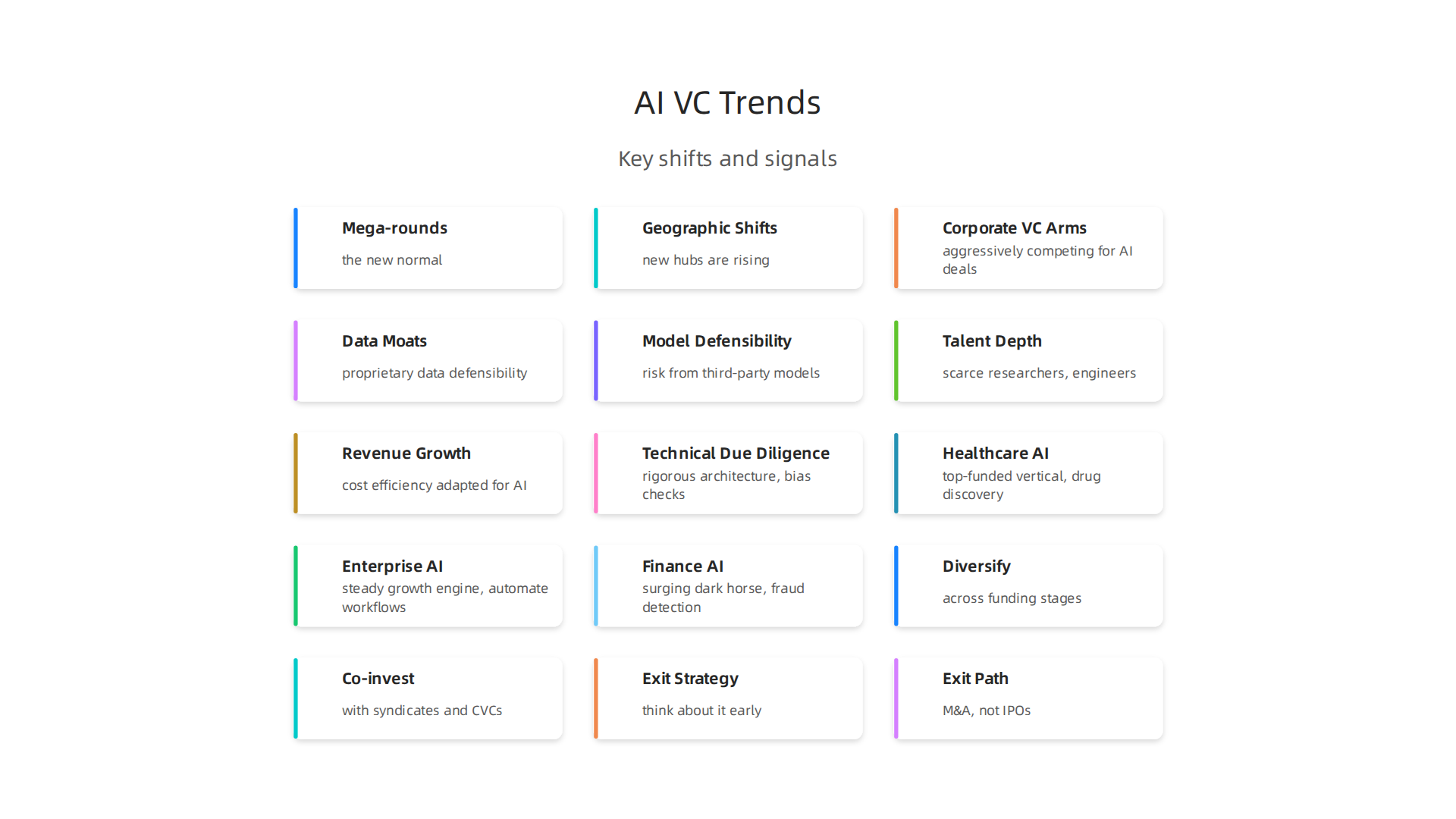
Now that we’ve seen the headline numbers, let’s dig into the specific trends that matter most for investors in businesses in 2026. The AI funding boom is not just about total dollars. Three big shifts are changing how deals get done.
Mega-rounds are the new normal
The size of AI funding rounds has exploded. In Q1 2026, ten funding rounds each raised more than $2 billion, as highlighted in a detailed report on AI capturing 80% of global venture funding. These 10 deals alone brought in over $206 billion. That means most of the capital is flowing into a tiny number of companies.
For investors in businesses, this changes the game. The old $100 million mega-round threshold is now table stakes. To break into the top tier in 2026, an AI company needs to raise $300 million or more. This concentration makes it harder for smaller investors to get into the hottest deals. But it also creates opportunities for those who can spot the next big thing early.
Where the money is flowing
The geographic map of AI investment is shifting. The United States still dominates, pulling in about $250 billion in Q1 2026, or 83% of the global total, according to Crunchbase’s Q1 2026 venture funding analysis. China came in second with $16.1 billion, and the United Kingdom followed with $7.4 billion.
But new hubs are rising. Asia as a whole attracted $33.6 billion in Q1 2026, and at least two funding rounds over $1 billion happened outside the US. The Middle East is also emerging as a serious player in AI investment. For investors in businesses, this geographic spread means you need to look beyond Silicon Valley. Some of the most innovative AI startups are now based in Singapore, Dubai, or London. Ignoring these regions could mean missing out on the next wave.
Corporate VC arms are stepping up
Traditional venture capital firms are no longer the only game in town. Corporate venture capital (CVC) arms are aggressively competing for AI deals. Companies like Google (GV), Microsoft (M12), and Nvidia are writing their own checks. In healthcare alone, major payer CVCs like CVS, Optum, and Cigna are actively backing AI startups, as noted in a guide to digital health investors writing checks in 2026.
This trend matters for investors in businesses because it changes deal dynamics. CVC arms can offer strategic value beyond money, like access to customers or data. That can make them more attractive to founders. But it also means traditional VC firms have to work harder to win deals. If you are an investor evaluating AI companies, understanding who else is at the table is critical.
For a deeper look at how private equity is also shaping the AI funding world, check out this analysis of record levels in private equity AI deals.
These three trends mega-rounds, geographic shifts, and CVC competition define the state of AI venture capital for investors in businesses in 2026. Knowing them helps you separate real opportunities from the noise.
How VC Firms Evaluate AI Startups: Metrics That Matter for Investors in Businesses
Imagine you are an investor sitting across from an AI founder. The demo looks incredible. The market sounds huge. But how do you know if this startup will survive the next two years? The old playbook of looking at revenue growth and customer counts still matters, but for AI startups, investors have added new layers of scrutiny.
If you are part of the group focused on investors in businesses, understanding these updated evaluation criteria is critical.

Data moats and model defensibility
The first thing top VC firms ask about is the data. Traditional SaaS companies build moats through network effects or switching costs. AI startups build moats through proprietary data. If anyone can train the same model using open data, the startup has no defensibility. Investors now demand to see documentation on training data provenance, licensing rights, and whether the data can be rebuilt by a competitor.
Model dependency is the second big concern. Many AI startups wrap around third-party foundation models from OpenAI, Anthropic, or Google. That creates risk. If the foundation model raises prices or changes its API, the startup’s unit economics can break. Smart investors stress test this by asking what happens if the model provider drops a new version that makes the startup’s layer obsolete. A detailed guide on AI startup due diligence documents and metrics breaks down how to evaluate these risks step by step.
Talent depth is a deal breaker
In 2026, the best AI researchers and engineers are scarce. A startup with one star researcher who holds the key to the model is a concentration risk. Investors ask about retention plans, equity structures, and whether critical team members have non-compete or golden handcuff clauses. A single departure can crater the product roadmap. So when you hear a pitch, pay close attention to the team slide. If the technical team is thin, that is a red flag.
Revenue growth and cost efficiency adapted for AI
Yes, revenue growth still matters. But for AI startups, the cost side is more complicated. Training models and running inference can be expensive. Investors now look at gross margin under different usage loads. They want to see how margins hold up at 1x, 5x, and 10x current usage. Customer acquisition cost (CAC) also needs context. Early on, AI companies often burn cash on cloud compute and data acquisition. The key metric is whether CAC payback is getting shorter over time, not just whether total revenue is climbing.
Cohort retention is another standout metric. For AI products, users might try the tool once, get impressed, but then never come back. Investors dig deep into retention curves to see if usage sticks beyond month three. If it does not, the product has a novelty problem, not a real solution.
Technical due diligence goes deeper
Investors now perform technical DD that looks at model architecture, algorithm robustness, and scalability. They check for bias audits, especially in regulated fields like healthcare and finance. Compliance standards like SOC 2 and AI bias audits have become mandatory even at Seed stage. The due diligence process in 2026 is much more rigorous than it was two years ago.
If you are building or evaluating an AI startup, you need to prepare for these questions early. A good starting point is learning how to validate AI startup ideas with confidence. Check out this practical guide on how to validate AI startup ideas and build with calculated risk to strengthen your approach.
The bottom line for investors in businesses
The days of funding an AI startup based on a slick pitch deck are over. Investors now use a complete set of metrics that cover data, talent, model risk, and financial efficiency. For venture capital one firm after another, the focus has shifted from growth at all costs to sustainable defensibility. Understanding these metrics gives you an edge, whether you are writing checks or running an AI company yourself.
If you want to stay ahead of these evaluation trends, getting daily, clear AI intelligence is essential. The AI Newsletter Worth Reading delivers concise updates straight to your inbox, helping you track which startups are actually building defensible moats and which ones are riding hype. Subscribe to The Deep View Newsletter and sharpen your edge every morning.
Spotting AI Winners Early: Data-Driven Signals for VC Firms
Here is something most people miss. By the time an AI startup lands a huge Series A or makes the front page of TechCrunch, the best entry point is already gone. The real alpha comes from finding winners before they hit the mainstream radar. For investors in businesses, that means looking past headline numbers and focusing on three high-signal areas that predict breakout success.

Network-based signals: who knows whom matters
The fastest way to assess an early-stage AI startup is to look at the people behind it. Top VC firms now treat founder pedigree and advisor connections as primary due diligence filters. A founder who spent five years building infrastructure at a top AI lab or who has a strong academic publication record in machine learning signals that the team can execute. The same goes for advisors. If a startup has quietly onboarded a well-known AI researcher or a former executive from a leading tech company, that is a vote of confidence you can see before any revenue exists. According to the latest breakdown of AI startup funding stages and investor signals, seed-stage investors look for "a strong founding team and a credible technical thesis, often before revenue." That means the team itself is the product at that point.
Public data points that predict traction
You do not need insider access to spot early momentum. Public signals like GitHub stars, arXiv publications, and conference appearances give you a real, unfiltered look at a startup’s technical traction. An AI startup that actively contributes code to open-source repositories is showing the world what they can build. Publications on arXiv mean the team is thinking at a research level, not just stitching together existing APIs. Conference talks at NeurIPS or ICML signal that the broader AI community respects their work. These data points are free and hard to fake. The top 30 AI startups to watch in 2026 report makes this clear: domain expertise matters more in AI than almost any other sector, and the teams that publish and contribute open source tend to have deeper technical moats.
Experimental funding rounds: the hidden opportunity
The most overlooked deals happen in seed and pre-seed rounds that never appear in the news. Venture capital one firms have started running small, experimental funding programs specifically designed to back teams before they have a polished pitch deck. These rounds are often called "pre-seed" or "micro-seed" and typically range from $250,000 to $3 million. They are too small for traditional media coverage, but they offer outsized returns for investors who know where to look. The same DesignRush analysis notes that seed rounds have become bets on "a small group of people whom investors believe can build a category-defining model, priced before there is anything to measure." For investors in businesses, getting into these rounds early is where the real multiples are made.
If you want a complete playbook on how to find these hidden deals before the crowd, check out this guide on how to find strategic AI startup funding partners in 2026. It walks through the exact signals and networks that lead to early access.
The bottom line is simple. The best AI startups do not announce themselves with a press release. They show up in the network of people who know talent when they see it, in the public repositories where real work happens, and in the small funding rounds that media ignores. For alpha capital and every serious investor, these three signals are the new starting line.
AI Sector Spotlight: Where VC Money Is Flowing in 2026
The previous section showed you how to spot winners early. But none of that matters if you are looking in the wrong sectors. In 2026, AI funding is not spread evenly. Three verticals are pulling in the vast majority of capital,
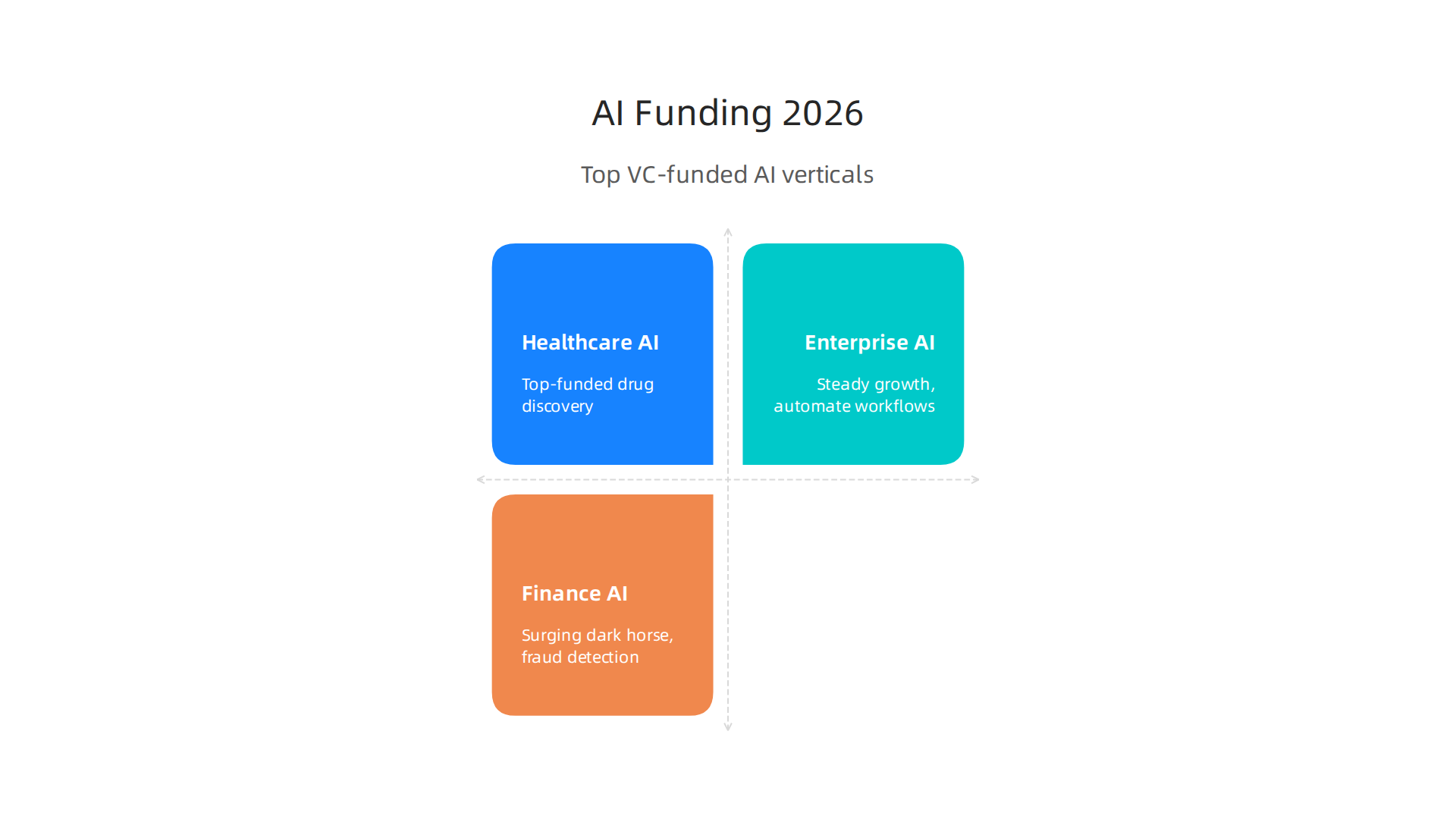
and each one has a different risk profile for investors in businesses watching the space.
Healthcare AI: The top-funded vertical
Healthcare AI is the clear leader. According to top VC firms and industry reports, AI now makes up about 46% of all healthcare venture capital investment. In 2025 alone, nearly $18 billion went into US and European healthcare AI companies. That number is on track to grow in 2026. The SVB 2026 Healthcare report showing AI’s dominance in VC notes that the largest healthcare AI deals are now $300 million or more, a new bar that signals how capital-intensive this sector has become.
The biggest winners are drug discovery and diagnostics. Companies using AI to speed up clinical trials or spot diseases earlier are pulling in the most attention from venture capital one funds and growth-stage investors alike. Biopharma AI alone saw more than $5 billion in investment in 2024, and that number jumped significantly in 2025. For investors in businesses, the healthcare AI space offers regulatory tailwinds that other verticals cannot match. The FDA is creating clearer pathways for AI-based medical devices and diagnostics, which reduces some of the execution risk.
Enterprise AI: The steady growth engine
Enterprise AI is different. It does not get the same mega-round headlines as healthcare, but it gets broad, consistent adoption. Every company in every industry is looking for ways to automate workflows, improve customer service, and cut costs with AI. According to the Digital Health Investors report on who is writing checks, capital in this space has become more evidence-driven and tied to measurable ROI. That is actually good news. It means companies that show real productivity gains get funded.
For alpha capital and growth-stage investors, enterprise AI represents the safest bet. The market is proven. The buyer demand is real. And the tools are getting cheaper to build. The challenge is differentiation. Hundreds of enterprise AI startups are chasing the same customers, so the ones that win tend to have deep domain expertise and existing distribution. If you want to understand how private money is flowing into this space, the analysis of private equity AI deals hitting record levels offers a useful breakdown of the latest trends.
Finance AI: The surging dark horse
Finance AI is the surprise sector of 2026. As fintech and AI converge, funding is flowing into fraud detection, robo-advisors, and automated compliance tools. Banks and financial institutions are under pressure to modernize. AI gives them a way to do it without replacing their entire legacy infrastructure. The healthcare AI startup funding analysis from New Market Pitch shows a related pattern: even though the report focuses on healthcare, its finding about capital efficiency applies across sectors. Investors are demanding evidence before writing large checks, and finance AI startups that can show real fraud reduction or cost savings are getting funded fast.
For investors in businesses, finance AI offers a unique mix of regulatory moats and high switching costs. Once a bank integrates an AI fraud detection system, swapping it out is painful. That creates sticky revenue and predictable growth.
If you want to track the latest funding rounds across all three of these sectors, a dedicated intelligence source helps cut through the noise. Get clear daily AI updates from The AI Newsletter Worth Reading to see where capital is moving and which startups are gaining ground.
Building a Resilient AI Portfolio: Risk and Reward Strategies for Investors in Businesses
Knowing where the capital flows is just the starting point. The real challenge for investors in businesses is building a portfolio that survives market swings and delivers real returns.
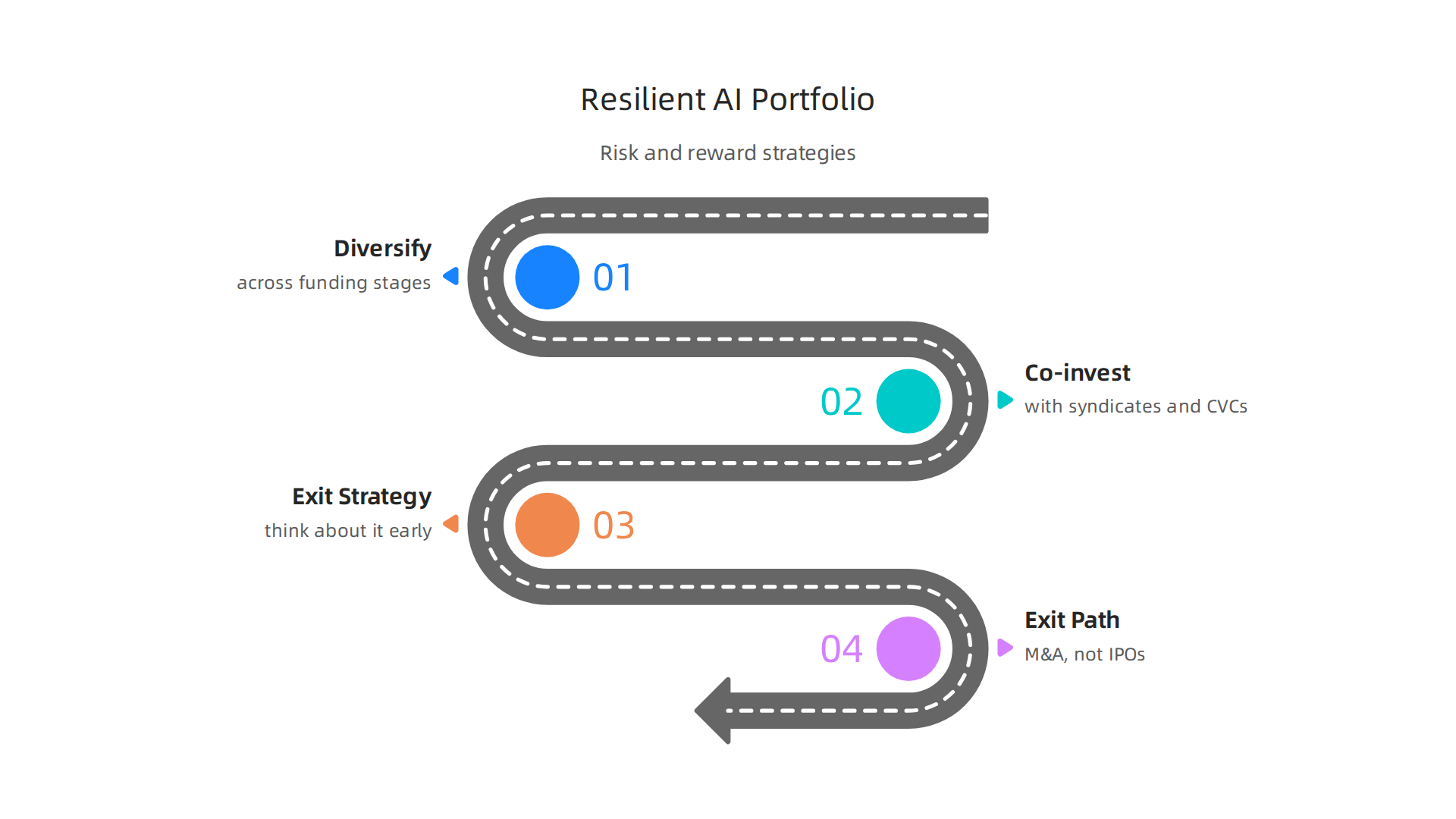
AI investing in 2026 requires more than just picking the hottest sector. It requires a strategy that balances risk across stages, leverages smart partnerships, and keeps the exit path in clear view from day one.
Diversify Across Funding Stages
The biggest trap in AI investing is putting all your capital into one stage. The companies raising $100 million mega-rounds are different from the ones raising $2 million seed rounds. Each stage carries its own risk profile.
Seed stage AI startups are high risk but offer the highest potential returns. You are betting on a team and a vision before there is much data to measure. Late stage AI companies, on the other hand, have proven product market fit and real revenue but may have limited upside if their valuation is already inflated.
For investors in businesses, a balanced approach means allocating across stages. The AI startup funding stages guide showing typical sizes and investor expectations explains how seed rounds traditionally range from $500,000 to $5 million, while growth stage rounds can reach $30 million or more. Putting a portion of capital into early stage bets and another portion into later stage, more proven companies reduces the risk of a single investment wiping out your portfolio.
Co-invest With Syndicates and CVCs
Going it alone in AI is getting harder. The biggest rounds are dominated by a small group of top VC firms and corporate venture capital arms that have deep domain expertise and deal flow access.
Co-investing with syndicates or CVCs gives you two advantages. First, you get access to deals you would never see on your own.

Many AI startups prefer to work with a lead investor who can add strategic value, not just write a check. Second, you share the risk. When a syndicate does the due diligence and negotiates terms, you benefit from their research without having to do all the work yourself.
Venture capital one funds are increasingly syndicating deals to smaller investors who bring specific industry knowledge. If you know healthcare, for example, partnering with a healthcare focused CVC can give you an edge in evaluating medical AI startups. For practical guidance on finding these partners, the resource on how to find strategic AI startup funding partners in 2026 offers a useful road map.
Think About Exit Strategy Early
Here is something that surprises many new investors in businesses. The exit strategy matters before you write the check. In 2026, most AI startup exits will come through M&A, not IPOs. Public markets remain selective, and only the largest AI companies have a realistic path to going public.
This changes how you evaluate investments. If the most likely exit is an acquisition, you need to ask different questions. Who would buy this company? What would they pay? How long will it take to reach an exit size that makes sense for your fund?
The venture capital return expectations analysis covering IRR and exit timing shows that the best performing funds focus on realizable exits and cash distributions, not just paper valuations. A startup with impressive revenue growth but no clear buyer is riskier than one with moderate growth and a strong strategic fit with three potential acquirers.
Alpha capital investors have learned that patience matters. AI companies take time to build defensible moats. The ones that rush to exit often leave value on the table. The ones that build slowly, with deep enterprise relationships and proprietary data, command premium prices when they do sell.
Building a resilient AI portfolio is not complicated, but it requires discipline. Diversify across stages. Co-invest with partners who know the space. And always know how and when you plan to exit before you write the check.
Summary
This article maps the 2026 AI funding landscape and gives practical guidance for investors in businesses who want to separate hype from durable opportunities. It explains the headline numbers—record global VC ($330.9B in Q1 2026) with AI capturing over 80%—and breaks down three structural shifts: mega-round concentration, geographic spread beyond the U.S., and growing corporate VC influence. You will learn the specific evaluation criteria VCs now demand (data moats, model defensibility, talent depth, and compute economics), high-signal ways to find winners early (networks, public research, micro-seed rounds), and which sectors—healthcare, enterprise, and finance—are attracting the most capital. The guide also lays out portfolio tactics (stage diversification, co-investing, and exit focus) and practical due diligence steps you can apply when evaluating or sourcing AI deals in 2026.