

Private Equity AI Deals Hit Record Levels in 2025 and the Trends Shaping 2026
Overview
Introduction: Decoding the Private Equity Guy in AI
Picture this. You read about a hot AI startup raising $200 million. The press release mentions a "private equity guy" or a big name like CVC Capital Partners. But what does that actually mean for you, the founder, investor, or executive trying to understand who is backing the next wave of artificial intelligence?
Here is the truth. The private equity guy is one of the most powerful yet most misunderstood players in the AI funding ecosystem today.

These firms control massive pools of capital. They shape strategy at the companies they back. And their influence is growing fast.
But tracking who is writing checks and why is surprisingly hard. Information is scattered across dozens of sources. News moves at lightning speed. And the difference between a PE-backed deal and a VC-backed deal matters more than most people realize.
That is where this article comes in. We are cutting through the noise to give you a clear, data-driven snapshot of the private equity landscape in artificial intelligence. You will learn who the key players are, where the money is flowing, and how to evaluate the deals that matter most.
The numbers tell a compelling story. According to the Private equity: AI deals report from With Intelligence, deal volume reached 589 transactions in 2025, up 57% from the year before.
AI now accounts for more than 7% of all deal activity. Meanwhile, the Global Private Equity Report 2026 from McKinsey shows that PE deal value rebounded sharply, increasing 19% to $2.6 trillion in 2025. The technology sector saw a 29% increase in buyout deal value alone.
So yes, the private equity guy is not some shadowy figure. He is active, strategic, and pouring serious capital into AI. And if you want to understand where this market is heading, you need to understand his playbook.
We will walk through the major firms, the trends shaping 2026, and the signals that separate smart bets from hype. For a deeper look at how top investors like Thrive Capital evaluate opportunities, check out our breakdown of Thrive Capital’s playbook for AI startup investing.
This is your guide to decoding the private equity guy in AI. Let us get started.
Want daily AI intelligence that actually cuts through the noise? Get clear updates straight to your inbox with The AI Newsletter Worth Reading from The Deep View.
Who Is the ‘Private Equity Guy’ in AI? Defining the Profile
When you hear "private equity guy" in the AI world, what picture comes to mind? Is it a Wall Street type in a suit? A former tech operator who now writes big checks? The truth is a mix of both.
The private equity guy in AI is rarely a pure finance person.
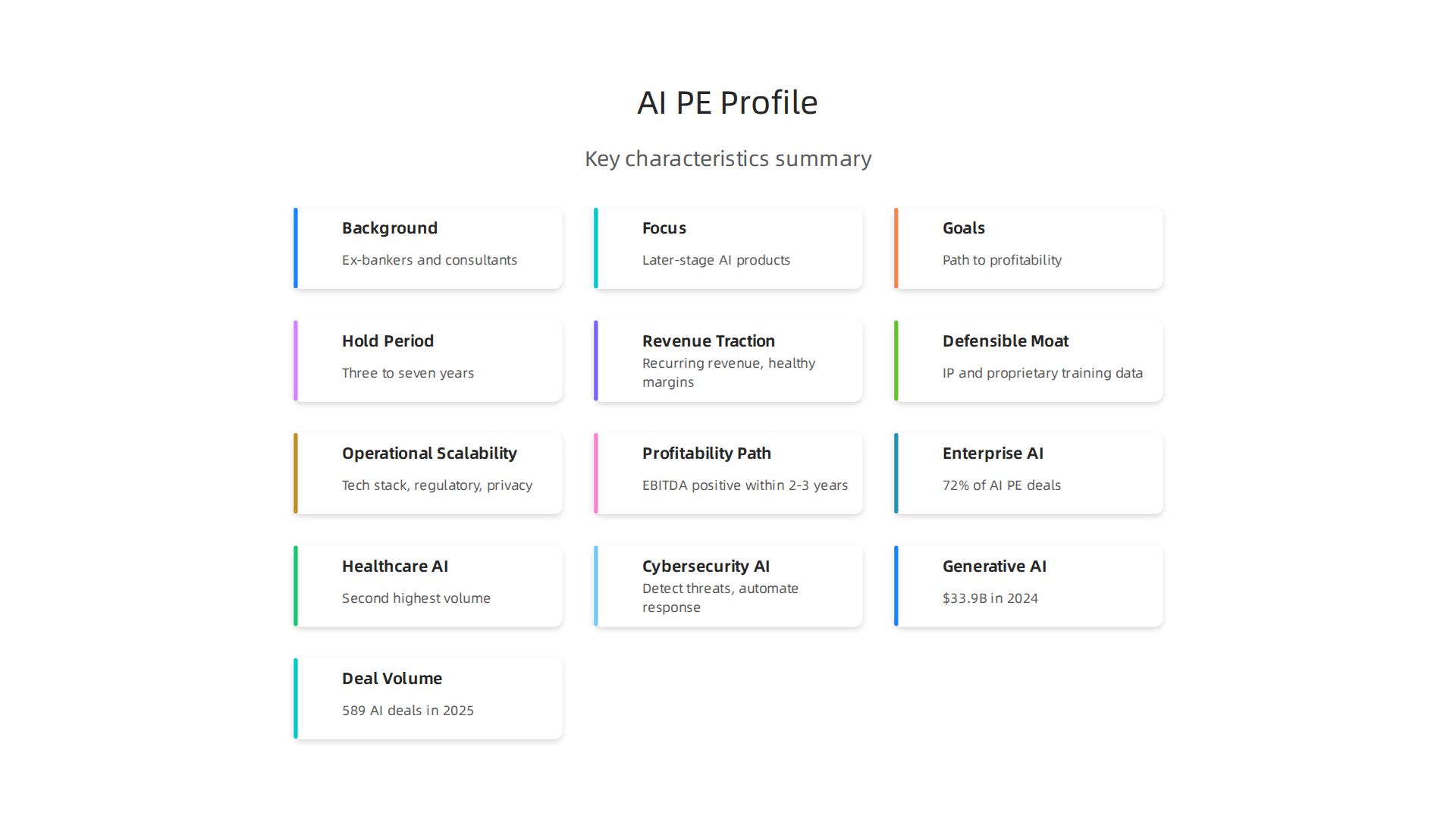
Most started as investment bankers, management consultants, or corporate development specialists. They spent years building financial models, analyzing companies, and executing deals. Then they moved into private equity, where they learned to run businesses, not just buy and sell them. According to a Private Equity Career Path overview, PE professionals typically hold degrees in finance, economics, or business from top universities, and many earn an MBA or CFA certification along the way.
That background matters because it shapes how they invest in AI. Unlike venture capitalists who take early bets on unproven ideas, the private equity guy prefers later-stage AI companies. He looks for startups that already have a working product, real customers, and proven revenue. He wants to see a clear path to profitability, not just user growth.
Why does this matter to you? If you are a founder, knowing this profile helps you tailor your pitch. You do not need to sell the vision in the same way you would to a VC. You need to show unit economics, operational metrics, and a realistic growth plan. The PE guy is thinking about operational improvements and multiple expansion over a three to seven year hold period. He is patient but demanding.
Firms like CVC Capital Partners, Cerberus Capital Management, and Arrowstreet Capital exemplify this style.
They operate with dedicated teams of operators who work directly with portfolio companies to improve margins, expand into new markets, and build scalable tech infrastructure. Equity research firms often feed these firms with deal flow, so understanding how PE analysts evaluate AI businesses can give you an edge in positioning your company.
If you want to see how this thinking applies to evaluating early-stage opportunities, check out our guide on how to validate AI startup ideas and build with calculated risk. It walks through the same kind of disciplined analysis that PE professionals use.
So the next time you hear someone mention a "private equity guy" in an AI deal, remember: this is not just a financial engineer. This is a seasoned operator with a long-term plan. And he has very specific criteria for the companies he backs.
The Landscape: Key Trends in PE Investment in AI (2026)
The private equity guy is not just talking about AI. He is putting real money to work. And the numbers from 2025 and 2026 show a clear pattern.
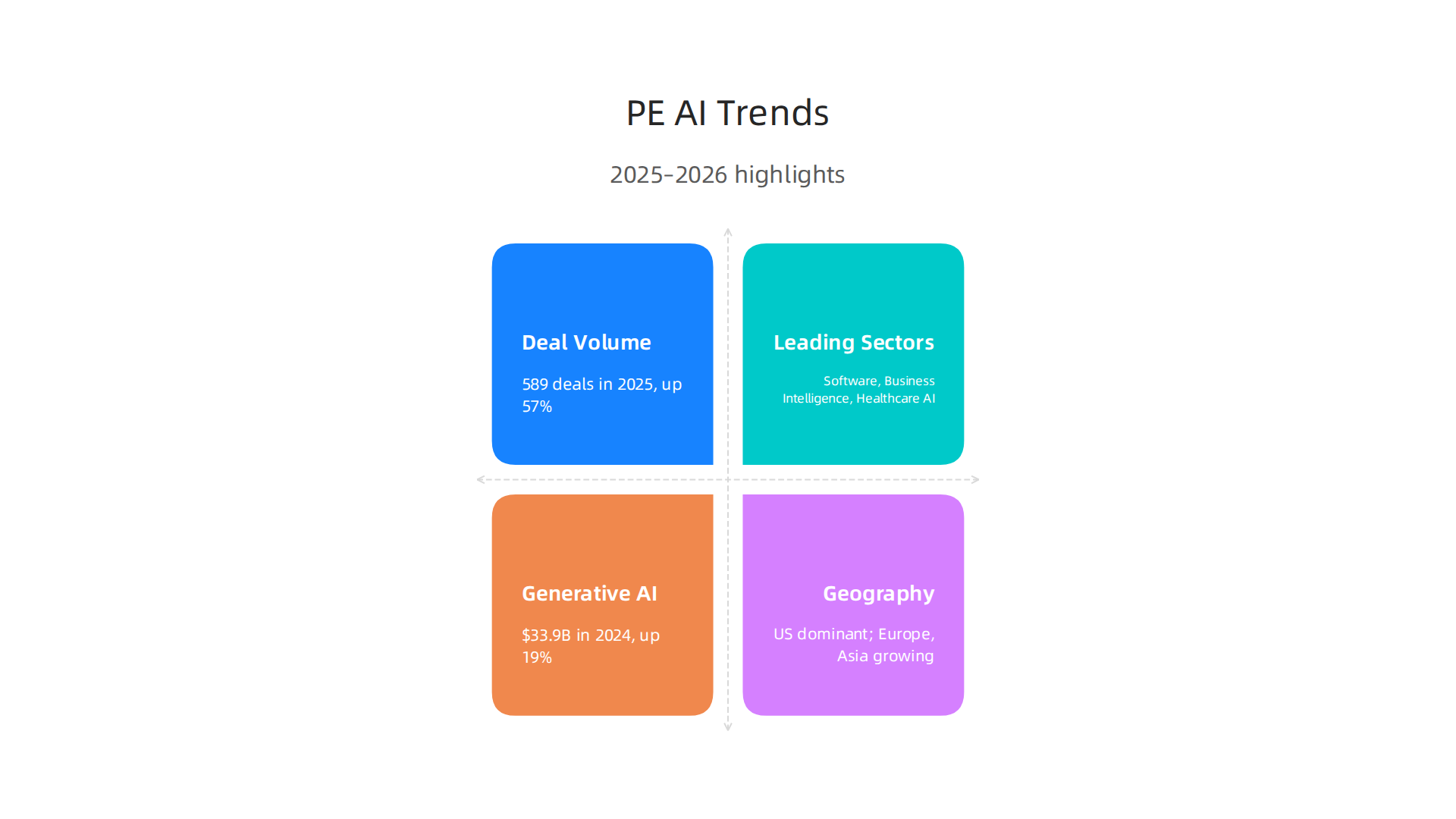
Deal volume is exploding. In 2025, PE firms completed 589 AI-related deals. That is a 57% jump from the 375 deals in 2024, according to a recent analysis of Private Equity AI deals. By 2025, AI already accounted for more than 7% of all PE deal activity. And the momentum is not slowing. In the first half of 2026, even though total deal count dropped, the average deal size nearly quadrupled. PE firms are concentrating capital on fewer but bigger bets. The companies that get funded are receiving much larger checks.
Which sectors are getting the most attention? Software leads by a wide margin. Business intelligence tools and process automation software are the biggest sub-industries within AI. Companies that help other businesses run smarter and faster are hot. Healthcare is another huge area. AI-driven diagnostics, drug discovery, and patient management systems are attracting record investment. Autonomous systems and robotics also rank high. Investors see massive potential in self-driving tech, warehouse automation, and industrial robots.
In 2024, private investment in generative AI alone hit $33.9 billion, up nearly 19% from 2023. That was over 8.5 times the level in 2022, according to the 2025 AI Index Report from Stanford HAI.

Generative AI now represents more than 20% of all AI private investment.
Geography matters too. The United States is still the dominant player. US private AI investment reached $109.1 billion in 2024, nearly 12 times China’s total and 24 times the UK’s. But Europe and Asia are catching up fast. Deal activity in those regions is accelerating as local PE firms build their own AI capabilities.
This landscape tells you something important. The private equity guy is not spreading small bets everywhere. He is picking winners in specific sectors and backing them with large sums. If you want to position your startup to catch his eye, understanding these trends is your first step.
For a deeper look at how top investors evaluate AI companies, check out the Thrive Capital’s playbook for AI startup investing. It walks through the same disciplined approach PE firms use.
And if you want daily intelligence on the AI funding landscape, you need The AI Newsletter Worth Reading. Get clear daily AI updates from The Deep View Newsletter. It cuts through the noise and delivers the deals and trends that matter, straight to your inbox.
Top Private Equity Firms Reshaping AI (2026)
So who are the key players actually writing these big checks? Knowing the names and strategies of the most active firms can save you months of wasted outreach.
The top private equity firms investing in AI are a mix of traditional mega-funds and newer specialists. According to a recent breakdown of the most active private equity investors in AI, Insight Partners leads the pack with the highest number of AI-related investments since 2013. CPP Investments, Thoma Bravo, and General Atlantic also rank near the top. These firms have made at least five AI deals each, and many have done far more.
But deal count is only half the story. The real action in 2025 and 2026 is about deal size. Mega-funds like Blackstone, KKR, Apollo, and Carlyle are putting massive capital to work. In May 2026, Blackstone joined TPG and SoftBank to back OpenAI’s new deployment company with $4 billion. That is not a small bet. That is a signal.

As noted in the Global M&A trends in private capital: 2026 mid-year outlook from PwC, these firms are forming direct partnerships with AI leaders like OpenAI and Anthropic to deploy AI across their portfolio companies.
At the same time, specialist PE firms focused only on AI are emerging. They move faster, understand the technology deeper, and often write smaller checks to earlier-stage companies. This creates two distinct paths for founders. If you need a $50 million growth round, you target the mega-funds. If you want a $5 million partnership with hands-on operational support, you target the specialists.
Here is what matters most for fundraising. Every firm has a sector focus. Thoma Bravo goes after software and tech-enabled services. Insight Partners targets high-growth software companies. Warburg Pincus leans toward industrials and healthcare. If you try to pitch a healthcare AI startup to a firm that only does fintech, you will waste your time.
Understanding each firm’s average check size, sector preference, and stage focus is your real competitive advantage. For a deeper dive into matching your startup with the right capital partner, learn to decode CEO announcements for real AI startup funding insights. It gives you a practical framework for reading between the lines of funding news.
The private equity guy you want to meet already has a clear thesis. Your job is to show him how your company fits perfectly inside it.
How PE Firms Evaluate AI Startups: A Framework
So you know who the key players are. Now you need to understand what goes through that private equity guy’s mind when he looks at your AI company. It is very different from how a VC thinks.
VCs bet on potential. They love a great story, a brilliant team, and a massive market. They are okay with zero revenue as long as the vision is bold.
A private equity guy is not wired that way. He has a much stricter checklist. Here are the three big things he cares about most.
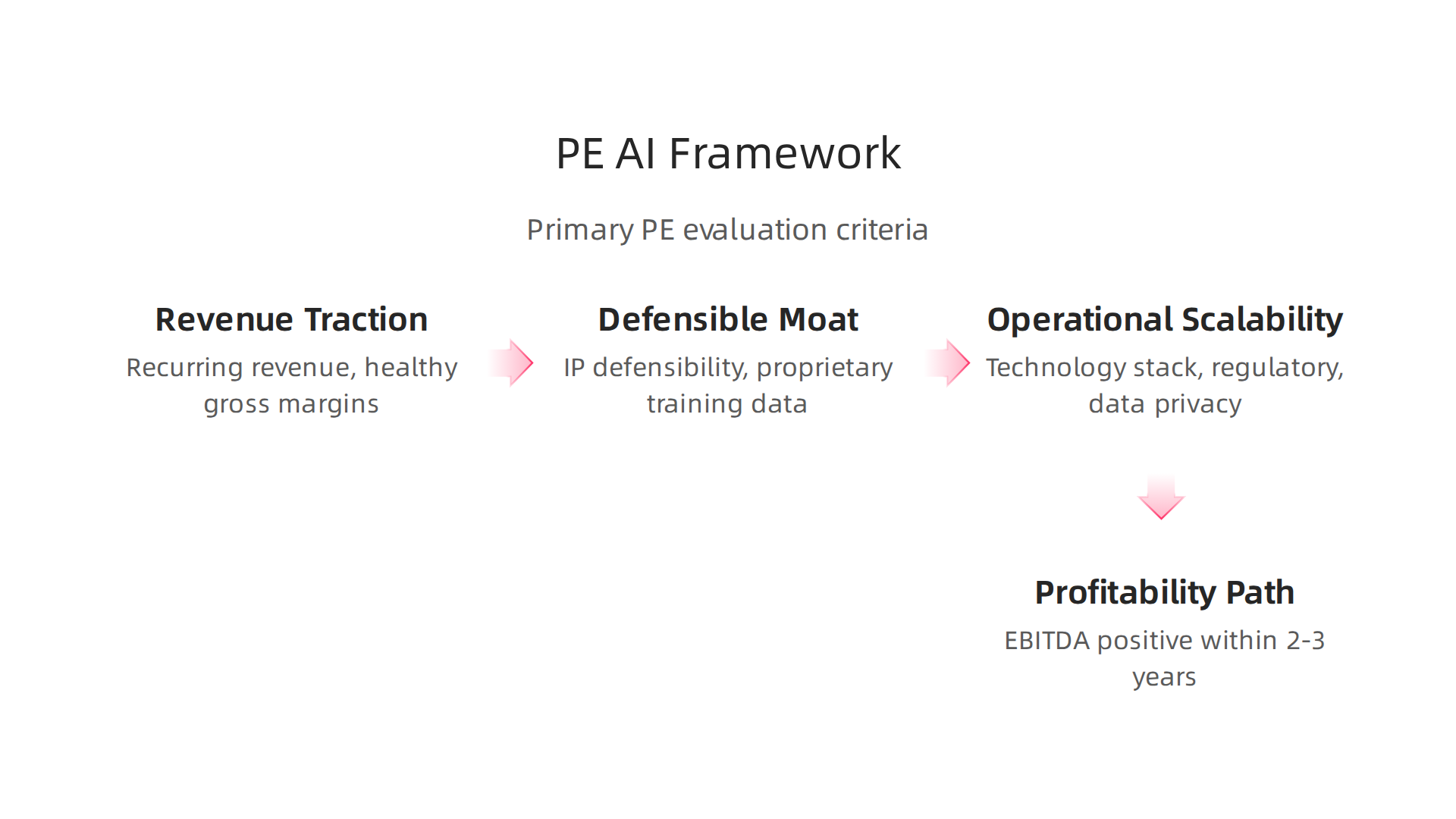
First, revenue traction is everything. PE firms want proof that customers will pay you real money. They are not interested in a prototype or a beautiful deck. They want to see recurring revenue, healthy gross margins, and a clear sales motion. If you do not have at least a few million dollars in annual recurring revenue, most PE firms will not take a meeting. They are looking for businesses that have already found product-market fit.
Second, they need a defensible moat. Raw innovation is exciting, but it fades fast. What protects your company from the next hot startup? The number one thing PE firms look for is intellectual property defensibility. According to recent analysis of how AI startups are actually valued, IP defensibility accounts for 30 to 40 percent of the valuation gap between companies with the same revenue. That means patents, proprietary training data, and documented know-how matter more than your growth rate. A private equity guy will dig deep into whether you own your core technology or just use someone else’s API.
Third, operational scalability is non-negotiable. PE firms are not buying a science project. They are buying a business they can grow and eventually sell. This means they run a serious due diligence process. They will audit your technology stack, check how dependent you are on your top five customers, and evaluate every regulatory risk specific to your AI application.

They ask hard questions about data privacy, model bias, and compliance with new AI laws.
And here is the most important number for your planning: most PE firms want a clear path to EBITDA positivity within two to three years. They are not patient like VCs. They expect you to be disciplined with spending and focused on profitability.
If you want to understand more about building the kind of AI company that passes this PE test, check out this practical guide on how to validate AI startup ideas before raising capital. It gives you a step-by-step process for proving your business model works before you pitch.
Understanding this framework is your secret weapon. When you walk into that meeting, you are not just pitching your technology. You are showing the private equity guy exactly how you fit inside his checklist.
If you want to keep a pulse on which PE firms are actively deploying capital into AI and spot new investment patterns, stay informed with The AI Newsletter Worth Reading. It gives you daily updates on real funding activity so you never miss a shift in the market.
Sector Focus: Where PE Capital Is Flowing in AI
Now you know what a private equity guy looks for in a deal. But here is the next question every founder asks: where exactly is the money going?
You don’t want to build something that has no buyers. You want to aim at the sectors where PE firms are already writing checks. And the data from 2025 makes the answer crystal clear.
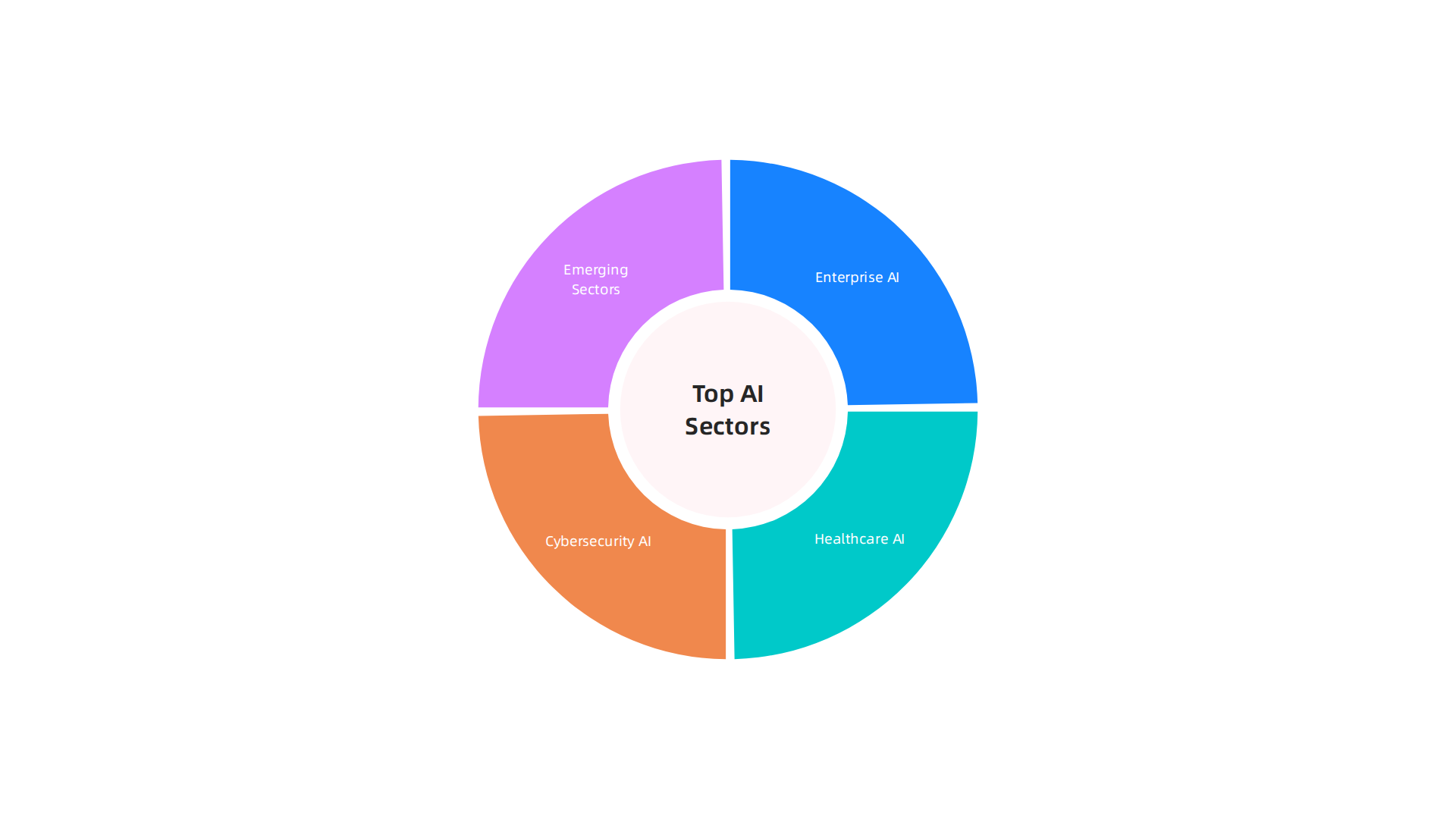
Enterprise AI leads by a wide margin. If you look at the overall deal activity between 2021 and 2025, software companies captured 72 percent of all AI-related private equity deals in North America. That is not a small edge. It is total dominance. Within software, business intelligence and process automation tools saw the most action. According to the latest analysis of private equity AI deals, deal volume in that sub-industry alone in 2025 exceeded the total of the top five sub-industries combined from any single year between 2021 and 2024. The message is loud and clear: PE firms want AI that helps existing businesses run faster, cheaper, and smarter.
Healthcare AI is the second big play. It is a different kind of investment though. Healthcare deals tend to be smaller on average, but they are steady and growing fast. The sector saw the second-highest number of AI-related transactions by volume. The catch is that healthcare AI is capital intensive. You need regulatory approvals, clinical validation, and strong data partnerships. That makes it a better fit for larger buyout funds rather than smaller growth equity shops. If you are building in this space, you need to show a private equity guy that you have already navigated HIPAA and FDA risk.
Cybersecurity AI remains a magnet for PE capital. Every business on earth is terrified of data breaches. AI tools that detect threats in real time, automate incident response, and scan for vulnerabilities are in high demand. Cybersecurity startups with strong AI defenses attract premium valuations because the moat is real: proprietary threat data, trained models, and sticky enterprise contracts.
Emerging sectors are heating up too. Climate tech AI and robotics are gaining serious traction. The Robotics and Hardware segment actually ranked second by total deal value in the first half of 2025, even though it ranked fourth by deal count. That means when PE firms do invest in robotics AI, they write much larger checks. Autonomous vehicles, warehouse automation, and industrial inspection robots are the big draws here.
If you want to see which specific companies and funds are leading these trends, check out this breakdown of the top AI companies shaping 2026 markets. It gives you a clearer picture of which subsectors have the most momentum right now.
The bottom line for you: pick a sector where PE has already shown interest. Do not try to pioneer a category that has zero deal history. Align your startup with the sectors that the market has already validated.
Tracking PE Activity: Tools, Data Sources, and Intelligence
Once you know which sectors are hot, the next step is learning how to track where the money is moving in real time. You can’t make smart decisions if you’re relying on old news. A private equity guy doesn’t guess where capital is flowing. He uses dedicated tools, databases, and signals that give him an edge. You can do the same thing.

The most powerful tools are paid databases. Platforms like PitchBook, Crunchbase, and S&P Capital IQ give you detailed data on deals, valuations, and investor activity.
These are the industry standards for a reason. PitchBook alone is described as a robust private markets database with visibility into PE, VC, M&A, and fundraising. It tracks millions of deals and helps you spot trends before they become obvious. If you’re serious about following PE activity, getting a subscription to one of these platforms is worth the investment. Even a quick weekly scan of new deals in your target sector can tell you which firms are writing checks and what they are paying.
But not everyone has a budget for expensive data subscriptions. That is where free and low-cost sources come in. Curated newsletters are a great alternative. The Deep View Newsletter delivers a daily snapshot of AI funding rounds and technology trends straight to your inbox. It is a fast way to stay on top of which startups are raising money and which investors are leading the charge. For a free daily dose of curated AI funding news, subscribe to The Deep View Newsletter. It is one of the simplest ways to keep your finger on the pulse without digging through dozens of websites every morning.
Beyond databases and newsletters, you can set up your own intelligence network. Custom alerts on platforms like Google News, Crunchbase, or even Twitter can flag new deals in seconds. Follow partners at major PE firms like CVC Capital Partners, Cerberus Capital Management, and Arrowstreet Capital on LinkedIn. These partners often share portfolio news, hiring announcements, and even deal theses publicly. Watch for patterns. When a firm you follow starts hiring for a specific AI vertical, it is often a sign that capital is about to flow in that direction.
You can also learn a lot by studying how specific funds operate. For example, take a look at Thrive Capital’s playbook for AI startup investing. Understanding how one successful firm thinks about valuation, team quality, and market timing gives you a framework for evaluating other investors.
The key is to build a routine. Spend 15 minutes each morning scanning deal announcements, newsletter updates, and social feeds. Over time, you will start seeing the same names and themes emerge. That is when you know you are ahead of the curve.
Summary
This article decodes the growing role of private equity in artificial intelligence, explaining who the