

Study AI in 2026 with a Proven Roadmap to Cut Through the Noise
Overview
Introduction
You want to study AI in 2026. Maybe you are a professional who needs to keep up. Maybe you want to develop startup ideas. Or maybe you are curious about artificial intelligence 1956 origins and how far the field has come. Whatever your reason, one thing is clear: the pace of change is staggering.
In just the first quarter of 2026, global venture funding for AI startups hit $242 billion — 80% of all venture capital dollars that quarter. Four frontier labs alone raised $188 billion combined. The money is flowing because breakthroughs are happening monthly, not yearly. New reasoning models, physical AI robots, and agentic workflows are moving from research labs into real businesses faster than most people can track.
That speed creates a real problem. Information overload is real. You open one article, then another, then a YouTube video, then a LinkedIn post. Soon you have sixteen tabs open and no clear path forward. You waste hours sifting through noise. And you still do not know what actually matters for your goals.
That is where this guide comes in. We built it for people like you who want a structured way to study AI without getting lost. You will learn the foundations first — the core concepts, the history, the key algorithms. Then you will understand the funding landscape so you can spot real opportunities. Along the way, we point you to proven resources, including a practical roadmap that shows you how to learn AI in 2026 with a proven six month plan.
As we move through each section, keep one thing in mind: the best way to cut through the noise is to focus on structure over speed.

Start with the fundamentals, build your mental model, then layer in the market trends. This article gives you exactly that path.
And if you want a daily dose of clear, no fluff AI updates that help you stay ahead without the overwhelm, consider subscribing to The AI Newsletter Worth Reading.
It delivers the essential stories straight to your inbox so you can keep learning without the clutter.
Let us begin with the foundations. What is AI, really, and where did it come from?
Decoding AI: Essential Knowledge Areas and Terminology
What is AI, really? The best way to answer that question is to start with its main branches. When you study AI systematically, you do not jump straight into the hype. You build a clear mental map first.
That map starts with five core areas.
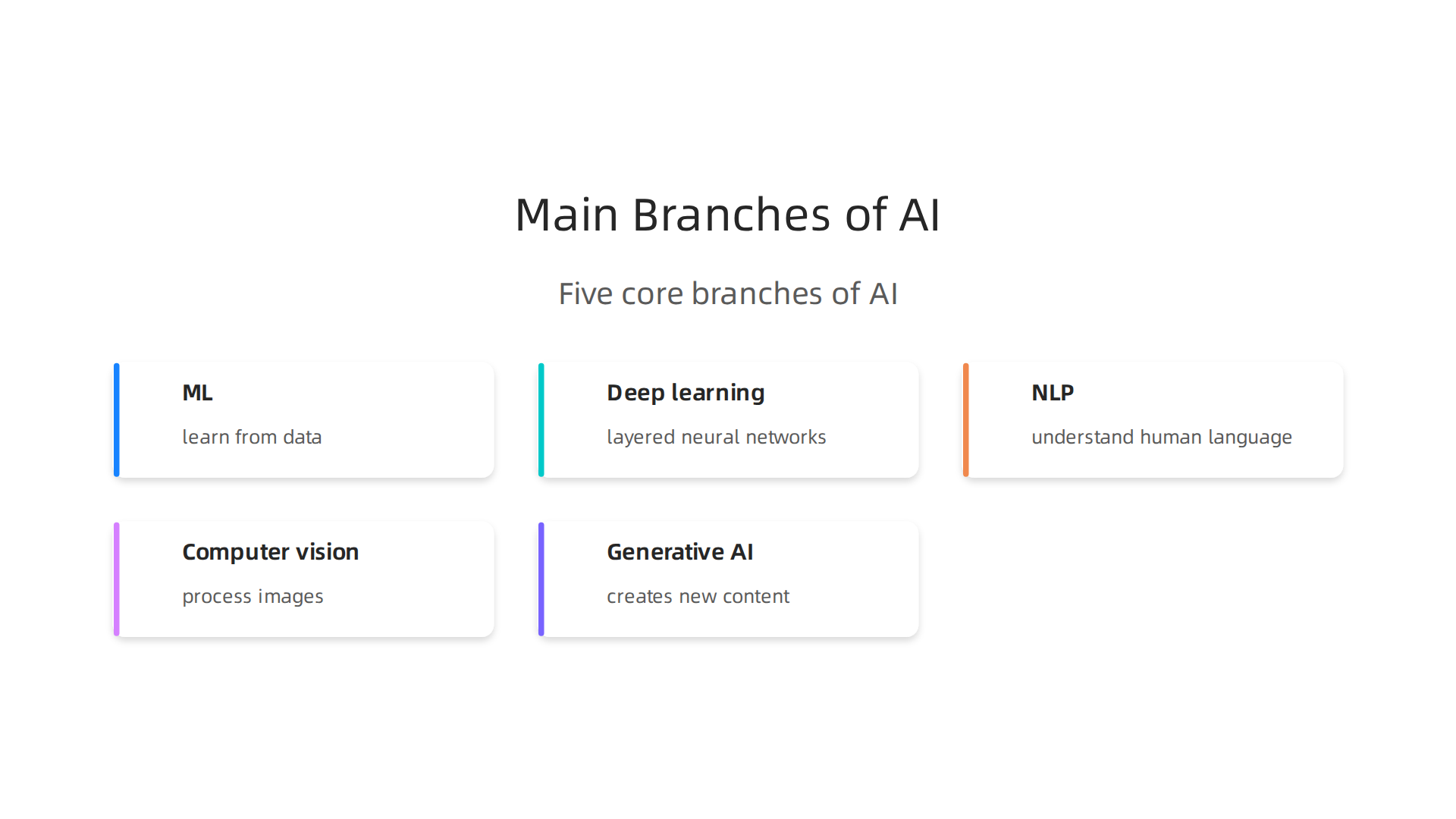
The Main Branches of AI
Machine learning (ML) is the foundation of modern AI. It teaches computers to learn from data without being programmed with every rule. Most of what we call AI today is really ML under the hood.
Deep learning takes ML further. It uses layered neural networks to find patterns in huge datasets. This is what powers speech recognition, image classification, and the large language models you hear about every day.
Natural language processing (NLP) lets computers understand and generate human language. Every chatbot, translation tool, and voice assistant you use relies on NLP to work.
Computer vision allows AI to process images and video. It identifies objects, faces, and scenes. Self-driving cars and medical imaging tools depend on this technology.
Generative AI creates new content. Text, images, code, music. Models like GPT-4o and Claude are generative. This branch has grown faster than any other in the last two years.
Terms You Will Hear Constantly in 2026
Once you know the branches, certain terms appear in every funding announcement and technical discussion.
Foundation models are giant AI models trained on massive datasets. They act as a starting point you can adapt for specific tasks. Most modern AI products build on a foundation model.
Transformers are the architecture that made these models possible. They process entire sequences of data at once instead of word by word. This is why modern AI feels so natural and fluent.
Fine-tuning means taking a pre-trained model and training it a bit more on your own data. It makes the model better at a specific job, like answering customer support questions for your business.
RAG stands for retrieval augmented generation. It lets a model pull in fresh information from a database before answering. This keeps answers accurate without retraining the whole system.
Why does this shared vocabulary matter? Because when you study AI with the right terms, you can read funding news with confidence. You can spot which companies solve real problems and which are just chasing hype. And you can develop startup ideas that are grounded in actual technical capability instead of buzzwords.
The shift from individual AI tools to team-wide coordination is one of the big developments in 2026. You can read more about this and other major trends in this overview of the trends that will shape AI and tech in 2026.
If you want to go deeper on how data, algorithms, and compute power work together, this guide on the three elements of AI explains the engine behind every modern system.
Navigating the Information Maze: How to Filter and Trust AI News
Here is a truth nobody tells you when you decide to study AI. The information coming at you is overwhelming. Every day brings a new model, a new funding round, and a new headline claiming the world has changed forever. Some of it is real. A lot of it is noise.
The worst part? Some news is outright wrong. Hype sells better than reality. So how do you cut through the confusion and find signals you can actually trust?
You need a simple filter. Three questions will save you hours of wasted time.
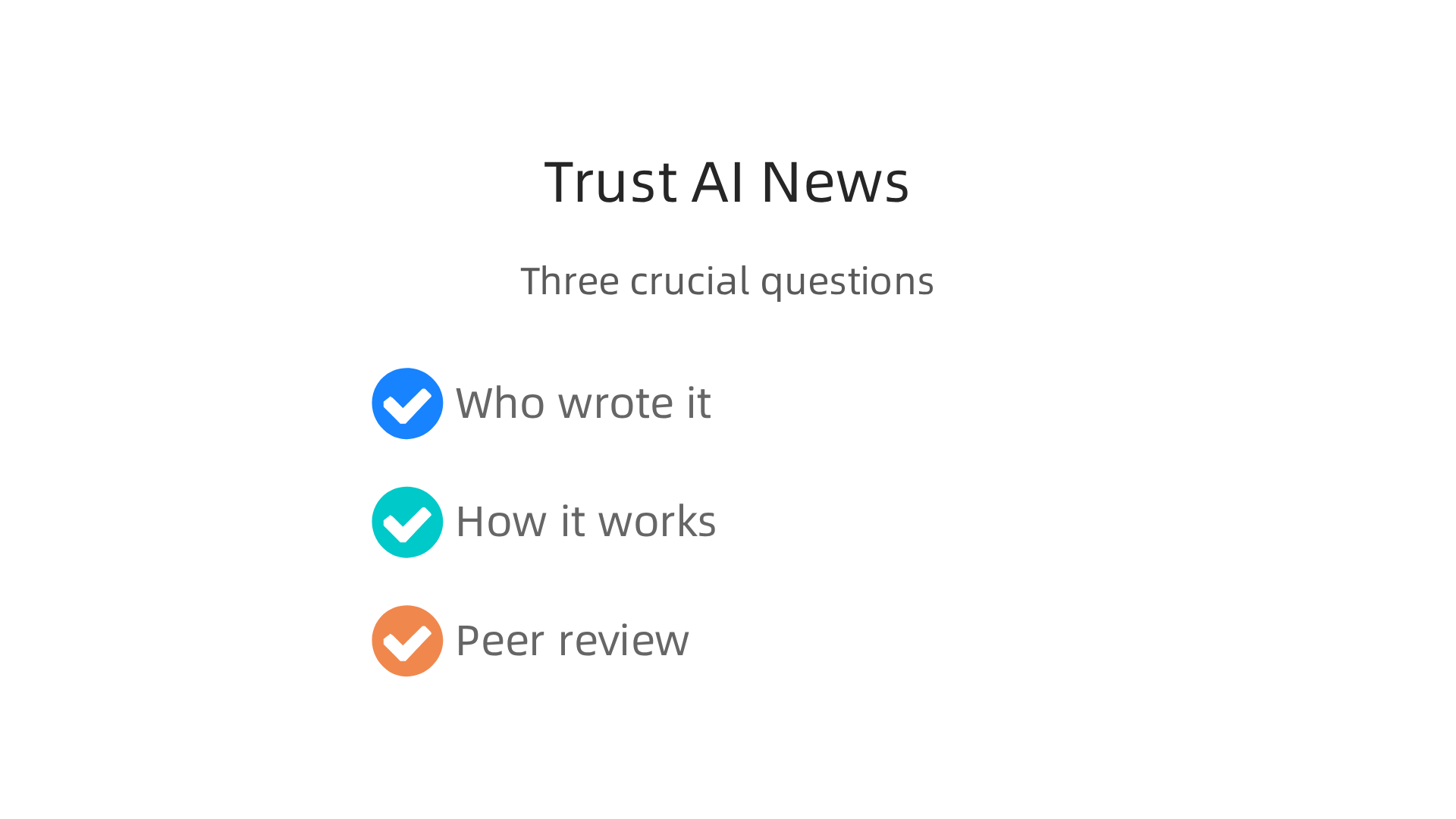
Three Questions to Ask Before You Trust Any AI Story
Who wrote it and why should I care? Look at the source. A reporter at a respected outlet with a track record of covering AI carries more weight than a random blog. The AI news outlets list from CanIPhish names MIT Technology Review as the gold standard for balanced, deeply researched reporting.
That is a good place to start.
Does the article explain how the technology works? Serious journalism walks you through the method. It tells you what data was used, what the model can and cannot do, and who paid for the research. If a story is just breathless claims with no methodology, treat it with suspicion.
Is there independent testing or peer review? The best sources cite specific benchmarks, third party evaluations, or academic validation. If the only source is a press release from the company itself, you are reading marketing, not news.
The Shortcut: Curated Newsletters That Filter for You
You do not have time to evaluate every source yourself. That is where curated newsletters earn their keep. They do the filtering for you.
The 2026 ranking from DataCamp puts The Median by DataCamp at the top for signal quality and editorial depth.

For daily speed, TLDR AI and The Rundown AI both serve bullet proof summaries in under five minutes. If you want deep policy analysis, Import AI by Jack Clark has been running since 2016 and is written by an Anthropic cofounder.
The trick is to pick two. One daily digest for speed, one weekly deep dive for substance. That is enough to stay informed without letting AI news become a second job.
Actually, there is one newsletter that deserves a special mention here. It gives you clear daily updates without the hype spiral. You can check out The AI Newsletter Worth Reading as a practical starting point.
When Hype Costs You Real Opportunities
Bad information does more than waste your time. It can cost you money and misdirect your career.

If you are trying to develop startup ideas, fake AI news can make you chase a trend that is already dead. If you are exploring AI ethics jobs, misleading reporting about a company’s safety practices can send you to the wrong employer. The cost of trusting the wrong source is real.
This is exactly why learning to study AI with the right filters matters so much. The knowledge you build is only as good as the information you feed it.
For more practical help cutting through the overload, this guide on how YouLearn AI cuts through information overload offers a concrete approach to filtering what matters.
Building Your AI Study Roadmap: From Fundamentals to Frontier Research
Now that you know how to cut through the noise and find trustworthy AI news, it is time to build a real study plan. The goal is to go from zero to a solid working knowledge of AI without getting lost. A clear roadmap makes that possible.
The path breaks into four main stages. Each one builds on the one before it.
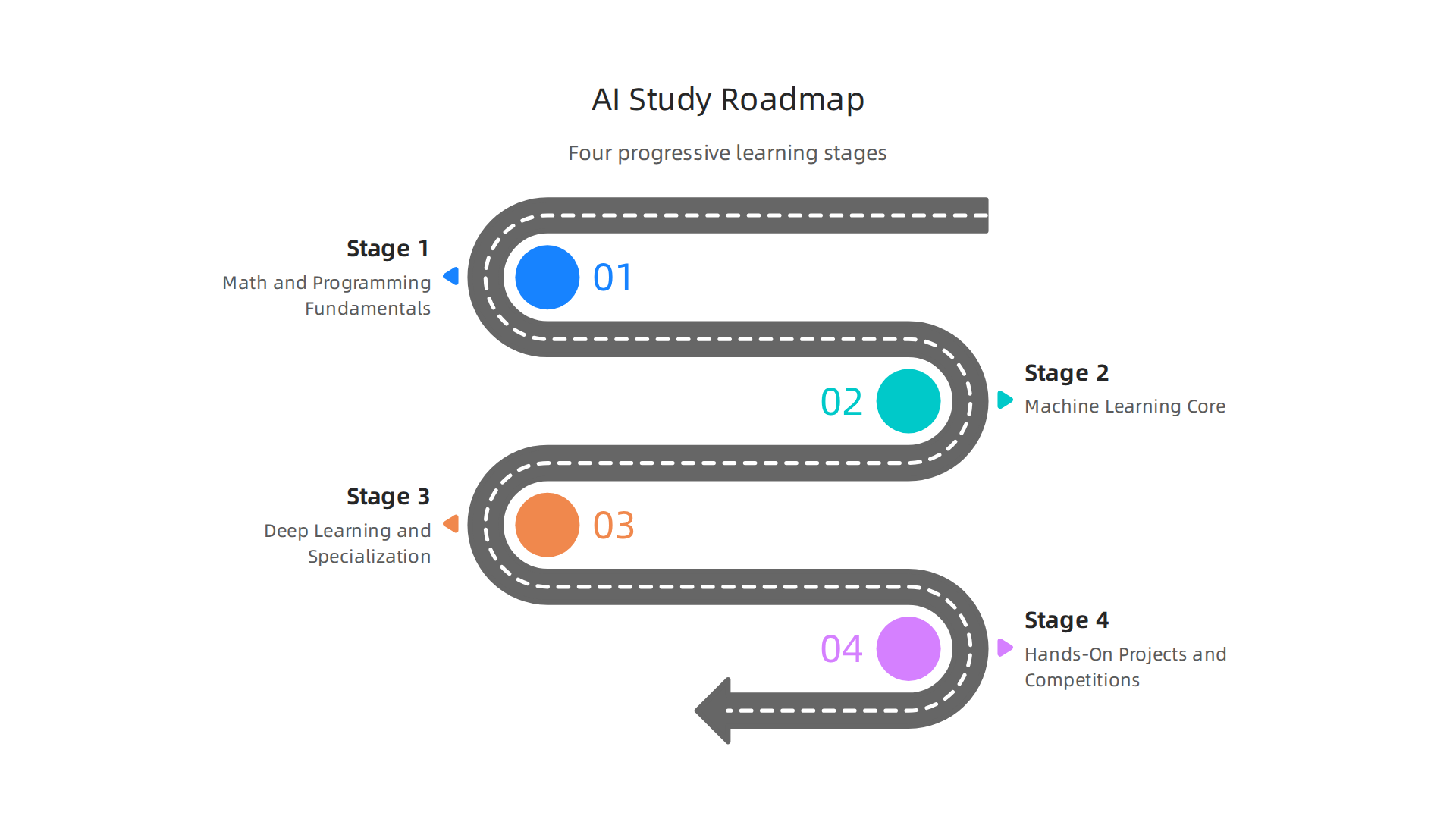
Skip a stage and you will struggle later.
Stage 1: Math and Programming Fundamentals
You do not need a PhD to study AI, but you do need basic math. Focus on three areas:
- Linear algebra – vectors, matrices, and how data transforms
- Calculus – derivatives and gradients (the engine behind learning)
- Probability and statistics – distributions, Bayes’ theorem, and uncertainty
On the programming side, Python is the standard. Learn the basics first. Then practice with libraries like NumPy, pandas, and Matplotlib. You do not need to be a software engineer. You just need to be comfortable writing code to manipulate data.
Stage 2: Machine Learning Core
Once you have the math and Python down, move into machine learning. The best starting point is still Andrew Ng’s Machine Learning course on Coursera. It is free and has taught millions.
You will learn supervised learning (regression, classification), unsupervised learning (clustering, dimensionality reduction), and evaluation metrics. Do not just watch the videos. Implement the algorithms yourself in Python. That is where the real learning happens.
Stage 3: Deep Learning and Specialization
After machine learning comes deep learning. Neural networks, convolutional networks for images, transformers for language. Again, Andrew Ng’s Deep Learning Specialization is a solid choice. You can also try fast.ai for a more practical, top-down approach.
This is also the point where you start reading research papers. Pick one paper a week.

Use tools like NotebookLM or Perplexity AI to summarize and explain them. The Reddit community suggests using AI tutors to break down complex ideas, but warns against over-dependence on AI for creative tasks. A good approach is to use AI to study in 2026 as a learning partner, not a crutch.
Stage 4: Hands-On Projects and Competitions
Theory without practice is useless. Kaggle competitions are the best way to apply what you have learned. Start with the Titanic competition (beginner friendly) and work up to more complex challenges like image classification or NLP tasks.
Build a portfolio of 3 to 5 projects. Share them on GitHub. This is what employers and investors look for when they want to see that you can actually build things.
If you want a detailed week-by-week guide that covers exactly what to study and when, check out this six-month plan to learn AI in 2026. It walks you through each stage with specific resources and milestones.
The key is to stay consistent. Study a little every day. Practice what you learn. And do not be afraid to get stuck. That is how you grow.
The Top Resources for AI Research in 2026: Datasets, Journals, and Communities
You have a study roadmap now. But a roadmap without resources is just a wish. You need data to train on, papers to learn from, and people to ask when you get stuck. Here is where to find all three in 2026.
Key Datasets and Benchmarks
You cannot build AI models without data. The most famous dataset in computer vision is ImageNet, with over 14 million labeled images. It is the benchmark that launched the deep learning boom. For natural language processing, Common Crawl gives you billions of web pages to train large language models. And for evaluating how well a model understands language, GLUE and SuperGLUE are still the standard tests.
If you want ready-to-use datasets for practice, Kaggle Datasets has thousands of free collections sorted by topic. The Hugging Face Datasets library lets you load hundreds of curated datasets with a single line of Python code. This makes experimenting fast and easy.
Peer-Reviewed Journals and Preprint Archives
To study AI at a deeper level, you need to read the original research. The Journal of Machine Learning Research (JMLR) is the top peer-reviewed journal in the field. The NeurIPS proceedings publish the most influential machine learning research each year. Other major venues include ICML, ICLR, and AAAI.
For speed, arXiv is where researchers post their work before peer review. Most new AI papers appear on arXiv months before they hit any journal. You can browse the cs.AI, cs.LG, and stat.ML categories daily to see what is new. With thousands of papers uploaded every month, staying on top of everything is impossible alone. That is why many researchers rely on curated summaries. The Best AI Newsletters to Subscribe to in 2026 rank the top sources that do this filtering for you.
Online Communities for Real-Time Knowledge Sharing
Reading papers in isolation will only take you so far. You need conversations with people who build and research AI every day.

Here are the most active communities in 2026:
- Reddit: r/MachineLearning and r/artificial have daily discussions on new papers, tools, and techniques. You can find threads where researchers debate findings and share reliable sources for AI research recommendations.
- Discord servers: Hugging Face’s Discord is one of the busiest, with channels for beginners and experts alike. Many open-source model projects also run active Discords.
- Hacker News: The comments section is unmatched for critical, real-time analysis of new papers and products.
- Specialized forums: LessWrong and the Alignment Forum dive deep into AI safety and alignment theory.
These communities help you spot new trends early. They also give you a front-row seat to see which approaches are working in practice and how the top AI companies in 2026 are shaping the field.
If you want a single source that delivers clear daily AI updates straight to your inbox so you never miss important research or news, check out The AI Newsletter Worth Reading. It cuts through the noise so you can focus on learning and building.
Following the Money: AI Research Funding and Investor Insights for 2026
If you want to study AI with a practical edge, you need to know where the money is going. Funding trends tell you which technologies are hot, which sectors are growing, and where future jobs will appear. And in 2026, the numbers are staggering.
The Record-Breaking Wave of AI Investment
Investors are pouring more money into AI than ever before. In the first quarter of 2026 alone, global venture funding to AI startups hit $242 billion. That is 80% of all venture capital dollars worldwide. To put that in perspective, a single quarter in 2026 nearly matched all of 2025’s total AI funding. The biggest winners? Frontier labs like OpenAI, Anthropic, and xAI, along with self-driving company Waymo. Those four companies alone raised $188 billion in Q1, which is 65% of global venture investment for the quarter. You can dig into the full breakdown in this report on Q1 2026 venture funding records.
This trend is not slowing down. In 2025, AI startups captured over half of all VC dollars worldwide, up from 34% in 2024. According to an analysis of AI startup stats for 2026, the growth has been massive.
Sectors That Are Attracting the Most Funding
Not all AI areas are getting the same attention. Here are the sectors drawing the biggest checks in 2026:
- Generative AI: Still the star of the show. Frontier labs and LLM developers attracted 41% of total AI investment in 2025.
- Vertical AI: Industry-specific solutions are gaining steam. Companies building AI for healthcare, legal, finance, and defense are seeing strong growth. For example, healthcare AI startups raised billions, and defense tech companies like Anduril raised $2.8 billion.
- Robotics and Autonomous Systems: Robots and self-driving machines captured the largest share of AI deals in 2025 at 11.4%, according to CB Insights.
- Agentic AI: Y Combinator’s Winter 2026 batch had about 60% AI-focused startups, with 41.5% building agent infrastructure specifically.
These sectors are where many new jobs and startup opportunities will appear. If you are learning AI, focusing on one of these areas can give you a head start.
How to Track Funding Rounds and Valuation Trends
You do not need to be an insider to follow the money. Here are practical ways to stay informed:
- Use funding databases: Platforms like Crunchbase, PitchBook, and CB Insights track every major round. You can filter by sector, geography, and investor.
- Read specialized newsletters: Instead of wading through hundreds of press releases, let curated sources do the filtering for you.
- Watch company announcements: When a startup announces a big funding round, read the press release carefully. It will often mention what they plan to build next.
- Follow investors on social media: Many VCs share their thesis and portfolio companies openly. This gives you early signals on what is trending.
For a deeper look at which companies are leading the pack, check out our guide on top AI companies in 2026. It covers the startups and labs that are shaping the future.
Putting It All Together
Understanding AI funding helps you make smarter decisions. If you are a founder, you can align your startup with investor priorities. If you are an operator, you can spot which tools and platforms are gaining traction. If you are just learning, you can focus your study time on the technologies that have real market momentum.
The money is a signal. Learn to read it, and you will always be one step ahead.
If you want a single source that delivers clear daily AI updates straight to your inbox so you never miss important funding news, check out The AI Newsletter Worth Reading. It cuts through the noise so you can focus on learning and building.
Ethics and Safety: The Responsible Researcher’s Foundation
Before you dive into building models or chasing funding rounds, there is one topic you cannot skip: ethics and safety. As you study AI, understanding how to build trustworthy systems is just as important as knowing how to code. In 2026, the demand for responsible AI is reshaping the entire field.
Why Bias and Fairness Matter
Every AI model learns from data. If that data contains hidden biases, the model will reflect and even amplify them. That is why bias detection and fairness metrics are now standard tools in any serious AI project. Transparency is also key. You need to be able to explain how a model reached its decision, especially in high-stakes areas like healthcare, hiring, or lending. Organizations that follow a clear ethical framework are far better positioned to avoid public backlash and regulatory penalties. For a deeper look at the core principles, check out this guide on building a responsible AI framework from Harvard.
Safety Frameworks That Protect Users
Safety in AI goes beyond bias. Researchers focus on three main areas:
- Alignment: Making sure the AI’s goals match human values and intentions.
- Interpretability: Understanding why the model gives a particular output.
- Adversarial robustness: Ensuring the system can resist attacks designed to trick it.
These concepts are not just academic. They directly affect whether a product gets funded, approved, or adopted. If you want to build AI that people trust, start here.
The Regulatory Landscape in 2026
Governments around the world are stepping in. The European Union’s AI Act, for example, classifies AI systems by risk level and imposes strict requirements on high-risk applications. In the US, new executive orders and agency guidelines are pushing for more oversight. This regulatory wave has a real impact on research funding and publication. Labs and startups that cannot prove their models are safe and fair may struggle to attract investment or publish their results in top conferences.
Paying attention to ethics early is not just the right thing to do. It is a smart career move. Roles in AI ethics, governance, and safety are growing fast. If you are looking for ai ethics jobs, these skills give you a serious edge. They also help you develop startup ideas that can actually scale without hitting legal or reputational roadblocks. And if you want to build your knowledge from the ground up, start with our guide on how to build AI strong foundations.
The bottom line: ethical AI is not a buzzword. It is the foundation everything else rests on. Master it early, and you will stand out.
If you want to stay on top of the latest AI developments, including ethics news and regulatory updates, get The AI Newsletter Worth Reading. It delivers clear daily AI insights straight to your inbox so you never miss what matters.
Summary
This guide gives a practical, structured path for anyone who wants to study AI in 2026 without getting lost in hype. It explains the field’s main branches—ML, deep learning, NLP, computer vision, and generative AI—then defines the must-know terms like foundation models, transformers, fine-tuning, and RAG. You’ll get a four-stage study roadmap (math and programming, core ML, deep learning and specialization, then hands-on projects), recommendations for courses and projects, and a week-by-week six-month option to turn learning into tangible skills. The article also shows how to filter AI news with three quick questions, where venture funding is concentrating, which sectors attract investment, and where to find datasets, journals, and active communities. Finally, it covers ethics, safety, and the regulatory landscape so you build responsible, fundable work. After reading, you’ll know what to study first, which resources to trust, and how to turn knowledge into a portfolio and career moves.