

Private Equity AI Funding Hits 285 Billion as Institutional Investors Pour In
Overview
Why Private Equity Is the Sleeping Giant of AI Funding
When you hear about AI funding, what comes to mind? Probably venture capital deals, flashy startup pitches, and billion-dollar valuations for the next big language model. That story gets the headlines. But here is what most people miss.
Private equity has quietly become one of the largest sources of capital for AI companies.

And it is growing fast.
According to the Stanford HAI 2026 AI Index Report, U.S. private AI investment reached $285.9 billion in 2025. That is more than 23 times the amount invested in China. A huge chunk of that money is not coming from venture capitalists. It is coming from PE firms you may not think of as tech investors.
Firms like American Equity Partners, Stone Point Capital, and Starwood Capital Group are writing massive checks to AI companies. They move differently than VCs. PE players bring longer timelines, different deal structures, and strategic goals that reshape the whole AI startup ecosystem.
To understand how this works, you first need to define institutional investors and see how their approach to AI differs from the venture capital world.
Private equity does not chase the same quick exits VCs look for. PE firms buy large stakes, build operational value over years, and often hold companies for a decade or more. That changes everything for an AI startup. It means steadier capital, less pressure to hit quarterly metrics, and more room to build real technology.
In 2026, the deals are getting bigger. A PwC midyear outlook notes that average deal size in H1 2026 rose nearly four times compared to the same period in 2025. Capital is concentrating into fewer, higher-conviction bets.
This is the part of the AI funding story most people are not talking about. And it matters for anyone building, investing in, or working with AI companies right now.
If you want to stay ahead of these shifts, start by reading our deep dive into the latest AI venture capital and private equity trends. And for daily updates that cut through the noise, check out The AI Newsletter Worth Reading from The Deep View.

The PE Revolution: How Institutional Capital Is Flooding AI
So what does this flood of institutional capital actually look like on the ground? To understand, you first need to define institutional investors. These are the big money managers: pension funds, university endowments, insurance companies, and sovereign wealth funds. They manage money on behalf of millions of people think retired teachers, government workers, and families saving for college.
Historically, institutional investors stayed away from early-stage technology. It was too risky. But AI changed that. Instead of betting on individual startups directly, these giants now pour money into AI through private equity vehicles. And the numbers are staggering.
According to the latest Global Private Equity Report 2026 from Bain & Company, AI now accounts for about 61% of the total value of all private investment worldwide.
That is up from just 30% in 2022. The shift happened fast.
Here is how it works. A sovereign wealth fund might allocate 10% of its portfolio to alternative assets. A piece of that allocation goes to PE funds. Those PE funds then invest in AI companies. The result? Massive, steady capital flows into the AI ecosystem.
Firms like American Equity Partners, Stone Point Capital, and Starwood Capital Group are leading this charge. They are writing checks that dwarf typical VC rounds. Their edge is patience. Institutional capital does not demand a quick exit. It is looking for long-term returns over a decade or more.
This is where the phrase wsj private equity comes up often in market analysis. The Wall Street Journal has tracked how pension funds and endowments are increasingly turning to private equity to capture AI growth. The reason is simple: public markets do not offer enough exposure to the fastest-growing AI companies. Many stay private longer. PE gives institutions a way in.
The data backs this up. The Wall Street Journal coverage of private equity deals highlights that in 2025 alone, institutional investors committed hundreds of billions to AI-focused PE funds. That trend has only accelerated in 2026. Fewer deals but bigger checks is the new normal.
If you want to explore specific deals and strategies, check out our complete breakdown of private equity AI deals hit record levels in 2025 and the trends shaping 2026. It is packed with the numbers that matter right now.
This institutional shift is still in its early stages. But for anyone watching AI funding, it is the single biggest story that most people are missing.
Beyond Venture Capital: Why PE Firms Are Placing Big Bets on AI
So why are PE firms so drawn to AI right now? It comes down to three things: maturity, proven revenue, and operational leverage.
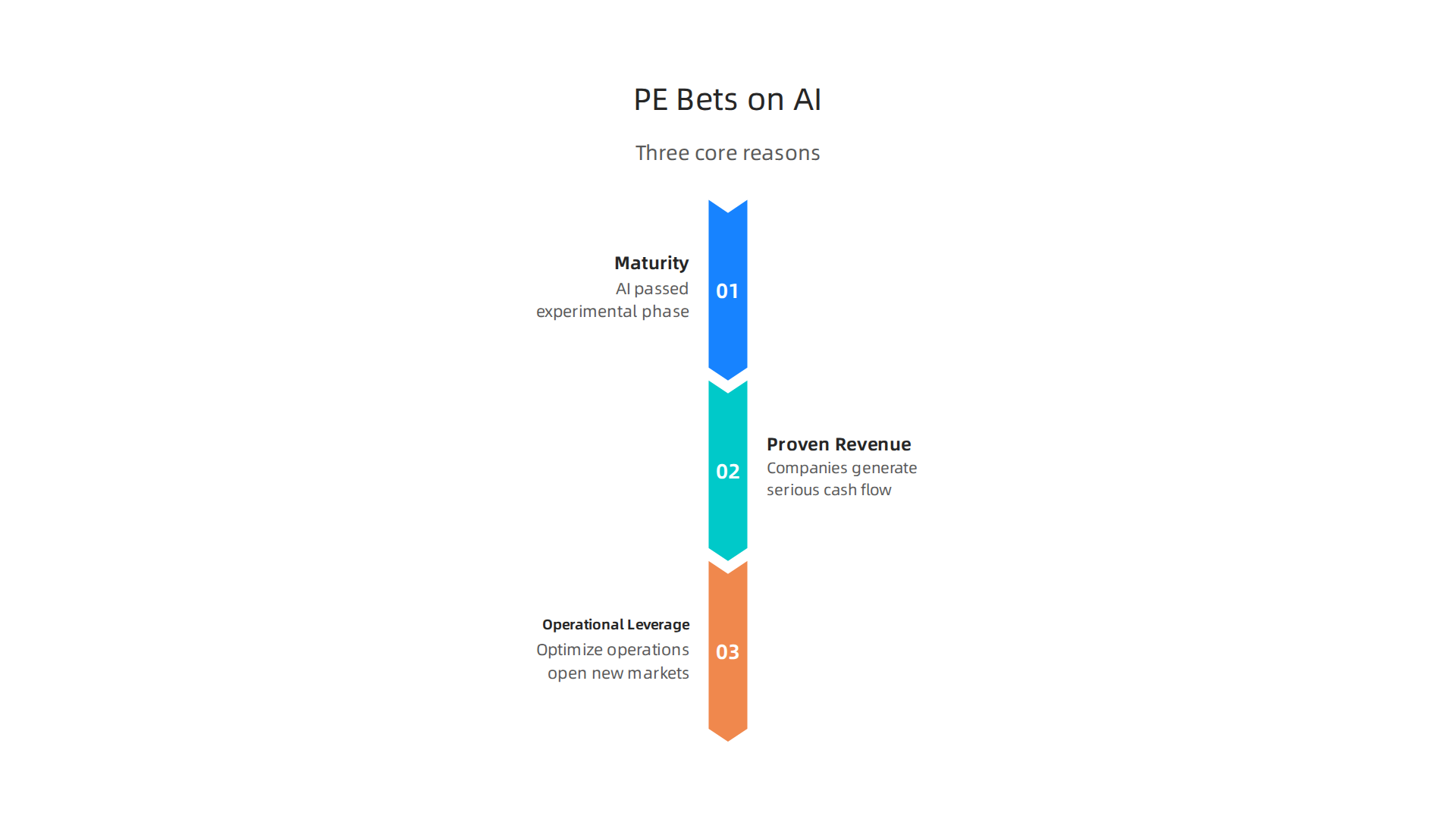
Venture capital loves early-stage bets. PE is the opposite. PE firms target companies that already have real customers, real revenue, and a clear path to scale. They skip the risky garage-stage days. They step in when the technology is proven and the business model works.
That matters because AI has passed through its experimental phase. Many AI companies now generate serious cash flow. And PE firms are experts at taking a solid business and making it better. They optimize operations, cut inefficiencies, and open new markets.
Take American Equity Partners or Stone Point Capital firms already named in the previous section. Their playbook is not about guessing which startup will win. It is about buying into companies that have already won in their niche, then helping them dominate a bigger slice of the market.
The same wsj private equity coverage that tracks institutional capital flows also highlights PE’s preference for later-stage AI companies with clear business models. Limited partners the pension funds and endowments that invest in PE funds are demanding this shift. They want AI exposure through vehicles that feel safer than angel investing. PE delivers that.
The data backs up the strategy. According to the 2026 Private Equity AI Radar from FTI Consulting, 95% of PE funds report that their AI investments meet or exceed original business case criteria.

That is an astonishing success rate. It tells you PE firms are not gambling. They are placing calculated bets on companies with measurable results.
Another trend driving PE interest is the ability to apply AI across many industries at once. A PE firm might own companies in healthcare, logistics, and manufacturing. AI tools that improve efficiency in one sector can be ported to another. That cross-sector leverage is something VC rarely offers.
For investors and founders trying to make sense of this landscape, knowing how to find the right partners matters. This guide on finding private investors for small business AI startups walks through the practical steps of identifying and approaching PE firms that are actively deploying capital into AI.
The bottom line is clear: PE is not replacing VC. It is playing a different game. But for companies that have moved past the startup stage, PE money is the fuel that turns a good AI company into a market leader.
If you want to stay ahead of these funding shifts and know exactly where the big money is moving next, The Deep View Newsletter delivers clear daily updates so you never miss a beat.
Deal Structures in AI: From Growth Equity to Buyouts
We have covered why PE firms are pouring money into AI. But how do they actually structure these deals? It is not a one-size-fits-all approach. PE firms use a range of deal structures depending on the company’s stage, revenue, and growth potential. The three most common are growth equity, leveraged buyouts, and take-privates.
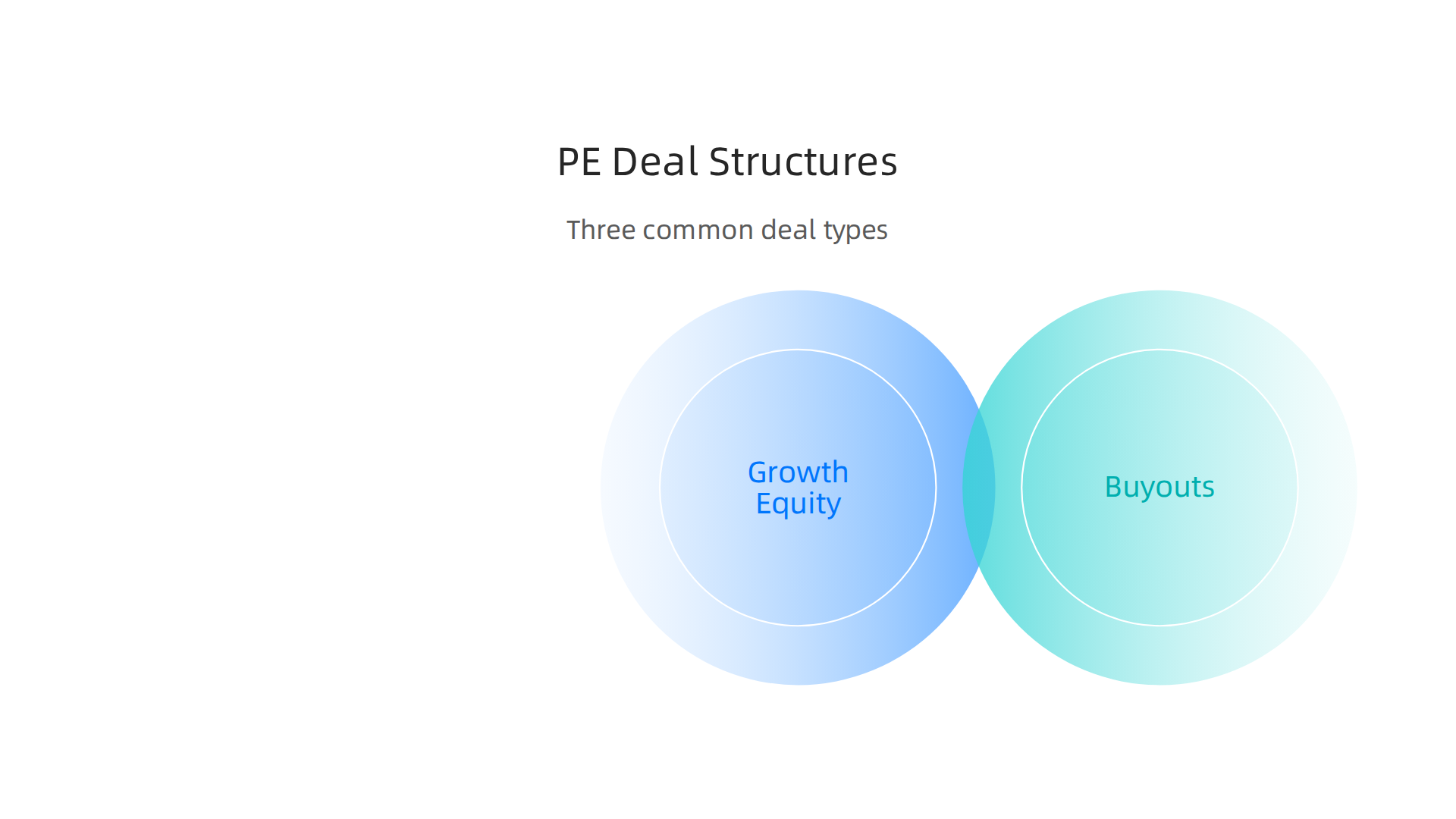
Growth equity is the most popular structure right now. In a growth equity deal, the PE firm takes a minority stake in the company. The founders keep control and continue running the day-to-day operations. The PE money goes toward scaling the business: hiring talent, expanding into new markets, or building out the product. This is a natural fit for AI companies that already have proven traction but need capital to reach the next level. It is lower risk for the PE firm because the business is already running.
According to the latest trends covered in the 2025 AI deal landscape analysis from Morgan Lewis, investors are increasingly prioritizing startups that demonstrate traction in enterprise adoption. Growth equity matches this preference perfectly. It allows PE firms to back winners without forcing a full change of control.
Buyouts are becoming more common as AI companies mature. In a buyout, the PE firm acquires a majority stake or the entire company. This often happens when founders want liquidity. They have built a successful business and are ready to cash out some or all of their ownership. It also happens when a company needs a major operational overhaul that the current management cannot deliver alone. The PE firm takes control, brings in new leadership, and works to increase the company’s value before selling it a few years later.
Leveraged buyouts use debt to finance part of the purchase price. This strategy amplifies returns but also adds risk. For AI companies with predictable recurring revenue, this structure can work well. The debt is paid down using the company’s cash flow over time.
Take-privates are the third structure gaining traction. When a publicly traded AI company is undervalued by the stock market, a PE firm may buy all its shares and take it private. This removes short-term quarterly pressure so the company can focus on long-term innovation. We saw more take-privates in 2025 and 2026 as some AI stocks struggled to maintain high valuations in the public market.
A typical private equity deal moves through several phases, from sourcing and screening all the way to exit. Understanding each phase helps founders know what to expect when a PE firm comes knocking.
If you want to learn how the deal lifecycle works in detail, the guide on the entire private equity deal process breaks it down step by step. For founders looking to prepare their AI company for a potential deal, the practical advice on finding strategic AI funding partners is worth reading.
Geographic Hotspots: Where PE Money Is Flowing in AI
So we know the deal structures. But where in the world is this money actually landing? The answer matters for founders deciding where to build and for investors figuring out where to deploy capital.
The United States remains the heavyweight champion by a wide margin. According to the latest findings from the Stanford HAI 2026 AI Index Report, U.S. private AI investment hit $285.9 billion in 2025.

That is more than 23 times the $12.4 billion that flowed into China. The gap is staggering. Over 80% of all private AI investment globally heads to U.S. firms, as confirmed by a recent MUFG analysis on private AI investment concentration.
But things are shifting. Europe and parts of Asia are growing their share of the pie. It is not that the U.S. is losing ground. It is that other regions are finally waking up. Sovereign wealth funds from the Middle East and Asia are becoming major players in AI private equity deals. They are not just writing checks to U.S. funds either. They are investing directly in local AI champions and co-investing alongside American PE firms in global deals.
Inside the U.S., three cities dominate the landscape. The San Francisco Bay Area is still the undisputed king. More than 70% of all AI-related North American venture funding goes to companies there. New York holds the second spot, especially for AI fintech and enterprise software. And Austin, Texas, has emerged as a serious contender. Lower costs, no state income tax, and a growing pool of engineering talent have drawn both startups and satellite offices of major AI firms.
The broader trend is clear. PE money is following talent and compute infrastructure. As the 2026 State of the Markets Report from Silicon Valley Bank notes, we are seeing near-record venture rebounds concentrated in AI mega-deals. That capital concentrates where the ecosystem is already strong.
If you are an AI founder deciding where to plant your flag or an investor trying to track where the next wave of deals will come from, these geographic shifts matter. The smart money is following the talent. And the talent is concentrating in superhubs.
For a deeper look at how different funds are positioning themselves across these regions, check out the analysis on AI venture capital 2026 trends and investment strategies. And if you want to stay on top of where the next billion-dollar deal might land, consider subscribing to The AI Newsletter Worth Reading for daily intelligence on funding flows and investor moves.
The Impact on AI Startups: Valuation Pressures and Strategic Shifts
So the money is flowing into specific hubs. But what happens when private equity firms start knocking on the doors of AI startups? The answer is a mix of opportunity and serious pressure.
Let’s start with valuations. PE involvement often pushes startup valuations higher. That sounds great on paper. But here is the catch. Private equity firms come with a different mindset than traditional venture capital. They run rigorous due diligence. They demand governance structures. And they expect a clear path to profitability. According to a 2026 analysis from CNBC, AI startups that last raised money before the ChatGPT boom saw their valuations drop by 68% on average, while the AI surge funneled over $250 billion into top players like OpenAI and Anthropic. That gap creates a two-tier market. Hot AI startups with proven traction get eye-popping multiples. Everyone else faces tough questions.
For founders, this creates real trade-offs. On one side, you get more capital and operational support from experienced PE teams. Firms like American Equity Partners or Stone Point Capital can bring industry connections and operational know-how. On the other side, you give up control. Exit timelines shorten. PE firms expect an exit in 3 to 7 years, not the 10 to 15 year horizon many founders dream about. You are no longer building for the long haul. You are building for a sale or IPO.
The influx of PE capital is also driving consolidation in certain AI sub-sectors. Think about AI infrastructure data centers, enterprise AI tools, and healthcare AI. PE firms see efficiency gains in putting smaller players together into one bigger company. A report by FTI Consulting on private equity AI benchmarks backs this up, showing that 59% of PE funds now view AI as a key driver of value creation. When PE firms own multiple portfolio companies in the same space, they push them to merge and cut costs. That is great for investors. For startup founders, it means you might end up working for someone else sooner than you planned.
This is where understanding the broader landscape matters. If you are a founder evaluating an offer from a PE firm, you need to know what you are signing up for. That is why many smart operators spend time learning how to find strategic AI startup funding partners before they sit down at the negotiation table. The better you understand the investor’s playbook, the stronger your position when terms get discussed.
Case Studies: Major PE-Backed AI Deals of 2025–2026
So what do these deals actually look like in the real world? Let me walk you through a few standout examples from the last 18 months. These cases show you exactly how private equity is reshaping the AI landscape right now.
Start with the biggest headline. In September 2025, a group of private equity firms pulled off the largest take-private deal in history when they acquired EA Sports for $55 billion. That is not a typo. Fifty-five billion dollars for a gaming giant that is betting heavily on AI powered game experiences. This deal alone signaled to the market that PE firms are willing to write massive checks for companies with strong AI potential. It is a clear example of how the wsj private equity coverage around AI deals has shifted from cautious interest to full commitment.
Beyond mega deals like EA Sports, the numbers tell a bigger story. According to an analysis by With Intelligence, AI related private equity deals hit 589 transactions in 2025. That is a 57% jump from just 375 deals in 2024. By the end of 2025, AI accounted for more than 7% of all PE deal activity globally. Think about that for a second. Nearly one in every fourteen private equity deals now involves an AI company.
The types of deals vary too. Some are classic buyouts where a PE firm takes a majority stake. Others are growth equity rounds where the firm buys a minority position to help the company scale. Firms like Insight Partners and Thoma Bravo have been especially active, backing everything from enterprise AI tools to defense focused AI platforms. These firms are not just writing checks. They are placing executives on boards, pushing for operational changes, and demanding clearer paths to revenue.
A report from Cherry Bekaert confirms that aggregate PE deal value hit $1.2 trillion in 2025 across more than 9,000 transactions. That is only the second time total PE deal value has crossed the trillion dollar mark. And AI is a major driver of that momentum.
Here is the key takeaway for founders and investors. The landscape is moving fast. Deals that were unthinkable three years ago are closing today. If you want to stay ahead of these trends, you need a reliable source of daily intelligence. That is why many professionals in the space subscribe to a newsletter that cuts through the noise and delivers clear updates straight to their inbox.
The game is changing fast. These deals show you exactly where the smart money is going.
Navigating the Regulatory Landscape for PE in AI
But as exciting as those mega deals sound, there is another side to this story that every founder and investor needs to understand. The regulatory environment around PE and AI is tightening fast. And it is changing how deals get done.

Start with the biggest regulator in the room for cross-border deals. The Committee on Foreign Investment in the United States, or CFIUS, has been blocking or conditioning more AI-related PE deals. If a foreign entity tries to buy an AI company with sensitive technology, CFIUS steps in. This directly affects firms like American Equity Partners and Stone Point Capital when they look at targets with defense or data heavy AI. Even institutional investors need to understand these rules before committing capital.
The numbers back this up. Major outlets like the Wall Street Journal have covered these trends closely. Following WSJ private equity coverage helps you track which industries face the most scrutiny.
Then there is the European Union. The EU AI Act creates a whole new set of rules for any company doing business in Europe. PE firms have to check whether their AI targets are high risk under this law. A startup with a facial recognition product might face much stricter rules than a chatbot company. That changes the valuation math.
According to a 2026 article from Forbes on how private equity and venture capital adapt to AI value creation, regulatory compliance is now a core part of how PE firms assess potential returns. You cannot just look at the technology anymore. You have to look at the legal risks too. In fact, a Qubit Capital analysis of AI startup valuation multiples shows that regulatory defensibility is one factor separating companies valued at 10x revenue from those at 50x.
What does this mean for you as a founder or investor? It means you need to build regulatory thinking into your deal process from day one. A great AI product that runs into CFIUS or EU AI Act hurdles could lose months of time and millions in value.
If you are interested in how PE firms are structuring their deals around these new rules, check out our article on private equity AI deals hit record levels. It gives you more context on the deal making side.
And if you want to keep up with how all these regulatory changes affect funding and valuations, there is a simple way. Get clear daily AI updates from The Deep View Newsletter. It cuts through the noise so you do not miss important developments.
But here is the good news. The firms that understand these rules earliest will have a big advantage. Regulatory savvy is becoming a competitive edge in AI investing.
Summary
This article explains why private equity (PE) has become a dominant, fast-growing source of funding for AI companies and how that trend reshapes the ecosystem. It walks through who institutional investors are, why they prefer later-stage AI businesses with proven revenue, and why PE firms favor deal structures like growth equity, buyouts, and take-privates. The piece highlights shifting deal sizes, geographic concentration (with the U.S. far ahead), and how PE’s operational focus changes valuation, exit timelines, and consolidation patterns for startups. It also covers regulatory headwinds—CFIUS and the EU AI Act—and why regulatory defensibility now affects deal math. Readers will learn how PE differs from venture capital, what founders should expect when evaluating PE offers, and where to look for further data and deal examples so they can make smarter fundraising and partnership decisions.