
Practical AI Roadmap Template for Business Leaders 2026
Overview
The world of Artificial Intelligence (AI) is changing super fast in 2026. Every day, there’s new information, new tools, and new ideas about how AI can help businesses. This quick growth can feel like a lot. For leaders, it’s easy to get lost in all the buzz. It becomes very hard to figure out what’s really important and what steps to take next. If you’re an AI driven leader, you might wonder how to make smart choices for your company without wasting time or money.

Actually, having a clear plan is more important than ever. You need a way to cut through all the noise. This is where an effective AI roadmap comes in handy. It’s like a map that shows your company exactly where to go with AI. This map helps you decide which AI projects to start, who needs to be involved, and how to get the money to make it all happen.
Many companies struggle to make AI work for them because they don’t have a clear path. They might try many small things without a big picture plan. But a good AI roadmap makes sure that all your AI efforts work together towards your main business goals. It helps you align your technology choices with your team’s skills and your funding plans. When you have a solid plan, it’s easier to show investors that your AI ideas are sound and will bring good results. This makes securing needed funding simpler and helps in mastering AI investments for the future.
A well-made AI roadmap gives you a structured way to plan out how you will use AI. It helps you connect your big business ideas with the daily actions you need to take, including your people and processes. For example, some roadmaps help you assess where you are now, figure out your main goals, and choose the best AI projects to work on first. This whole article will walk you through a helpful, practical AI roadmap template. It’s designed for leaders like you, so you can take action now to make sure your technology, your team, and your money all work together smoothly. It’s about knowing how to become an AI driven leader in 2026 and truly Building an AI Roadmap that delivers results.
With so much information coming out daily, staying informed is key. To get clear daily AI updates and cut through the noise, consider subscribing to The AI Newsletter Worth Reading.
1) Define business objectives, value hypotheses, and success metrics
The first big step in creating a useful AI roadmap is to clearly say what your business wants to achieve.

This isn’t just about using fancy new AI tools. It’s about using AI to reach your company’s main goals, like making more money, serving customers better, or cutting down on costs. An effective AI roadmap starts by making sure every AI idea helps these larger business plans.
As an AI driven leader, you need to turn your company’s big picture strategy into specific ideas about how AI will add value. These are called "value hypotheses." Think of them as educated guesses about how AI can make things better. For example, if your company wants to sell more products, a value hypothesis might be: "Using AI to suggest products to customers will make them buy more."
Once you have these ideas, you need ways to measure if they are actually working. These are called "success metrics" or Key Performance Indicators (KPIs). These metrics help you know if your AI projects are truly bringing good results. For instance, if your value hypothesis is about selling more products, your success metric could be "a 10% increase in sales from AI suggestions." These numbers help you see the real impact of your efforts and are key for AI investments 2026 proven strategies for maximum returns.
It’s important to map out how different parts of your company will benefit from your AI roadmap. This means looking at what each group (or "stakeholder") hopes to gain.
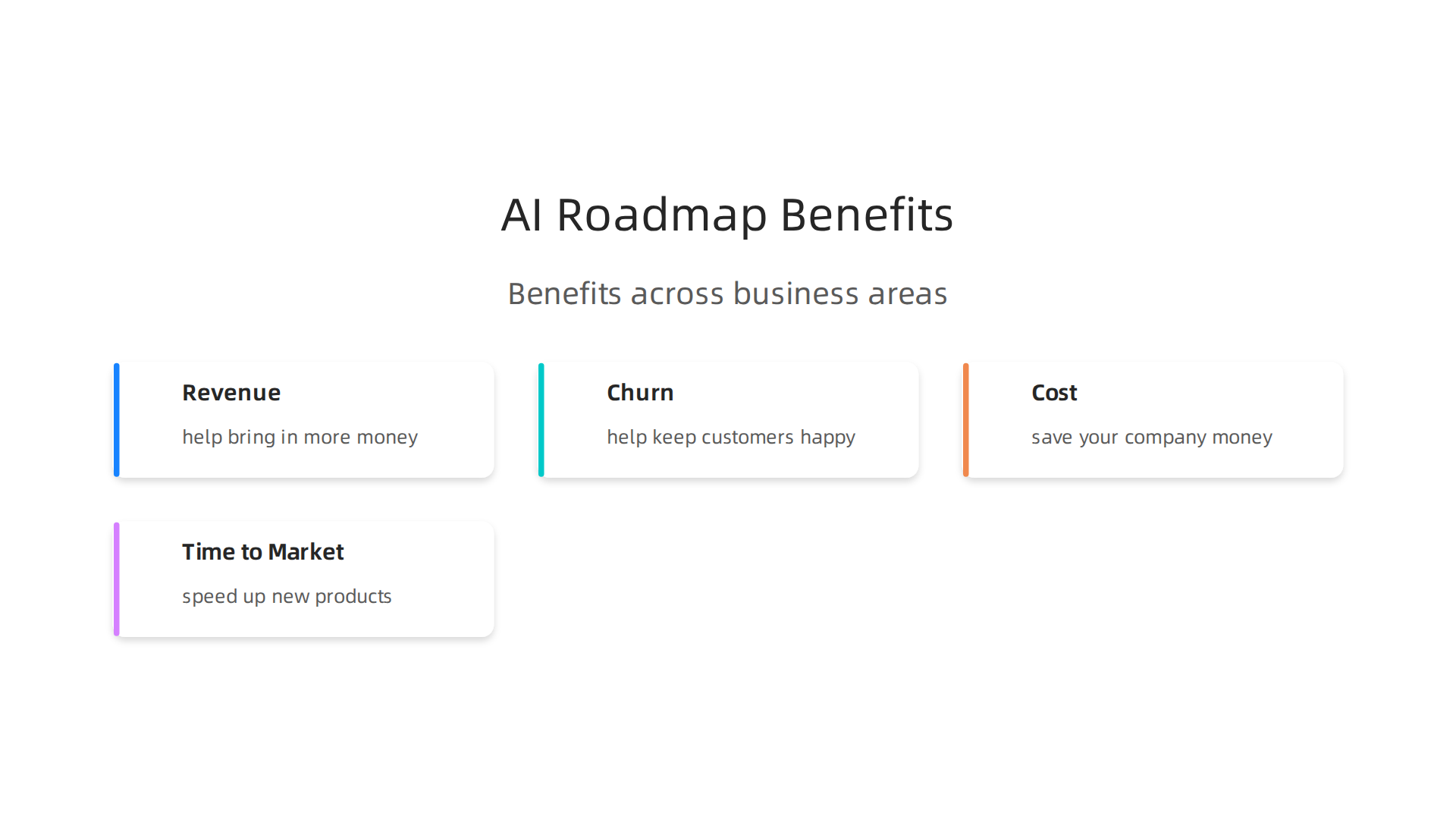
- For Revenue: How will AI help bring in more money? Maybe by finding new customers or making old customers buy more.
- For Churn: "Churn" is when customers leave. How can AI help keep customers happy so they don’t leave? This could mean using AI to understand why people leave and fix those problems.
- For Cost: How can AI save your company money? Maybe by making tasks faster or by using fewer resources.
- For Time-to-Market: This means how fast you can get new products or services to customers. Can AI help speed up how quickly you develop and launch new things?
When you connect these big company goals to clear AI projects, you make sure that every step in your AI roadmap serves a real purpose. This helps you build a strong plan for practical business-first AI software development for enterprise growth 2026. A good AI strategy roadmap template will help you align your AI plans with your overall business strategy and define these important success metrics upfront, making sure everyone is on the same page about what "winning" looks like for AI within your company in 2026, as noted in resources like the AI Strategy Roadmap Template.
To truly master AI, a smart AI driven leader must also keep a close eye on what’s happening outside their company. This means building a way to spot important market "signals" and gather useful information. Think of it like having a special radar that shows you where the AI world is heading. This helps you shape your AI roadmap so it’s always up-to-date and ready for what’s next.
Setting up these streams of truth means you know about new things as they happen. You want to track:
- Funding rounds: This is about who is investing money in which AI companies. When new money goes into certain areas of AI, it often means those areas are growing fast and are worth watching. For example, in 2026, there have already been a huge number of funding rounds, with billions of dollars invested in AI companies, showing how quickly the industry is moving along according to an AI Funding Tracker.
- Talent moves: This looks at where the best AI minds are going to work. If many experts move to a certain type of AI project or company, it can be a sign that something big is about to happen there. AI skills are now mentioned in many job postings, showing how much demand there is for these experts, as noted in the Stanford AI Index Report 2026.
- Model breakthroughs: This is about new AI technologies or models that are invented. These breakthroughs can change how AI is used everywhere. Staying informed helps you understand the bigger AI market landscape 2026 global investment and future trends.
Once you get all this raw information, the next step is to make it useful. You need to turn these facts into "lead indicators." These are like early warnings or hints about what might happen next.
- Investor interest: If investors are pouring money into AI tools for customer service, it might mean your company should look into using AI there too. You can learn more about finding good investment spots by checking out how to spot high potential AI companies to invest for 2026 growth.
- Competitor pivots: If a rival company, even one of the fast-growing Chinese AI companies, suddenly changes its main focus to a new AI area, it’s a strong hint that you might need to adjust your own AI roadmap.
By understanding these signals, you can decide which AI projects to work on first. It helps you make sure your AI roadmap is not just good for today, but also ready for tomorrow. This careful watching is key for any AI driven leader looking to stay ahead.
For deeper insights into daily AI and technology intelligence, make sure you don’t miss out. Get clear daily AI updates.
The AI Newsletter Worth Reading
To build a strong AI roadmap, an AI driven leader must not just know what’s happening outside their company, but also how to build the AI itself. This means making smart choices about the AI models, how to handle data, and what computer systems to use. It’s all about picking the right tools and setting them up in the best way for your business.
Choosing the Right AI Brains and Skills
First, think about what you want your AI to do. Do you need it to learn a lot from your own specific company information? Or do you need it to be good at finding answers from a big pile of documents? These are different "capabilities" that lead to different choices in AI models.
For example, "fine-tuning" means taking a smart AI model and teaching it more using your company’s special data. This makes the AI very good at your particular tasks. Another way is "retrieval-augmented generation," or RAG. This is like giving the AI a smart library where it can look up facts to answer questions, without having to learn all those facts beforehand. Your choices here should always be based on what brings the most value to your company.
A Smart Plan for Data and AI Operations (MLOps)
Next, you need a good plan for your data. Think of data as the fuel for your AI. The quality of your data directly affects how well your AI works. So, you need a clear data strategy that covers how you collect, clean, and store your information. You also need a plan for "MLOps," which is just a fancy way of saying how you build, run, and keep your AI tools working smoothly.
This MLOps plan needs to balance a few things:
- Speed: How fast can you get new AI tools up and running?
- Quality: How well do your AI tools work? Do they give correct and helpful answers?
- Cost: How much money does it take to build and run your AI?
Deciding whether to build your own MLOps setup or use ready-made platforms is a big choice. Sometimes, using existing tools (buying) can be quicker and simpler. Other times, building your own system (developing in-house) can save a lot of money in the long run, especially if you have very specific needs or huge amounts of AI work, as noted in a Cost-Benefit Analysis of In-House MLOps Platforms. To really master AI, you need to understand these choices. For more on how these parts fit together, read about The Three Elements of AI Data Algorithms and Compute.
Choosing Your AI’s Home (Infrastructure)
The last part of your technical roadmap is deciding where your AI models will actually live and run. This is called infrastructure. You can either use "managed services" from big cloud companies (like Amazon, Google, or Microsoft) or "self-host" your AI on your own computers.
- Managed Services: These are often good for smaller projects or when you’re just starting. You pay a fee based on how much you use the AI, and the cloud company handles all the complex setup. However, for very busy AI tools, this can become quite expensive.
- Self-Hosting: This means you set up and run the AI on your own servers. This can be cheaper if your AI is used a lot, but it takes more upfront work and special skills to manage.
Many companies are finding a "hybrid" approach is best. This means they use managed services for some AI tasks and self-host for others. This can cut costs significantly, sometimes by 30 to 60 percent, as discussed in Best Practices for Deploying Foundation Models at Scale in 2026: Why Hybrid Beats All-In. It’s important to look at the costs carefully. For example, a "self-hosted" AI can be much cheaper per use than a cloud-based one, especially if your usage is high, according to a Build vs Buy: LLM Features for Your Product | 2026 Decision Guide. When your AI is processing millions of requests per day, self-hosting can save a lot, though using managed services is often cheaper for lower usage, as explained by Should You Self-Host Inference?.
By carefully planning your models, data, MLOps, and infrastructure, an AI driven leader can ensure their AI roadmap is solid and cost-effective. Learning more about Evaluating AI Platform Tooling for Investors and Founders 2026 can help you make these critical decisions.
After picking the best AI brains, data plans, and computer systems, an AI driven leader must also think about the people involved. Building a strong AI roadmap isn’t just about the technology itself. It’s also about having the right team, organized well, and working together smoothly.
Roles, Missions, and Clear Decisions
For your AI team to do its best work, everyone needs to know their part. This means giving clear roles and missions. For example, some teams might focus on building the core AI tools, while others embed AI engineers directly into product teams to create specific AI solutions. Many companies use a "hybrid" model where a small central team manages shared AI tools and rules, and smaller groups work within business units on everyday tasks, as noted in a report on AI Team Structures 2026: Central, Embedded, and Hybrid Models.
It’s also very important to decide who gets to make which choices. If too many people need to agree on everything, things slow down. This is called a "decision-rights model." When you have clear rules for who decides what, your team can move faster and avoid getting stuck. Companies that are ready for AI often set up clear reporting lines, processes for how things are managed, and ways to decide on funding, according to insights on How High-Readiness Companies Organize AI Teams in 2026.
A Steady Rhythm for AI Work
Think of your AI team’s work like a steady beat or rhythm. This "operating cadence" helps everyone stay on track and keeps the AI roadmap moving forward. It includes regular meetings like:
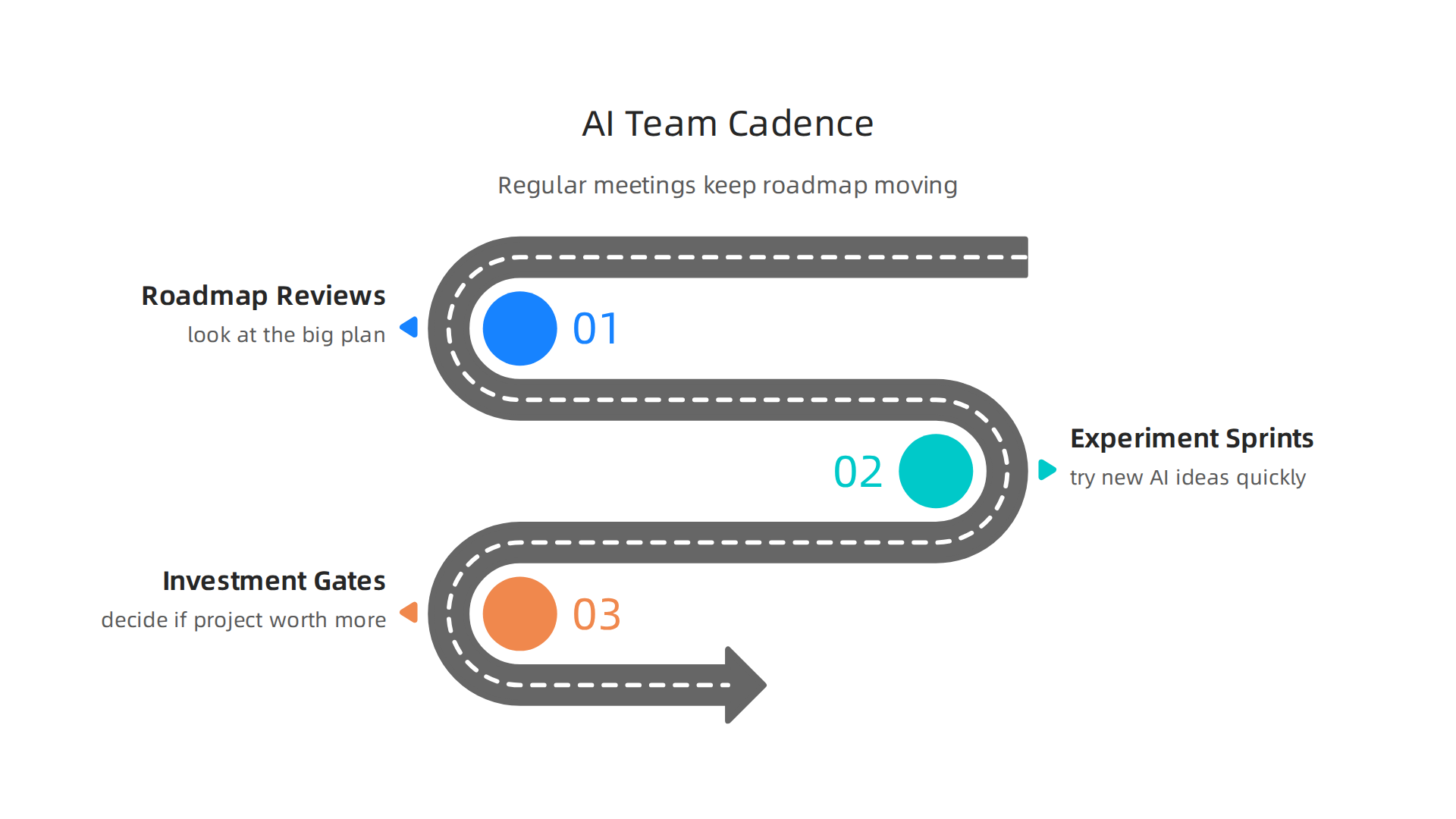
- Roadmap Reviews: These are times to look at the big plan for AI and make sure it still fits the company’s goals.
- Experiment Sprints: These are short, focused periods where the team tries out new AI ideas quickly to see what works best.
- Investment Gates: These are checkpoints where you decide if a project is worth more time and money.
Having a clear rhythm helps make sure that new AI tools can be brought to life and used without a lot of trouble. For example, an AI Center of Excellence often uses weekly check-ins, monthly reviews of projects, and quarterly looks at their main goals to keep everything aligned, as detailed in the AI Center of Excellence: Charter, Roles, Playbook [2026].
An AI driven leader needs to set up these structures to help their teams succeed. Mastering AI requires not just technical smarts, but also smart ways of organizing people and work. To learn more about leading these changes, consider reading about How to become an AI Driven Leader in 2026.
A clear AI roadmap is not just for your team; it’s also a powerful tool when talking to investors.

An AI driven leader knows that linking your funding needs to key steps in your AI roadmap helps investors see a clear path forward. This shows them exactly how their money will help you reach important goals and lower risks.
When you’re asking for money, you need to show investors that you’ve thought about all the important parts of your business. Investors want to see that your AI roadmap includes plans for reducing risks. They look for proof of your technical achievements, clear signals about how you’ll get your product to customers, and what makes your solution special and hard to copy. This is what we call building a strong story or "narrative."
For example, investors look for early signs that customers are actively testing your product and that pilots show real value. They also want to see a unique data advantage or insight that others can’t easily get, and early hints that customers will pay for your product, as highlighted by AI Startup Fundraising Trends 2026 (Seed to Series B).
Investors have become very smart about evaluating AI startups in 2026. They care more about how long your company will last, how well you use money, and if real customers are actually buying your product. This is often more important than just how good your AI model is by itself. They look at things like how much it costs to run your AI models and how much revenue each employee brings in, according to insights on AI Startup Funding: What Investors Look for in 2026.
When you build a strong narrative around your ai roadmap, you help investors understand your vision better. You should clearly outline your technical milestones, such as releasing a new AI feature, along with your go-to-market signals, like signing your first major client. Also, explain your defensibility, which means what makes your AI solution unique and difficult for others to replicate. Mastering AI involves not just building great technology, but also communicating its value in a way that attracts the right capital. To dive deeper into securing the necessary funds, learn how to maximize AI startup funding.
Stay informed on the latest AI investment trends and startup news to better align your roadmap with investor expectations.
The AI Newsletter Worth Reading
Get clear daily AI updates from The Deep View Newsletter.
A good AI roadmap does more than just impress investors. It also helps you spot and handle important risks before they become big problems. As an AI driven leader, you need to map out both the technical risks and the legal rules you must follow. This helps you plan how to fix them as your AI project moves forward.
It’s smart to think about your AI roadmap risks early on. This includes:
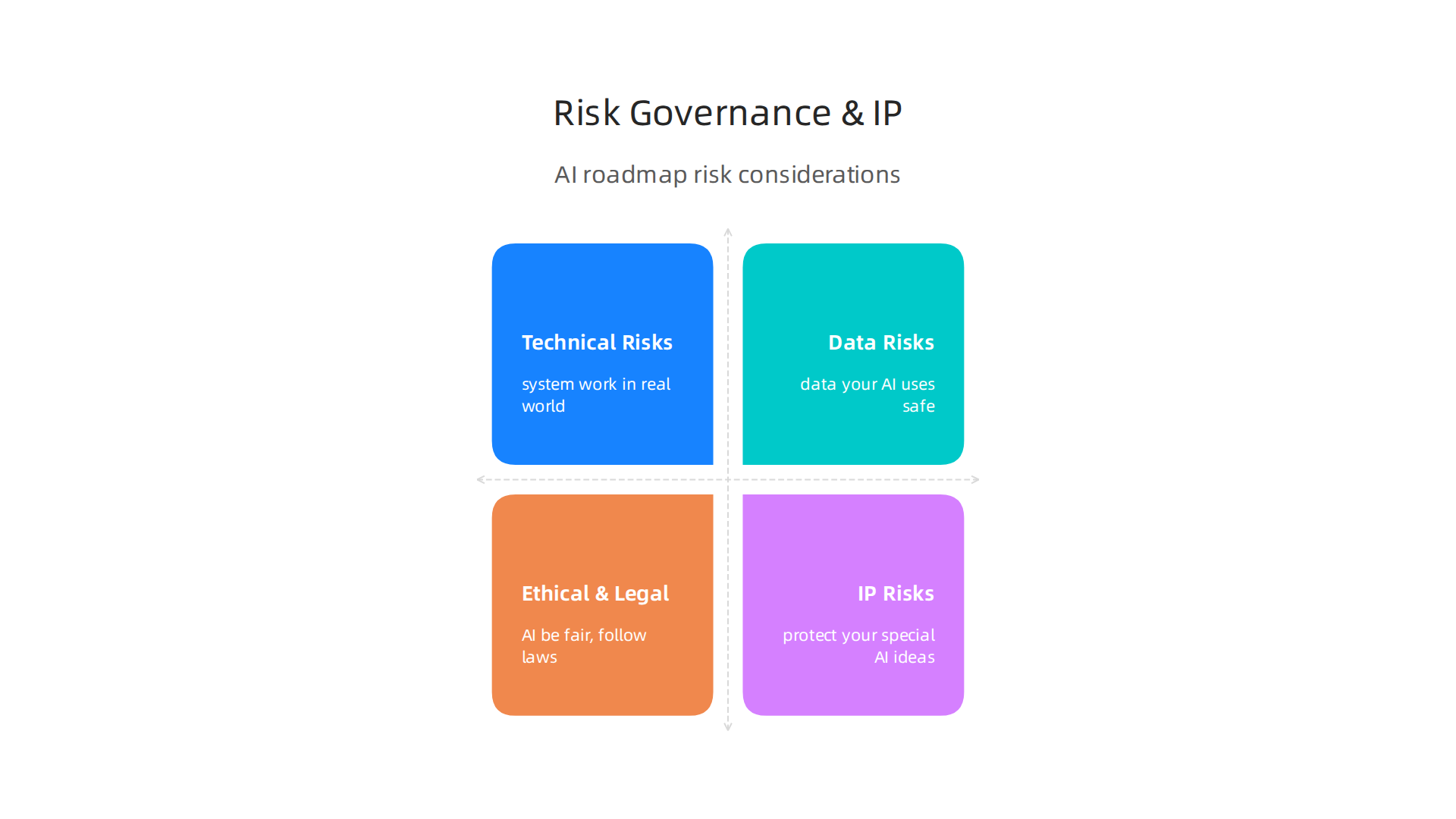
- Technical Risks: How will your AI system work in the real world? What if it costs too much to run? For example, the hidden costs of running AI models in production can be quite high, as discussed in MLOps Infrastructure Costs — The Hidden Price of Production AI. You need to know when it makes sense to use ready-made AI services versus building your own. Sometimes, a mix of both, called a hybrid approach, can save you a lot of money, cutting costs by a big amount, from 30% to 60%, according to experts on Best Practices for Deploying Foundation Models at Scale in 2026: Why Hybrid Beats All-In.
- Data Risks: Who owns the data your AI uses? Is it safe? Make sure you have clear rules for how you collect, store, and use data.
- Ethical and Legal Risks: Will your AI be fair? Does it follow all the privacy laws? It’s important to build trustworthy systems and address any Overcoming Public Distrust in AI from the start.
- Intellectual Property (IP) Risks: How will you protect your special AI ideas? You need a plan to keep your AI unique and hard for others to copy.
Planning your IP strategy, how you handle data, and checking for compliance should start early. This helps avoid delays later on. Establishing a strong Enterprise AI Governance Operating Model: CSO Blueprint to Scale means setting up clear rules for who decides what, how things get done, and who is in charge. This way, your AI projects move smoothly from small tests to big, useful tools. By mastering AI in this careful way, you’re not just building technology; you’re building a strong, lasting business. To truly succeed, you must also learn how to validate AI startup ideas and build with calculated risk.
To truly succeed in mastering AI, you must move beyond just planning. A strong AI roadmap also needs a clear plan for putting those ideas into action. This means turning your big vision into steps you can take in the next 6 to 18 months.
Make a Real Plan with Steps and Costs
When you have a good AI roadmap, the next step is to break it down. Think about what needs to happen over the next year or year and a half. These are your milestones. For each milestone, you should also figure out how much money you can spend. Experts suggest that successful companies set clear ways to measure how well they are doing and how they will pay for things Microsoft Word – 212604244068_SUBMITTED_260424080846.docx.
Set Your KPIs: How You Measure Success
KPIs, or Key Performance Indicators, are like scorecards for your AI projects. They tell you if you are hitting your goals. For example, if your AI is supposed to make customer service faster, a KPI might be "average time to resolve customer issues." Companies that build AI teams well make sure their AI teams have clear KPIs that are linked to what the business wants to achieve Building Your 2026 AI Organization: Teams, CoEs … – Fracto. This helps ensure that the AI work truly helps the company grow.
How to Check Progress and Fix Problems
It’s not enough to just make a plan; you also need to check on it regularly. This is called your "review rhythm."

- How often to check: Some teams have quick weekly meetings to see how things are going, especially for smaller tasks. Others, like an AI Center of Excellence, might have weekly meetings for new ideas, monthly reviews for all ongoing projects, and quarterly checks of their main goals AI Center of Excellence: Charter, Roles, Playbook [2026]. Product teams often use weekly planning to connect their work to what they hope to learn and achieve Design AI Teams and Ways of Working That Deliver Value.
- Who is in charge: Every part of the plan needs someone responsible. This is the owner.
- What if things go wrong: You need a clear way to handle problems or big choices. These are called escalation paths. It’s important to have clear rules about who makes decisions and what happens if there are problems Banco Bradesco and TELUS Case Studies Reveal What Works. Setting up better ways to make decisions can really help your company work more smoothly with AI Redesigning Tech Company Operating Models for an AI ….
By carefully setting up your milestones, budgets, KPIs, and review rhythm, you ensure your AI roadmap turns into real progress. This structured approach is key for any AI driven leader looking to build AI strong foundations for lasting success.
Stay updated on the latest AI trends, funding news, and industry developments to keep your AI roadmap sharp.
Get clear daily AI updates from The AI Newsletter Worth Reading.
Summary
This article explains how senior leaders can build a practical AI roadmap that turns fast-moving AI trends into measurable business value. It shows how to start by linking clear business objectives to value hypotheses and success metrics, then how to scan market signals to prioritize the right projects. The guide covers technical choices—models, data strategy, MLOps and infrastructure—and the trade-offs between managed services, self-hosting, and hybrid deployments. It also lays out how to organize teams, assign decision rights, set milestones and budgets, and keep a steady review rhythm. The roadmap helps you surface risks (technical, legal, ethical, IP) early and build a credible investor narrative. After reading, you’ll know what to include in an AI roadmap and how to turn it into funded, measurable progress over the next 6–18 months.