
ARK Venture Fund AI Investments Strategy and Portfolio for 2026
Overview
Introduction: Why ARK Venture Fund Matters for AI Investors
If you follow AI investing in 2026, you have probably noticed the noise. Hundreds of new startups launch every month. Funding rounds keep getting bigger. And everyone seems to claim their technology is the next big breakthrough.
Here is the real challenge: how do you separate real signals from the hype?

That is where the ARK Venture Fund comes in. This fund is a rare active, concentrated investment vehicle focused entirely on disruptive innovation. Unlike most funds that spread bets across hundreds of companies, ARK makes focused, high-conviction bets on the technologies reshaping our world. And right now, artificial intelligence sits at the center of that strategy.
Founded by Cathie Wood, ARK Invest built its reputation on spotting breakthroughs early.
The firm believes that innovations in AI, robotics, energy storage, DNA sequencing, and blockchain will fundamentally change how the world works. According to their own research, they focus on "the leaders, enablers, and beneficiaries" of these technologies across both public and private markets. You can see this focus clearly in their ARK’s strategy for disruptive innovation, which emphasizes long-term growth over short-term market movements.
What makes the ARK Venture Fund especially valuable for AI investors is how it acts as a bellwether. When ARK moves capital into a specific AI company, it tells you something. It signals where smart money believes the biggest opportunities sit. And when ARK shifts positions, it can reveal changing sentiment across the entire AI landscape.
Whether you are an AI founder looking for funding, an investor building a portfolio, or a startup operator tracking market trends, understanding ARK’s strategy helps you see where capital is flowing and why. It gives you context that raw funding announcements alone cannot provide.
And staying on top of these signals requires a steady stream of clear, actionable intelligence. That is why many professionals in the AI space rely on The AI Newsletter Worth Reading to cut through the noise and get daily updates on the trends that actually matter.
In the sections ahead, we will break down exactly how the ARK Venture Fund works, which AI bets it is making in 2026, and what those moves mean for your own investing decisions.
The ARK Invest Philosophy: Betting on Exponential Technologies
Ever wonder what makes the ARK Venture Fund so different from traditional investment firms? The answer lies in how they see the world. While most funds try to match the market, ARK hunts for exponential growth. They believe that disruptive innovation will outpace traditional economic growth by a wide margin. This is not a small bet. It is the entire foundation of their strategy.
ARK focuses on five major innovation platforms: artificial intelligence, robotics, energy storage, DNA sequencing, and blockchain technology.
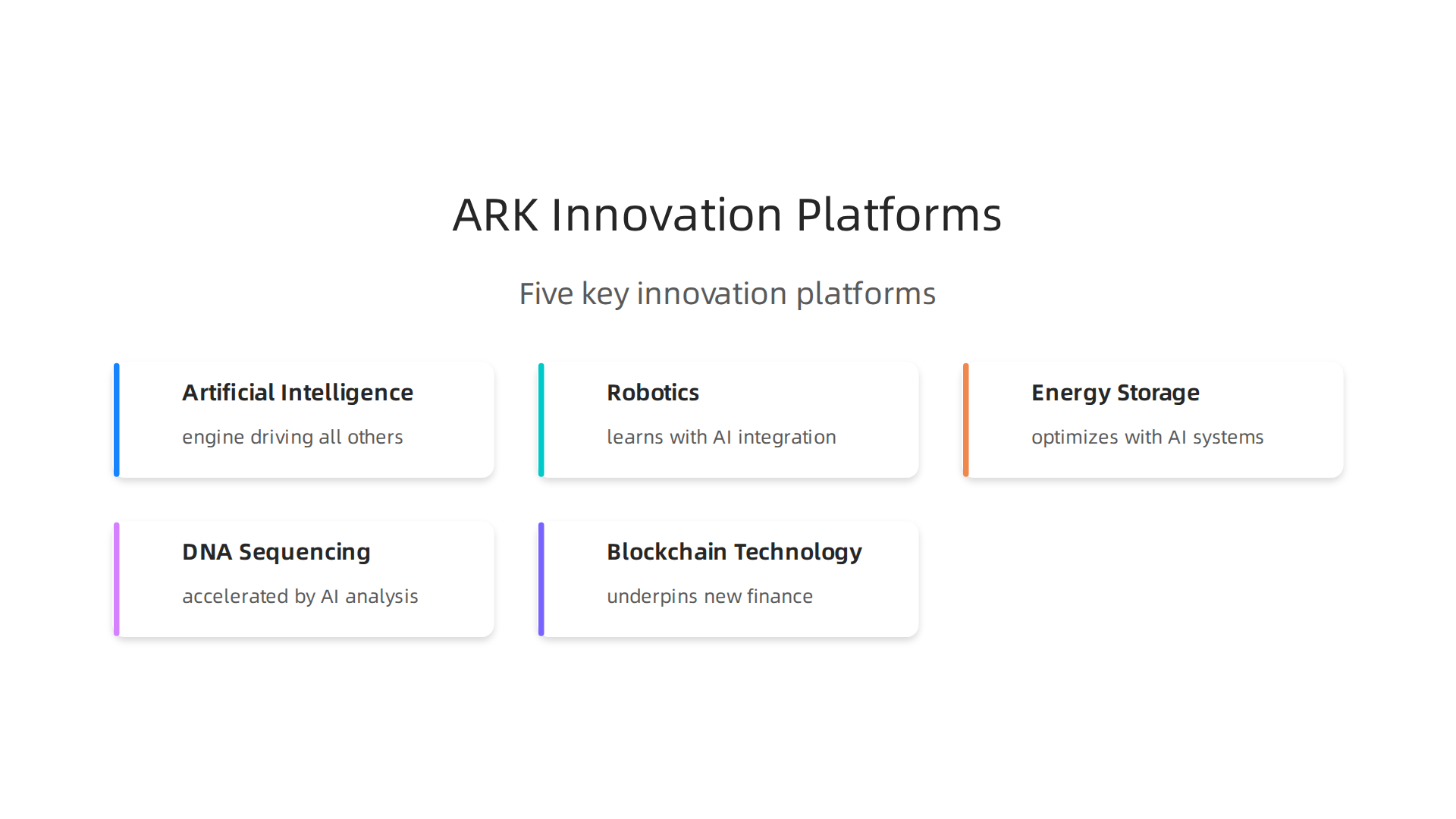
These are the technologies they believe will change how the world works. In their research on AI and Super Exponential Growth, they explain how AI acts as the central thread that connects and amplifies every other platform. Without AI, robotics does not learn. Without AI, energy storage systems cannot optimize. Without AI, DNA sequencing takes too long. AI is the engine driving all the others.
What makes this approach really different is the way ARK does its homework. Their research team uses what they call a deep dive model. Instead of scanning headlines, they go deep into one technology at a time. They build models. They talk to scientists and engineers. They produce public reports so anyone can see their thinking. Their annual Big Ideas 2026 report is a great example. It lays out exactly where they see the biggest opportunities across all five platforms, from autonomous taxis to gene editing to blockchain finance.
This philosophy sets ARK apart from other venture firms like founders fund, palladium equity partners, and bloom equity partners.

Those firms also invest in innovation, but ARK’s focus on convergence and transparency is unique. They are not just picking winners. They are betting that entire technology waves will reshape the economy.
If you are building an AI company and want to position yourself for investment, studying ARK’s philosophy can teach you a lot about the discipline needed to cut through the noise. You can learn a similar approach by reading about how to validate AI startup ideas and build with calculated risk. That article shows how to apply the same kind of rigorous thinking that firms like ARK use.
Understanding this philosophy is the first step to using the ARK Venture Fund as a signal for your own investing decisions. In the next section, we will look at the specific AI bets ARK is making in 2026 and what they tell us about where the market is heading.
ARK Venture Fund Portfolio: Key Holdings and Allocation Trends
Now that you understand the philosophy, let us look under the hood. What is actually inside the ARK Venture Fund right now? The answer might surprise you if you are used to traditional mutual funds.
One thing stands out right away. This fund is hyper-concentrated. The top 10 holdings make up a large share of the total assets. According to the latest ARK Venture Fund holdings data, the fund is heavily weighted toward private companies. About 60% of the portfolio sits in private investments. Only 40% is in public stocks. That is a very different risk profile than most funds you will find.
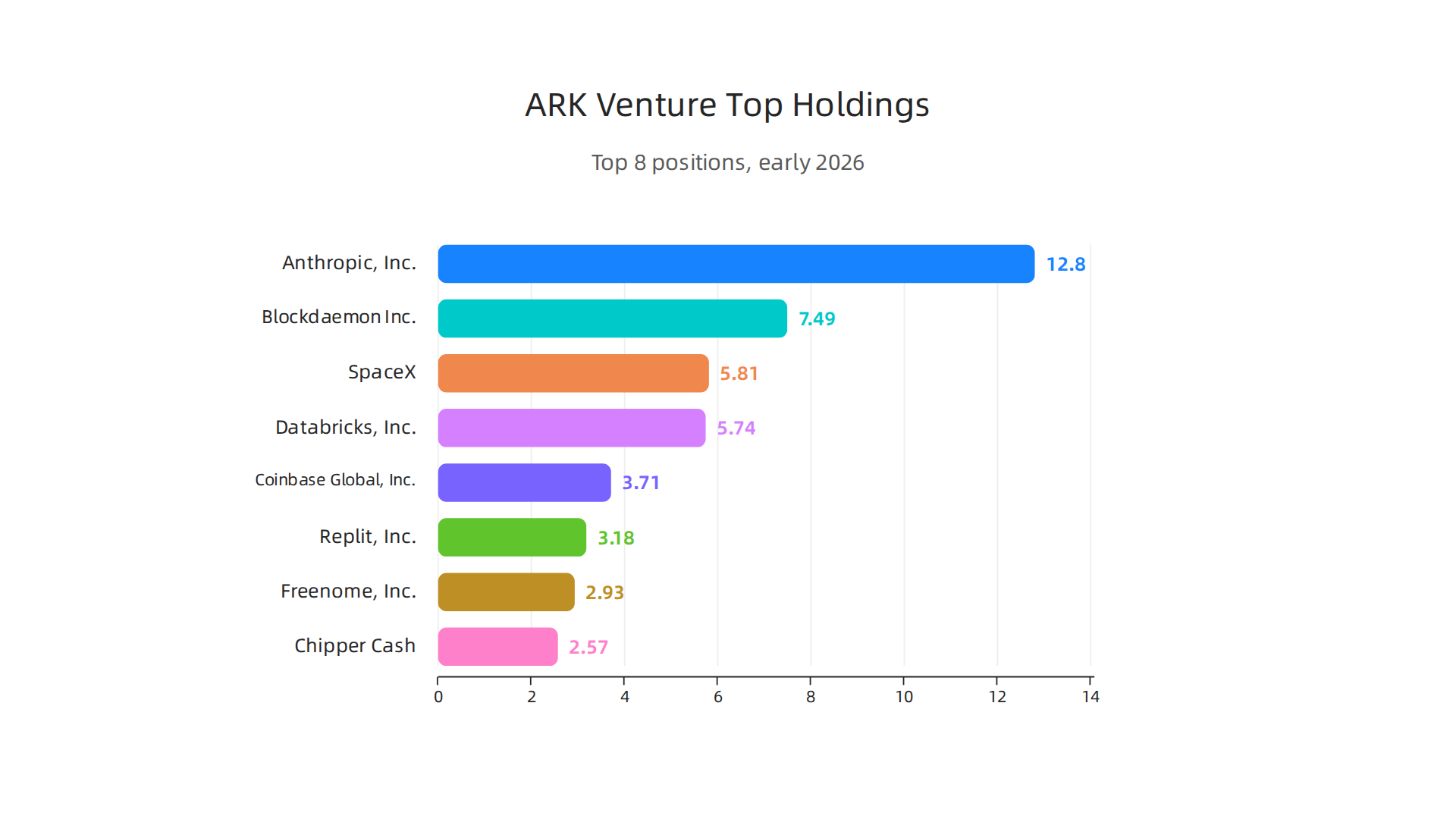
Here is a look at the top positions as of early 2026:
| Holding | Type | Weight (%) |
|---|---|---|
| Anthropic, Inc. | Private | 12.80% |
| Blockdaemon Inc. | Private | 7.49% |
| SpaceX | Private | 5.81% |
| Databricks, Inc. | Private | 5.74% |
| Coinbase Global, Inc. | Public (COIN) | 3.71% |
| Replit, Inc. | Private | 3.18% |
| Freenome, Inc. | Private | 2.93% |
| Chipper Cash | Private | 2.57% |
| Tenstorrent Holdings Inc. | Private | 2.51% |
| Shield AI | Private | 2.51% |
Notice the pattern here. Anthropic alone takes up 12.8% of the entire fund. That is a massive single bet. The fund is betting big on the AI model wars through Anthropic’s foundation models. Databricks gives exposure to AI data infrastructure. Tenstorrent plays the semiconductor angle. Shield AI focuses on defense AI. These are not safe bets. They are high conviction plays.
You might wonder, where are the names you hear about in traditional AI investing like founders fund or bloom equity partners? ARK is not competing with those firms on the same terms. ARK is building a public investment vehicle that acts like a venture capital portfolio. It gives everyday investors access to the private AI market in a way most funds simply do not.
The sector allocation tells an interesting story too. ARK is light on traditional SaaS companies. In their Q1 2026 commentary, they explained that they have little exposure to conventional subscription software. Instead, they concentrate on AI platforms, autonomous systems, and blockchain infrastructure. The fund also holds positions in self-driving truck companies like Kodiak Robotics and Gatik AI, which you can see on their full portfolio page.
What does this mean for you as an investor or founder? It means ARK is sending a clear signal about where they think the value is. They are not spreading bets across 200 small positions. They are putting 12 cents of every dollar into one AI company. That takes real conviction.
If you want to track these trends more closely and spot the next big AI opportunity before the market does, we recommend The AI Newsletter Worth Reading. It delivers clear daily updates so you stay ahead of the curve without drowning in noise.
In the next section, we will break down the specific AI subsectors ARK is betting on and how those bets connect to broader market shifts for 2026.
Performance Analysis: ARK Venture Fund vs. Benchmarks (2024–2026)
You now know the fund holds some very concentrated bets. So how has that actually worked out in real dollars? The performance story of the ARK Venture Fund is a wild ride.
Since the fund launched in September 2022, it has beat the market on a cumulative basis. The fund’s first annual report filed with the SEC shows that as of July 31, 2023, ARKVX returned 26.20% since inception. Over the same period, the S&P 500 returned 17.79% and the MSCI World Index returned 18.43%. That is a strong start.
But the road has been anything but smooth. The fund is built for high volatility. Its top holdings include both private startups with no public price and public names like Coinbase that swing hard. When AI stocks rally, this fund can soar. When the market turns cautious on innovation, it can fall harder than the indexes.
Take the first quarter of 2026 as an example. Global markets were unsettled. The S&P 500 fell about 4%. The Nasdaq dropped around 6%. Yet the ARK Venture Fund actually gained 5.29% during the same period, according to the ARK Venture Fund Q1 2026 update. That outperformance came from valuation step-ups in private holdings like SpaceX and Replit. Those were not available to public market investors directly.
But here is the other side. When innovation equities fall out of favor, this fund can get crushed. In Q1 2025, for example, the ARK Innovation ETF (ARKK) dropped over 12%. The ARK Venture Fund likely felt similar pressure because its public holdings are in the same disruptive themes. The fund’s heavy allocation to private companies actually helps cushion some public market swings, but it introduces liquidity risk instead. You cannot sell a private company stake quickly when fear hits.
So how does the fund compare over a full 2024–2026 window? Let us look at the numbers we know.
| Period | ARK Venture Fund (ARKVX) | S&P 500 | Nasdaq 100 |
|---|---|---|---|
| Since Inception (9/22–7/23) | +26.20% | +17.79% | Not available |
| Q1 2026 | +5.29% | -4.33% | ~ -6% |
The pattern is clear. In good times, the fund crushes the benchmarks. In bad times, it can lag badly.
What about risk-adjusted performance? The Sharpe ratio for this fund is likely lower than the S&P 500 because the volatility is so high. The maximum drawdown since inception could be in the 30% to 40% range during corrections like late 2022 or early 2025. Compare that to the S&P 500’s max drawdown of about 25% in 2022. You are taking more risk for the chance of higher returns.
This is not a fund for everyone. It works best for investors who can stomach big swings and do not need to sell during a downturn. If you are the type who panics when your portfolio drops 20%, this fund will test your nerves.
For founders and investors tracking these trends, understanding how concentrated portfolios perform is crucial. If you want to learn how to evaluate similar AI-focused investments without getting caught in hype, check out this guide on evaluating AI stocks and avoiding hype. It will help you separate signal from noise.
The key takeaway from the performance data is this: the ARK Venture Fund delivers on its promise of venture-style returns, but the ride is much bumpier than owning an index fund. You are paying 2.90% in expenses for that access, so make sure you understand the volatility before you buy.
How ARK Identifies the Next AI Unicorn: A Look at Their Research Process
You might wonder how the ARK Venture Fund picks its winners. It is not random guessing. The firm has a structured research process designed to spot disruptive companies years before they hit the mainstream.
ARK’s research team is organized around five innovation platforms: artificial intelligence, robotics, energy storage, blockchain, and multi-omic sequencing (think DNA and genomics).

Each platform has dedicated analysts who live and breathe that space. These analysts do not just scan headlines. They build detailed bottom-up financial models for every potential investment.
What does that mean in practice? For a company like SpaceX or a private AI startup, the analyst projects unit volume growth, cost declines, market adoption rates, and future revenue over a five-year horizon. They then estimate a target price based on expected multiples. If that price is well above the current valuation, the stock passes a key test.
But the models alone are not enough. ARK also publishes open research, including their annual Big Ideas 2026 report, which outlines where they see the biggest opportunities. They host expert calls with scientists, engineers, and industry insiders to stress-test their assumptions. This mix of public data and private intel helps them build conviction before placing a bet.
The firm uses a scoring system to rank companies by disruptive potential. Factors include the size of the addressable market, the strength of the technology moat, the team’s track record, and the likelihood of exponential growth. Companies that score high get added to the watchlist. Those that score lower are set aside.
This is not a passive process. The analysts revisit their models every quarter as new data comes in. For the ark venture fund, which holds both public and private companies, this constant research loop is critical. Private companies do not have daily stock prices, so the fund must rely on its own valuation work rather than market quotes.
The goal is to identify companies that will reshape entire industries, like autonomous driving or AI-powered drug discovery. ARK often invests in these areas five to ten years before the rest of the market catches on. That early entry is what drives the outsized returns you saw in the performance section.
If you want to learn how to apply similar thinking to your own investing or startup strategy, start by validating AI startup ideas with a structured framework. It will help you separate real potential from hype.
And for daily updates on the companies and trends ARK is tracking, you can get clear, concise coverage delivered to your inbox. Stay ahead of the next big wave without drowning in noise. The AI Newsletter Worth Reading delivers the essentials every day.
Risks and Criticisms: The Volatility of Disruptive Tech Investing
All that high return potential comes with a serious price tag. Disruptive tech investing is not for the faint of heart. The same concentrated bets that drive big gains can also cause painful losses. If you invest in the ark venture fund, you need to understand the risks before you commit.
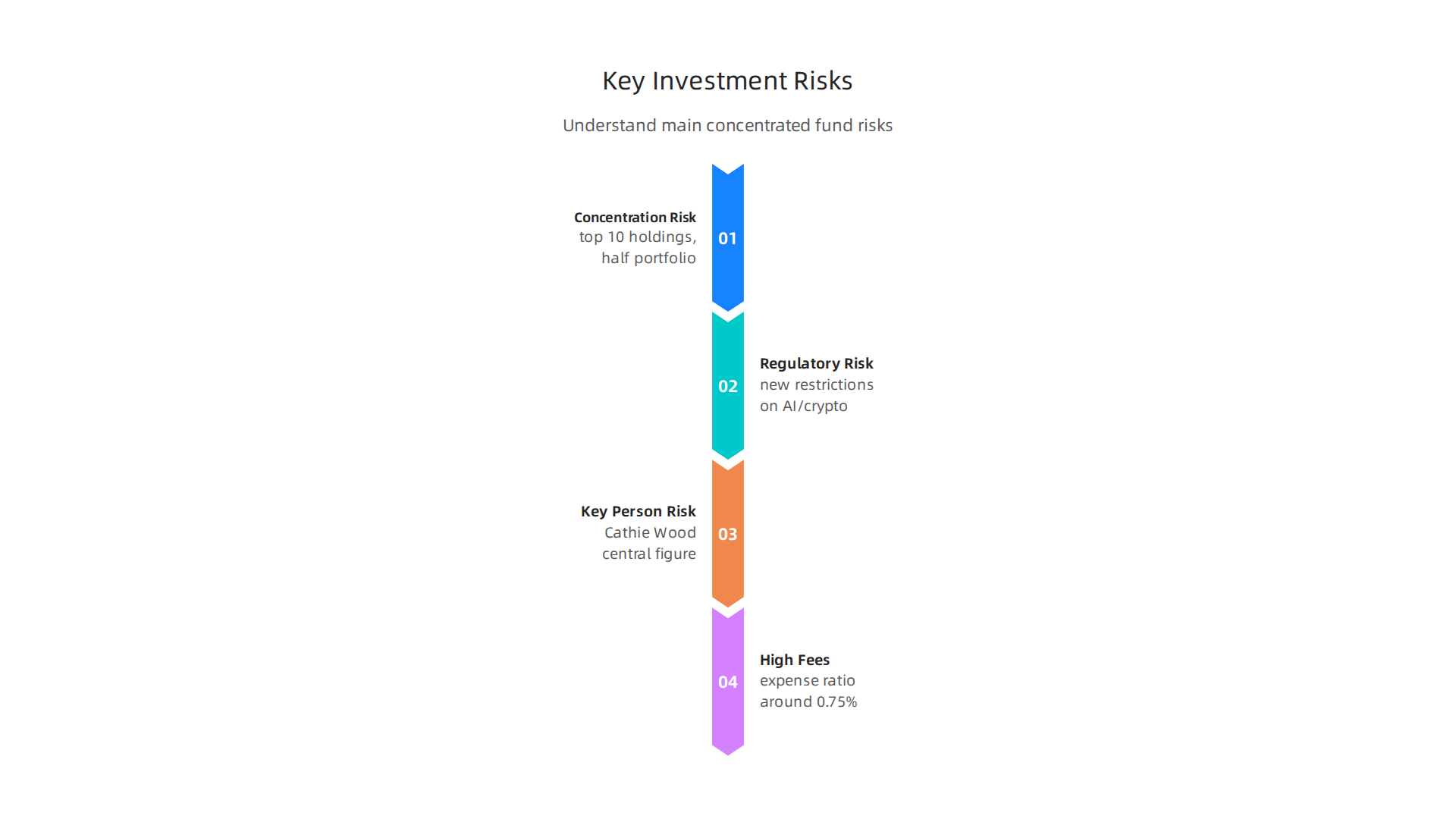
The biggest risk is concentration. ARK’s flagship fund holds about 50 stocks, but the top 10 make up roughly half of the total portfolio. That means a single bad quarter for a top holding like Tesla or Coinbase can hit the whole fund hard. As the ARK Disruptive Innovation Stra (AKI-1) prospectus clearly warns, a concentrated portfolio is more vulnerable to price swings than one spread across many sectors. When those frothy tech stocks pull back, the impact is outsized.
That is exactly what happened in 2022. After a stellar 2020 and 2021, ARK’s flagship ETF plunged 67%. A Morningstar analysis found that over the past decade, the firm destroyed an estimated $14.3 billion in shareholder wealth, making it the top wealth destroyer among all fund families. That sobering Morningstar report on wealth destruction notes that even as the broader market rose, ARK’s concentrated bets lost value. The ARKK ETF is still down 71% from its record high. Those numbers matter.
Another risk is regulation. Many of ARK’s top holdings depend on favorable rules around AI, autonomous driving, and crypto. Governments could impose new restrictions at any time. A law that slows self-driving car testing or tightens AI data rules could sink the value of a big position overnight. That kind of regulatory uncertainty is hard to predict and impossible to control.
There is also key-person risk. Cathie Wood remains the central figure behind all seven of ARK’s actively managed funds. Morningstar’s ARK asset management company profile points out that the firm has struggled to keep analysts. Only four analysts have been with the firm more than five years, and Wood is the only team member with hands-on portfolio management experience. If she ever left or made a wrong call, the whole fund could suffer.
Finally, you pay for that active management. The fund charges an expense ratio around 0.75%, which is higher than a simple index fund. If performance lags, those fees eat into your returns even more.
So what should you do? If you still believe in the disruptive thesis, consider keeping the ark venture fund as only a small part of your overall portfolio. Do not put your retirement savings into a concentrated bet. Instead, balance it with broader market exposure. And always do your own homework. A good starting point is to learn how to evaluate the top AI companies and avoid the hype so you can understand what you are actually buying.
Disruptive investing can pay off, but it demands a strong stomach and a clear head. Know the risks before you jump in.
Summary
This article explains the ARK Venture Fund and why it matters for AI investors in 2026, showing how an active, concentrated fund can act as a bellwether for disruptive technology. It breaks down ARK’s thesis—focusing on AI plus four other exponential platforms—details the fund’s hyper-concentrated portfolio (heavy in private AI names like Anthropic), and describes ARK’s deep-dive research process for identifying high-conviction bets. The piece compares fund performance with public benchmarks, highlights volatility and liquidity trade-offs from private holdings, and lays out the main risks such as concentration, regulation, and key-person risk. Readers will learn how to interpret ARK’s moves, what that implies for investing or fundraising, and practical steps to evaluate similar AI opportunities before committing capital.